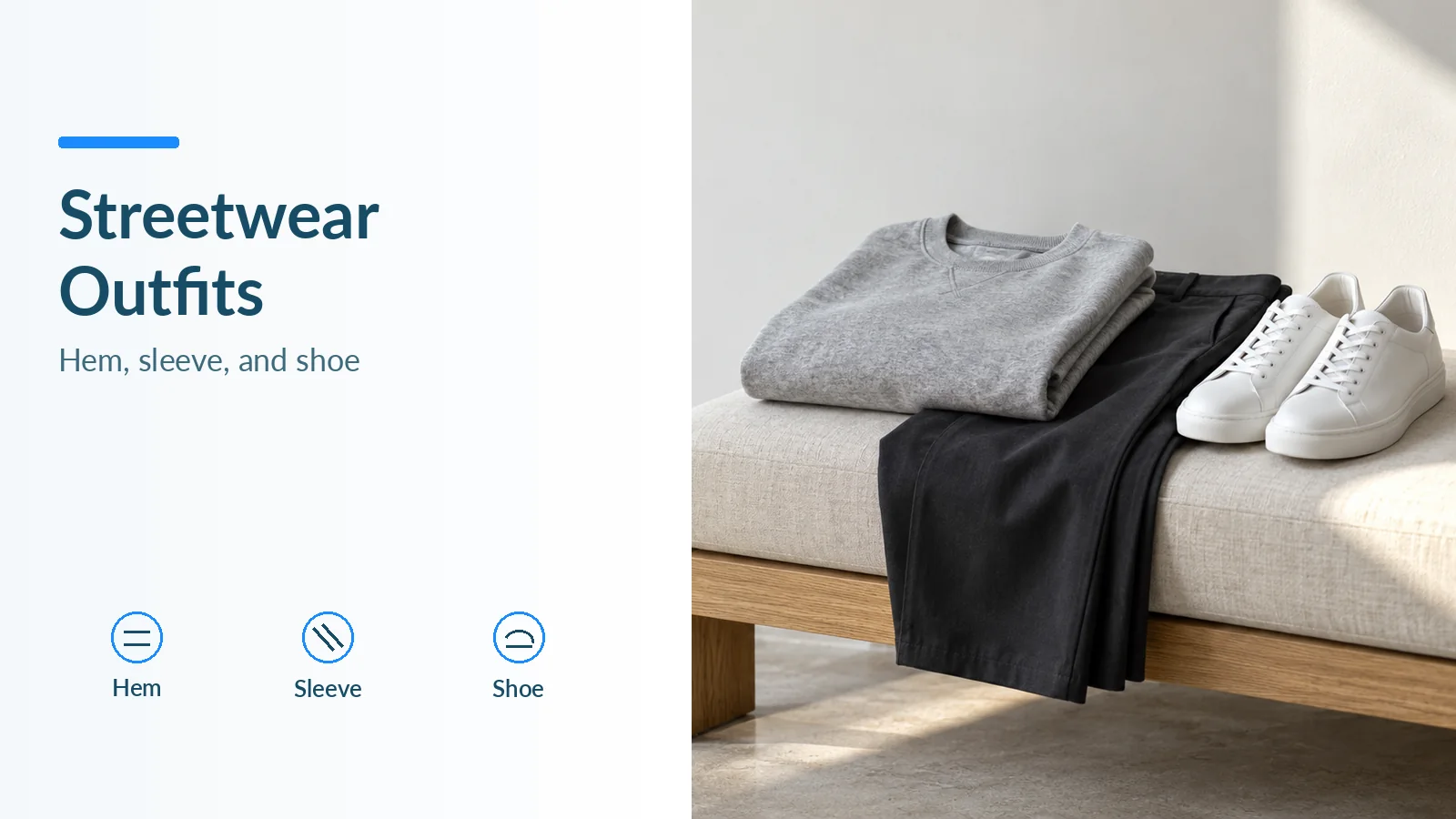
Streetwear outfits for women require an asymmetric 1:2 or 2:1 vertical waistline ratio, at least 180 GSM of fabric weight separation between adjacent layers, and a trouser flat hem width (19 to 28 cm) calibrated to the millimeter heel stack of the shoe (19.3 mm to 50.8 mm). Pairing an untucked hip-length top (62 to 66 cm) with low-rise baggy trousers (22 to 24 cm front rise) over flat court soles fails at the 50% hip midpoint (R_vertical = 1.00) and damages wide hems through wet-pavement heel drag.
While our temperature-band streetwear outfit guide sets the seasonal layer stack by outdoor forecast hours, and our men’s layering proportions guide checks hem and cuff overlap, womenswear styling introduces wider vertical cut differentials: cropped 44 cm ribbed baby tees, 30 cm high-rise wide-leg denim, 75 cm extended-shoulder blazers, and 135 GSM ripstop parachute trousers. The matrix below maps the five core silhouette formulas across vertical ratios, fabric weights, trouser openings, and lab-measured footwear stacks.
| Silhouette Archetype | Vertical Ratio (R_vertical) |
Upper Garment Length & GSM | Lower Rise & Flat Hem Width | Footwear Stack Height & Break | Target Temp Window |
|---|---|---|---|---|---|
1. High-Low Blazer Frame (1:2 Core) |
0.48 (1:2 inner split under open frame) |
45 cm crop rib tee (220 GSM) + open 75 cm wool blazer (320 GSM) |
30 cm high rise; 25 cm flat wide denim hem (460 GSM / 13.5 oz) |
32.7–37.1 mm retro runner (Kayano 14 / NB 1906R); Half Break |
15–24°C (59–75°F) Warm to Mild |
2. Utility Parachute Contrast (1:2 Split) |
0.51 (1:2 volume-contrast split) |
48 cm cinched brushed fleece hoodie (440 GSM) over 180 GSM base tee |
29 cm high rise; 27 cm flat DWR ripstop nylon hem (135 GSM) + toggle |
37.3 mm NB 9060 (open hem) or 19.3 mm Samba OG (cinched toggle) |
8–16°C (46–61°F) Mild to Cold |
3. Longline Boxy Upper (2:1 Split) |
2.00 (2:1 upper-dominant split) |
74–76 cm boxy crewneck (460 GSM) or leather bomber (+18 cm chest ease) |
38 cm pleated wool mini skirt or 18 cm bike short (1/3 lower block) |
50.8 mm Dr. Martens Jadon platform boot + 15 cm ribbed crew sock |
16–25°C (61–77°F) Warm to Mild |
4. Three-Layer Transit Column (1:2 + Coat) |
0.49 inner split + full outer column |
220 GSM tucked mock-neck + 50 cm crop cardigan + 115 cm wool coat (380 GSM) |
30 cm high rise; 24 cm flat tailored wool trouser (330 GSM) |
28.0–38.0 mm leather boot or cupsole sneaker; 10 mm heel clearance |
3–11°C (37–52°F) Cold Transit |
5. The 1:1 Mid-Hip Boxy Trap (Failure Mode) |
1.01 (0.50 : 0.50 static midpoint cut) |
65 cm untucked standard tee (200 GSM) ending at widest pelvic plane |
23 cm low-to-mid rise; 26 cm unhemmed baggy jean pooling at ankle |
19.3 mm flat court sole swallowed by 18 mm of wet-pavement heel drag |
Fails across all bands (Fix via +12 cm tuck) |
Rule-of-Thirds Vertical Proportions: 1:2 vs. 2:1 Silhouette Geometry
In patternmaking and visual composition, a standing outfit is governed by the visible vertical ratio between the upper torso block and the lower leg column. Rather than guessing whether a top looks “too long” or trousers look “too baggy,” measure the vertical transition line from the high point shoulder (HPS, at the base of the collar seam) to the floor:
R_vertical = L_upper_visible / L_lower_visible
L_total_visible = L_upper_visible + L_lower_visible
Where:
L_upper_visibleis the vertical distance (cm) from the high point shoulder (HPS) to the visible lower edge of the top (or the top edge of the trouser waistband when tucked).L_lower_visibleis the vertical distance (cm) from that waist transition line down to the bottom of the footwear outsole.
Worked Calculation on a 165 cm (5 ft 5 in) Standing Frame
On a 165 cm stature where the head and neck occupy 24 cm, the clothed vertical column from HPS to the pavement measures L_total_visible = 141 cm. Comparing the three proportion archetypes on this exact 141 cm column reveals why two outfits using the same garments produce opposite visual results:
- The
1:2Vertical Split (0.33 Upper : 0.67 Lower, TargetR_vertical = 0.45 to 0.52): Pair a cropped220 GSMribbed baby tee or waistband-cinched hoodie measuringL_upper_visible = 46 cm(32.6%of the column) with high-rise wide-leg denim or parachute trousers featuring a29 to 31 cmfront rise sitting at the natural anatomical waist above the iliac crest (L_lower_visible = 95 cm, or67.4%of the column).R_vertical = 46 cm / 95 cm = 0.48(an exact1:2rule-of-thirds split). A compact upper1/3block counterbalances62 to 72 cmof thigh circumference and48 to 54 cmof leg-opening circumference in the lower2/3cylinder. Leaving a0 to 3 cmwaistband fulcrum (a sliver of midriff in warm weather, or a tonal base tee and leather belt in mild weather) locks the1:2division even when you layer an unbuttoned75 cmblazer or115 cmtrench coat over the top. - The
2:1Vertical Split (0.67 Upper : 0.33 Lower, TargetR_vertical = 1.85 to 2.10): Pair an oversized tailored blazer,460 GSMboxy crewneck sweatshirt, or leather moto jacket (74 to 78 cmgarment length, creating a94 cmvisual upper block from HPS to low hip when combined with a peeking shirt tail or micro-skirt edge,66.7%) with15 to 20 cminseam biker shorts or a38 cmpleated mini skirt (L_lower_visible = 47 cmof exposed lower leg and footwear,33.3%).R_vertical = 94 cm / 47 cm = 2.00(an exact2:1split). Exaggerated architectural volume across the top2/3is prevented from overwhelming the frame by negative space along the lower1/3, anchored at the ground by14 to 16 cmribbed crew socks and a38 to 50.8 mmplatform boot or chunky runner. - The
1:1Boxy Compression Trap (0.50 Upper : 0.50 Lower, Failure ModeR_vertical = 0.90 to 1.10): Wearing an untucked65 cmstandard tee (L_upper_visible = 71 cm,50.4%) over mid-rise baggy jeans (23 cmfront rise,L_lower_visible = 70 cm,49.6%) yieldsR_vertical = 71 cm / 70 cm = 1.01. The horizontal hem cuts directly across the widest pelvic plane while both halves carry+15 to +20 cmof circumferential ease, erasing waist definition and shortening perceived leg length by12 to 15 cm.
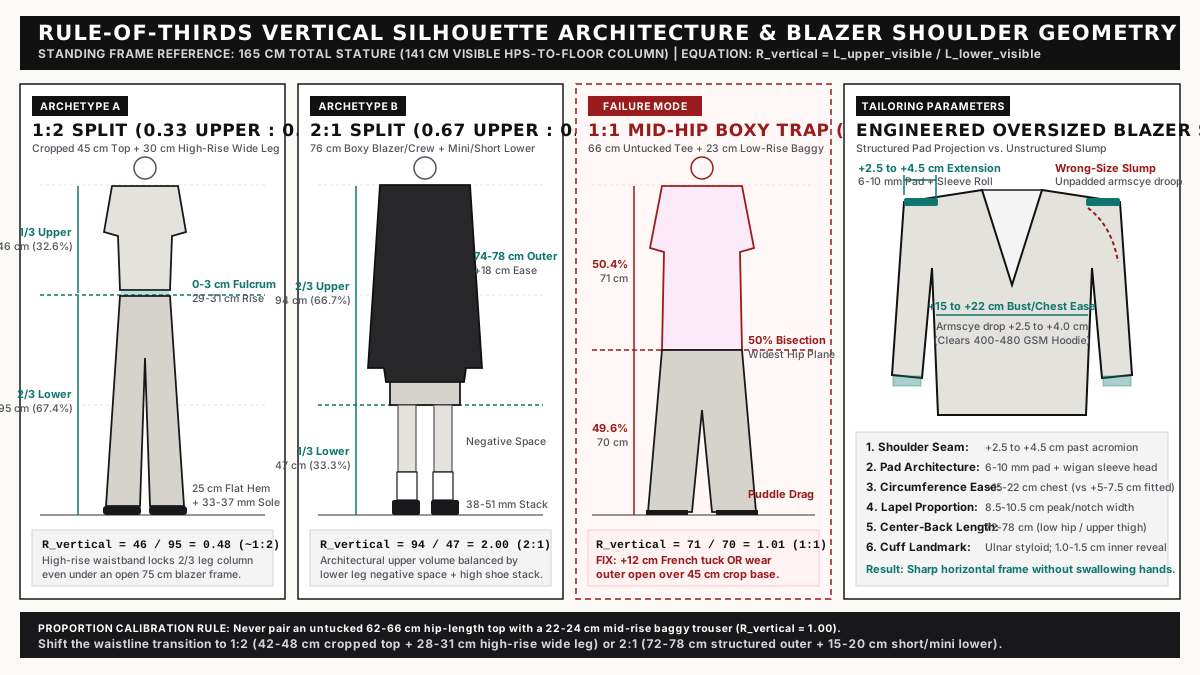
Three-Point Mechanical Fix for a 1:1 Outfit
When a mirror check shows your top hem bisecting the outfit at the 50% hip line, apply one of three structural adjustments without replacing your core pieces:
- Execute a
+12 cmfront tuck or elastic hem cinch: Tucking the front center of a65 cmtee into a30 cmhigh-rise waistband (or tightening an elastic shock-cord at the hoodie hem) raisesL_upper_visiblefrom71 cmto57 cmand lengthensL_lower_visibleto84 cm, shiftingR_verticalfrom1.01to0.68. - Unbutton the
75 cmouter layer over a45 cminner crop: If you want to keep both a long boxy jacket and wide-leg trousers, wear the jacket open over a high-contrast45 cminner crop top. The eye tracks the inner1:2waistline vertical column while the open jacket lapels form two vertical framing lines. - Swap the lower cylinder for negative space: Keep the untucked
75 cmheavyweight hoodie or blazer, but replace wide-leg trousers with a38 cmpleated mini skirt, bike shorts, or slim tapered pants to flip the ratio to2:1.
Oversized Blazer & Outerwear Geometry: Engineered Projection vs. Wrong-Size Slump
Mixing menswear-inspired tailoring with casual fleece is a signature move in what separates street style from standard sportswear, but sizing up three sizes in an unstructured womenswear jacket produces a collapsed silhouette rather than an architectural frame. When an unpadded shoulder seam extends past the deltoid, gravity pulls the armscye downward, creating diagonal drag folds across the upper chest and dropping the sleeve cuff over the knuckles.
An engineered oversized women’s blazer (or a purposefully altered menswear 38R to 42R jacket) relies on five patternmaking specifications:
- Lateral Shoulder Extension (
+2.5 to +4.5 cm/1.0 to 1.75 in) with Pad Support: Measure from your natural acromion bone (the outer bony tip of the shoulder) to the jacket’s shoulder seam. The seam should extend+2.5 to +4.5 cmlaterally and be supported internally by a6 to 10 mm(0.25 to 0.40 in) structured tailoring pad plus a bias-cut wigan sleeve-head roll so the extended line stays horizontal. - Bust/Chest Circumference Ease (
+15 to +22 cm) and Lowered Armscye (+2.5 to +4.0 cm): Standard fitted office blazers allow+5.0 to +7.5 cm(2 to 3 in) of total chest ease and a high armhole that binds immediately over a sweatshirt. A streetwear layering blazer requires+15 to +22 cm(6 to 8.5 in) of chest ease and a+2.5 to +4.0 cmdeeper armscye drop to accommodate a440 GSMhoodie sleeve without bunching at the bicep. - Proportional Lapel Width (
8.5 to 10.5 cm) and Lowered Breakpoint: Narrow5.5 cmlapels look undersized against a widened chest canvas. Select notch or peak lapels measuring8.5 to 10.5 cm(3.35 to 4.15 in) across the widest point, with the top button breakpoint positioned at the natural waist or high hip. - Center-Back Length (
72 to 78 cm): Measured from the center-back neck seam to the bottom hem, a72 to 78 cm(28.5 to 30.7 in) jacket clears the hip curve cleanly and hits the upper-to-mid thigh, locking into a2:1ratio over mini skirts or framing a1:2inner crop over wide trousers. - Wrist Landmark & Cuff Reveal (
1.0 to 1.5 cm): Even on a boxy block, the blazer sleeve should terminate between the ulnar styloid process (outer wrist bone) and the base of the thumb metacarpal. That length exposes1.0 to 1.5 cmof an inner ribbed hoodie cuff or allows you to push the sleeve to the mid-forearm to re-establish wrist negative space. If a vintage blazer fits across the shoulders (+3.5 cmextension) but swallows your hands, take it to a tailor using our Melbourne clothing repairs and alterations consultation checklist to shorten the sleeve from the cuff by2.0 to 3.5 cm.
High-Low Textile Weight (ASTM D3776 GSM) and Surface Specularity Matrix
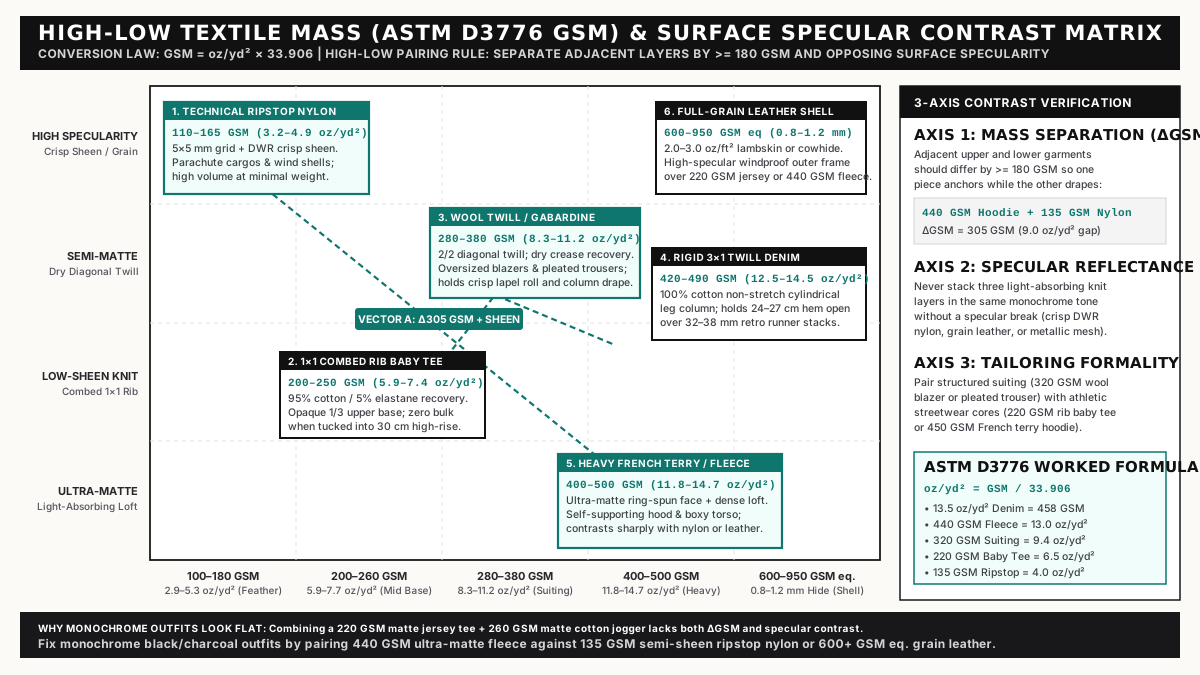
Monochrome streetwear outfits in black, charcoal, or espresso brown look flat when every garment shares the same midweight matte cotton jersey surface. Under ASTM D3776 / ISO 3801 fabric mass-per-unit-area standards, textile weight is measured in grams per square meter (GSM) or ounces per square yard (oz/yd²), linked by the exact conversion constant 33.906 (28.3495 g/oz ÷ 0.836127 m²/yd²):
GSM = oz/yd² × 33.906
oz/yd² = GSM / 33.906
Delta_GSM = |GSM_layer_A - GSM_layer_B| >= 180 GSM
Worked GSM Conversions & Contrast Verification
- Vintage
13.5 oz/yd²Rigid Denim to Metric GSM:13.5 × 33.906 = 457.7 GSM(~460 GSM). - Heavyweight
440 GSMBrushed Cotton Fleece to Imperial Weight:440 / 33.906 = 12.98 oz/yd²(~13.0 oz/yd²). - Adjacent Layer Mass Separation (
Delta_GSM): Pairing a440 GSM(13.0 oz/yd²) ultra-matte brushed fleece hoodie with135 GSM(4.0 oz/yd²) DWR crinkle ripstop nylon parachute trousers generatesDelta_GSM = |440 - 135| = 305 GSM(9.0 oz/yd²separation), exceeding the180 GSMthreshold while contrasting light-absorbing cotton loft against a crisp, semi-sheen technical weave.
| Textile Category & Garment Role | Metric Mass (GSM) |
Imperial Mass (oz/yd²) |
Weave Structure & Surface Specularity | Structural Role in Women’s Silhouette |
|---|---|---|---|---|
| 1. Technical Ripstop / Crinkle Taslan Nylon (Parachute pants, cargo maxi skirts, wind shells) | 110–165 GSM |
3.2–4.9 oz/yd² |
Plain weave with 5×5 mm reinforcement grid + DWR finish; high specular sheen and crisp snap |
Produces wide 26–28 cm billowing leg volume at featherweight mass; breaks up heavy matte fleece or wool |
2. Combed 1×1 Rib / Ring-Spun Jersey (Cropped baby tees, fitted racerback tanks) |
200–250 GSM |
5.9–7.4 oz/yd² |
95% combed cotton / 5% elastane 1×1 rib; low-sheen opaque knit with high elastic recovery |
Forms the zero-bulk 1/3 upper anchor (42–48 cm length); tucks smoothly into 30 cm high-rise waistbands |
| 3. Wool Twill / Gabardine Suiting (Oversized blazers, double-pleated wide trousers) | 280–380 GSM |
8.3–11.2 oz/yd² |
2/2 diagonal twill weave; dry semi-matte finish with sharp crease recovery and fluid drape |
Projects crisp blazer lapels and uninterrupted vertical trouser columns over casual streetwear bases |
| 4. Heavyweight French Terry / Brushed Fleece (Boxy hoodies, drop-shoulder crewnecks) | 400–500 GSM |
11.8–14.7 oz/yd² |
100% ring-spun cotton knit; ultra-matte light-absorbing face with dense interior loop or fleece loft |
Self-supporting double-lined hood and anti-cling torso box; requires contrast against leather, satin, or nylon |
5. Rigid / Vintage-Wash 3×1 Twill Denim (High-rise wide-leg, baggy skater & carpenter jeans) |
420–490 GSM |
12.5–14.5 oz/yd² |
100% cotton non-stretch 3×1 twill; rugged diagonal grain with structured matte surface |
Holds cylindrical 24–27 cm leg openings open around chunky sneakers without collapsing inward |
| 6. Full-Grain Lambskin / Cowhide Leather (Oversized moto jackets, leather trenches) | 600–950 GSM eq. (0.8–1.2 mm) |
2.0–3.0 oz/ft² hide |
High-specular natural grain or velvety matte suede; windproof architectural shell | Provides high-reflectance outer armor over soft 220 GSM jersey or 440 GSM fleece in mild-to-cold bands |
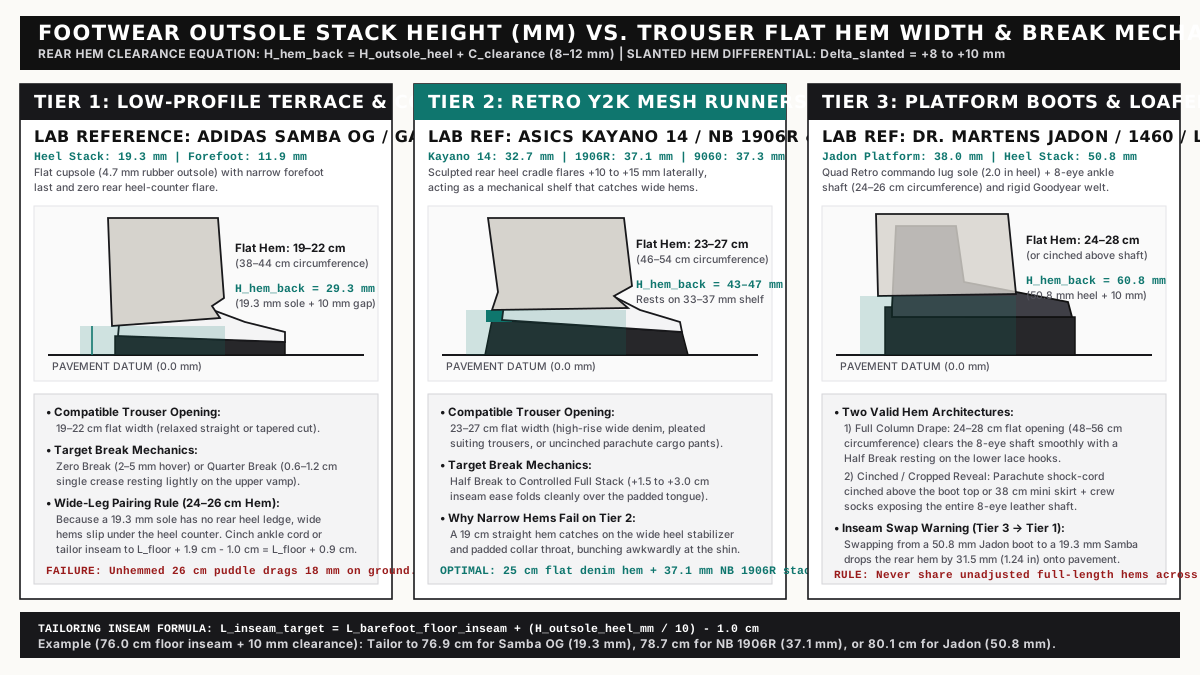
Footwear Outsole Stack Height (mm) vs. Trouser Flat Hem Width and Break Mechanics
As Proper Cloth’s casual pant fit reference emphasizes, trouser length and hem break must always be evaluated with the exact shoes and waistband position you intend to wear. In women’s streetwear, where wide-leg trousers (23 to 28 cm flat hem width) rotate between flat terrace court shoes and high-stack retro runners, ignoring outsole heel stack height (H_outsole_heel) causes immediate heel-under-sole stepping.
To keep the back edge of a wide trouser hem crisp and dry on city bluestone pavement, set the rear hem ground clearance (H_hem_back) and tailored inseam target (L_inseam_target) using three equations:
H_hem_back = H_outsole_heel + C_clearance   (where C_clearance = 8 to 12 mm, target 10 mm)
L_inseam_target = L_barefoot_floor_inseam + (H_outsole_heel_mm / 10) - 1.0 cm
Delta_slanted_hem = L_back_hem - L_front_hem = +8 to +10 mm
Worked Inseam Calibration Across Three Footwear Tiers (76.0 cm Barefoot Floor Inseam)
Suppose your barefoot crotch-to-floor inseam with high-rise trousers sitting at your natural waist is L_barefoot_floor_inseam = 76.0 cm, and you want a 10 mm (1.0 cm) rear pavement clearance:
- Tier 1 Court Sneaker (Adidas Samba OG, RunRepeat lab-measured heel stack
19.3 mm/1.93 cm, forefoot11.9 mm):L_inseam_target = 76.0 cm + 1.93 cm - 1.0 cm = 76.9 cm(rear hem hovers atH_hem_back = 29.3 mmabove the pavement). Because a19.3 mmflat cupsole lacks a flared heel counter ledge, pair it with a19 to 22 cmflat trouser opening (38 to 44 cmtotal circumference) for a clean Quarter Break (0.6 to 1.2 cmfront crease). If you wear26 cmwide parachute pants with Sambas, cinch the ankle shock-cord toggle so the fabric cannot slip beneath the4.7 mmrubber outsole. - Tier 2 Retro Mesh Runner (ASICS Gel-Kayano 14 at
32.7 mmheel /22.6 mmforefoot; New Balance 1906R at37.1 mmheel; New Balance 9060 at37.3 mmheel): For theNew Balance 1906R(37.1 mm/3.71 cmheel stack),L_inseam_target = 76.0 cm + 3.71 cm - 1.0 cm = 78.7 cm(rear hem sits atH_hem_back = 47.1 mmoff the ground). Sculpted Y2K runners feature a rear heel cradle and podular midsole that flare+10 to +15 mmoutward past the heel counter, acting as a mechanical shelf that catches23 to 27 cmwide-leg denim and pleated suiting trousers in a Half Break to Controlled Full Stack (1.5 to 3.0 cmcascading front fold). - Tier 3 Platform Lug-Sole Boot (Dr. Martens Jadon 8-Eye Platform,
38.0 mmplatform /50.8 mmheel stack):L_inseam_target = 76.0 cm + 5.08 cm - 1.0 cm = 80.1 cm(rear hem sits atH_hem_back = 60.8 mmabove the ground). Notice the3.2 cm(31.5 mm) vertical drop between Tier 3 (80.1 cminseam) and Tier 1 (76.9 cminseam): wearing trousers hemmed for Jadon platform boots with Adidas Sambas forces3.2 cmof fabric directly under your heel. When road grit or heel drag scuffs midsole foam or lifts a toe bumper, use our Melbourne sneaker cleaning, regluing and resoling guide to restore the sole unit.
| Footwear Stack Tier | Lab-Verified Reference Models & Stack Specs | Collar & Heel-Counter Geometry | Compatible Trouser Flat Hem Width | Recommended Hem Break & Tailoring Rule |
|---|---|---|---|---|
Tier 1: Low-Profile Terrace & Indoor Court (16–22 mm) |
Adidas Samba OG (19.3 mm heel / 11.9 mm forefoot; 4.7 mm rubber outsole); Gazelle Indoor (~20 mm); Mexico 66 (~17 mm) |
Flat vulcanized or cupsole profile; narrow forefoot last; zero rear heel shelf | 19–22 cm flat (38–44 cm circumference) for straight cuts; 24–27 cm wide legs require ankle toggle cinch or custom hem |
Zero to Quarter Break (0.6–1.2 cm fold); rear hem at 29.3 mm off floor (L_floor + 0.9 cm) |
Tier 2: Technical Y2K & Retro Mesh Runners (32–38 mm) |
ASICS Gel-Kayano 14 (32.7 mm heel / 22.6 mm forefoot); NB 1906R (37.1 mm heel); NB 9060 (37.3 mm heel, 427 g) |
Padded gusseted tongue + sculpted rear heel stabilizer flaring +10–15 mm laterally as a hem stopper |
23–27 cm flat (46–54 cm circumference) so leg cylinder clears padded collar throat and drapes over heel pods |
Half Break to Controlled Stack (1.5–3.0 cm fold); rear hem at 43–47 mm off floor (L_floor + 2.3 to 2.7 cm) |
Tier 3: Platform Lug-Sole Boots & Loafers (38–51 mm) |
Dr. Martens Jadon Platform (38.0 mm platform / 50.8 mm heel); 1460 Classic (28.0 mm); lug penny loafers (38–45 mm) |
8-eye ankle shaft (24–26 cm shaft circumference) + projecting PVC Goodyear welt ledge |
24–28 cm flat (48–56 cm circumference) for full column drape over shaft, OR 38 cm mini skirt / cinched parachute |
Half Break on lower lace hooks (L_floor + 4.1 cm) or Zero-Break Cropped Reveal exposing 5–8 cm of boot shaft |
Four Engineered Women’s Streetwear Formulas by Temperature Band
Long-term records from the Australian Bureau of Meteorology’s Melbourne Olympic Park station (086338) show a mean daily swing of 10.3°C (19°F) in January (16.5°C mean minimum to 26.8°C mean maximum) and 7.0°C (13°F) in July (7.5°C to 14.5°C). As detailed in our Melbourne street style guide, any city outfit that relies on a single non-removable pullover fails the moment you step from a shaded laneway into a heated tram or office. Each formula below locks the vertical ratio in the base layers so removing the outer shell never breaks the silhouette.
Formula 1: Warm-to-Mild Band (15–24°C / 59–75°F) — Smart-Casual Blazer & Vintage Denim (1:2 Inner Split)
- Upper Base (
1/3Block):220 GSM1×1ribbed cotton cropped baby tee (45 cmHPS-to-hem length in optic white or heather grey). - Outer Architectural Frame:
320 GSMcharcoal wool-twill oversized blazer (+3.5 cmextended shoulder pad,75 cmcenter-back length, worn unbuttoned). - Lower Column (
2/3Block): High-rise (30 cmfront rise)13.5 oz/yd²(460 GSM) vintage-wash rigid3×1twill wide-leg jeans (25 cmflat hem opening). - Footwear Anchor:
ASICS Gel-Kayano 14(32.7 mmheel stack) orNew Balance 1906R(37.1 mmheel stack) catching a Half Break10 mmabove the pavement. - Why the geometry holds: The open
75 cmwool blazer creates vertical framing lines across the torso while exposing the45 cmcropped tee meeting the30 cmhigh-rise denim waistband (R_vertical = 0.48). When the afternoon warms to23°Cand you drape the blazer over your tote, the1:2ratio and240 GSMmass contrast (460 GSMdenim vs220 GSMrib tee) remain intact.
Formula 2: Mild-to-Cold Band (8–16°C / 46–61°F) — Laneway Utility Parachute Contrast (1:2 Split)
- Upper Block (
1/3Block): Cropped or elastic-hem-cinched440 GSMbrushed cotton fleece hoodie (48 cmeffective length) layered over a180 GSMcombed cotton long-sleeve tee (1.5 cmcollar rim and wrist cuff reveal). - Lower Column (
2/3Block): High-rise (29 cmrise)135 GSMDWR crinkle ripstop nylon parachute cargo trousers (27 cmflat hem width equipped with an internal ankle shock-cord toggle). - Footwear Dual-Mode Calibration: Wear the
27 cmhem open over aNew Balance 9060(37.3 mmflared heel cradle), or pull the ankle shock-cord toggle tight above the malleolus to pair the exact same trouser with a19.3 mmAdidas Samba OGwithout heel drag. - Why the geometry holds: Combines a
305 GSMmass differential (440 GSMultra-matte cotton loft above vs135 GSMsemi-sheen technical nylon below) with instant hem-to-shoe adaptability.
Formula 3: Warm-to-Mild Band (16–25°C / 61–77°F) — 2:1 Longline Boxy Upper + Compact Lower
- Upper Block (
2/3Block): Oversized460 GSMFrench terry crewneck sweatshirt or700 GSM eq.(1.0 mm) full-grain leather bomber jacket (74 cmlength,+18 cmchest ease) worn over a crisp cotton poplin shirt tail peeking2.5 cmbelow the ribbed hem. - Lower Block (
1/3Block):38 cmpleated wool-blend mini skirt or18 cminseam heavyweight (260 GSM) compression rib bike shorts. - Footwear & Legwear Anchor: Mid-calf
200-needleribbed cotton crew socks (scrunched to14–16 cmabove the ankle bone) paired withDr. Martens Jadonplatform boots (38.0 mmplatform /50.8 mmheel stack) or40 mmlug-sole penny loafers. - Why the geometry holds: Commits deliberately to
R_vertical = 2.00(94 cmupper visual block to47 cmlower leg and boot column), using the50.8 mmlug sole at the base to counterbalance the+18 cmupper torso ease. For evening styling, pair this silhouette with the graphic liner or matte-skin directions in our street style makeup pairing guide.
Formula 4: Cold Transit Band (3–11°C / 37–52°F) — Three-Layer Removable Architecture
- Layer 1 (Tucked Base):
220 GSMfine merino wool or ribbed cotton mock-neck long-sleeve top tucked completely into the trouser waistband. - Layer 2 (Visible Mid-Layer): Cropped
50 cmboxy two-way zip cardigan, raw denim trucker jacket, or cropped matte down vest ending right at the iliac crest. - Layer 3 (Removable Outer Shell):
112 to 120 cmcalf-length380 GSMwool-twill overcoat or water-repellent gabardine trench worn open outdoors and removed on transit. - Lower Column & Footwear: High-rise (
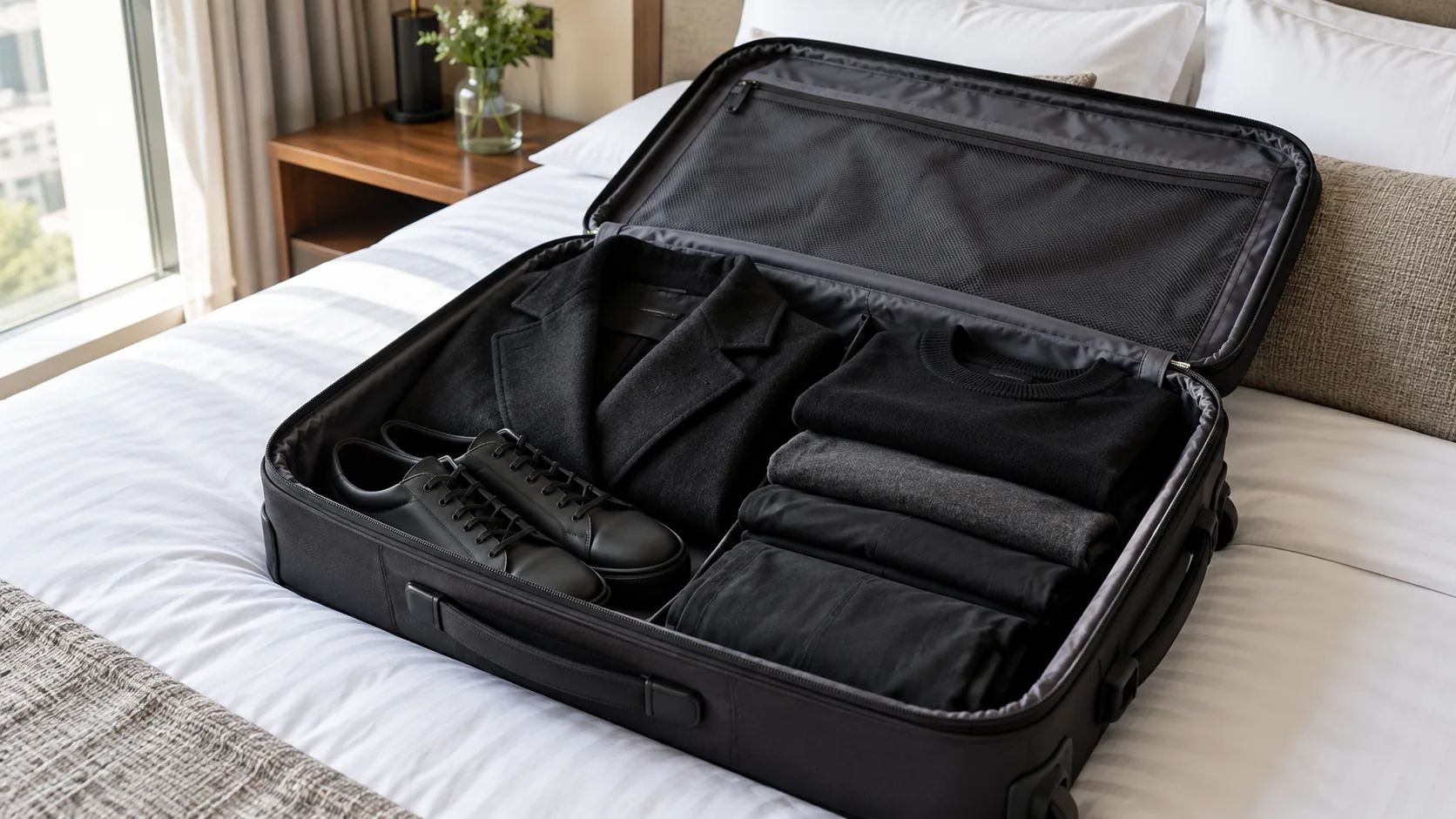
30 cmrise) double-pleated wide-leg wool trousers (24 cmflat hem opening) tailored with a+9 mmslanted heel differential over leather combat boots or cupsole sneakers. If you are packing this modular stack into cabin luggage for an interstate trip, cross-check total garment weights against our 7 kg carry-on capsule wardrobe packing guide.
Five-Step Pre-Door Fitting & Movement Verification
Before stepping out or pinning a trouser hem for alterations, run five physical checks in front of a full-length mirror:
- Measure the vertical waist split (
R_vertical): Confirm the visible horizontal break sits at1:2(33%upper :67%lower) or2:1(67%upper :33%lower). If the top edge cuts across the50%hip midpoint, execute a+12 cmfront tuck or open the outer layer. - Test blazer shoulder and forward-reach recovery: Stand relaxed, reach both arms forward
90 degrees, and drop them back to your sides. The extended shoulder pad (+2.5 to +4.5 cm) must remain horizontal without neck-collar gaping, and1.0 to 1.5 cmof your inner cuff or wrist bone should stay visible. - Verify two-axis fabric contrast (
Delta_GSM >= 180 GSM): Check that adjacent upper and lower pieces differ in both areal weight (for example,440 GSMfleece against135 GSMripstop nylon, or220 GSMrib against460 GSMrigid denim) and surface reflectance. - Walk five paces to test rear hem clearance (
H_hem_back): Wearing your intended footwear, walk across a hard floor and stop. Verify the back hem clears the ground by8 to 12 mm(29 mmtotal height onSamba OG,47 mmonNB 1906R/9060,61 mmonJadonboots) without catching under the heel counter. - Audit the coat-off indoor state: Remove your outer blazer, trench, or puffer and inspect the remaining base + mid-layer combination. If the inner layers maintain their
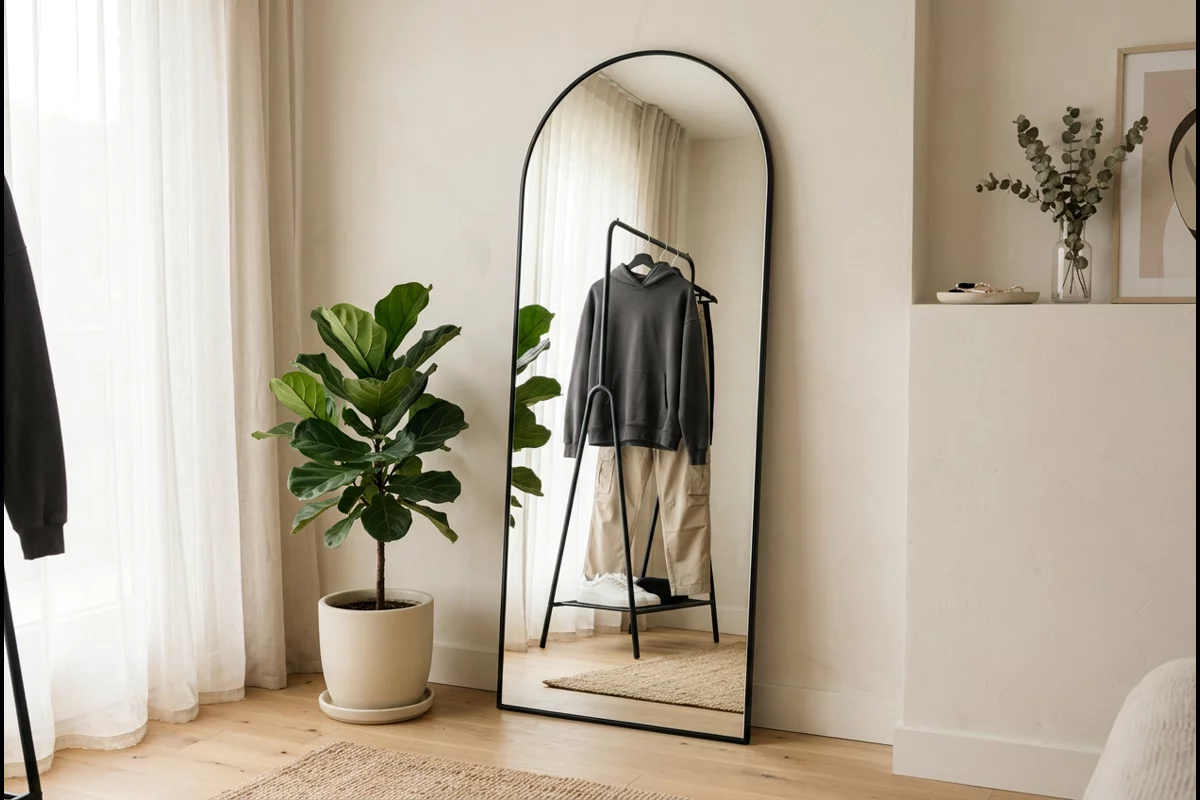
1:2waistline division and standalone sleeve proportions, the outfit is calibrated for all-day city transit. To preserve these exact1:2and2:1proportions on camera without wide-angle leg foreshortening, see our guide to street style fashion photography focal lengths and 0-degree waist-level camera pitch. Browse more proportion breakdowns in our Outfit Ideas archive and Street Style section, or view every guide in the Blog Archive.