Buying another piece before recording what is missing can cost you money and wardrobe space while leaving the same outfit unfinished. This capsule wardrobe checklist for men starts with the street-casual clothes you own: name their actual partners, check how they feel together, and record the unresolved role before shopping.
What a capsule wardrobe means here
Levi’s describes a capsule wardrobe as a small, interchangeable clothing collection. Its article suggests tees, shirts, sweatshirts, jeans and jackets, among other pieces. Those suggestions are examples you can consider; your own clothes and daily settings determine which roles belong in your capsule.
For this checklist, interchangeable means you can name combinations you would actually wear. A tee that works with your jeans and trainers can stay even if it is graphic or brightly coloured. A plain shirt still needs a try-on with its intended partners. Similar colours alone do not establish a comfortable outfit.
Start with your regular street-casual settings, such as commuting where casual dress is allowed, errands and meeting friends. Keep separate requirements visible if your work or an event calls for different clothing. For weather and occasion choices, use the existing streetwear outfit guide.
Choose garment roles from your own clothes
Lay out the pieces you reach for, then assign a role to each. An overshirt might serve as a top when buttoned and a layer when open; record the combinations that make each use work.
- Base top: An owned tee or similar top you like wearing alone or underneath a layer. Name the jeans or trousers and footwear you wear with it.
- Casual shirt or overshirt: A shirt worn as the main top or over another garment. Try it with the intended base top and check shoulder and arm movement.
- Knit or sweatshirt layer: A jumper, cardigan, sweatshirt or hoodie when it serves your routine. Check it over the actual top and beneath the intended jacket, if applicable.
- Bottom: Jeans, chinos or other casual trousers you already enjoy wearing. Check sitting, walking and the hem with your usual footwear.
- Outer layer: An owned jacket or coat for the conditions you expect. Record any protection you need to verify rather than assuming a garment category guarantees it.
- Everyday footwear: Trainers or other casual shoes suitable for the setting. Try them with the intended trouser shape and length.
- Accessory with a purpose: A bag, belt, cap or other item you use in these outfits. Leave the role out if it adds nothing you need or enjoy.
Levi’s and the men’s section of Rebekah Roy’s guide for Salvation Army Trading Company offer garment examples behind these roles. The grouping and record below are our editorial checklist.
Make a record: keep, repair or alter, missing, defer
Roy’s guide advises listing existing clothes and identifying gaps before shopping, including a top needed for trousers already owned (physical PDF page 13). Use that starting point to describe the exact outfit you cannot yet wear.
Reusable garment record
Copy this blank entry into your notes for each garment or unresolved role. Write the names you use to recognise your clothes rather than broad labels such as “versatile basics.”
Garment role: ______
Actual owned piece, or none owned: ______
Compatible top by name, or not applicable: ______
Compatible bottom by name, or not applicable: ______
Compatible layer by name, or not needed: ______
Compatible footwear by name: ______
Fit or movement concern after trying the combination: ______
Setting where this combination works: ______
Care requirement copied from this garment’s label: ______
Status — keep / repair or alter / missing / defer: ______
Specific gap or next action: ______
For a missing piece, leave its care field pending until you can inspect the actual garment. If an owned piece’s label is unreadable, record that uncertainty and seek garment-specific guidance. Check whether the care and drying arrangements are practical for you.
Compare the record statuses
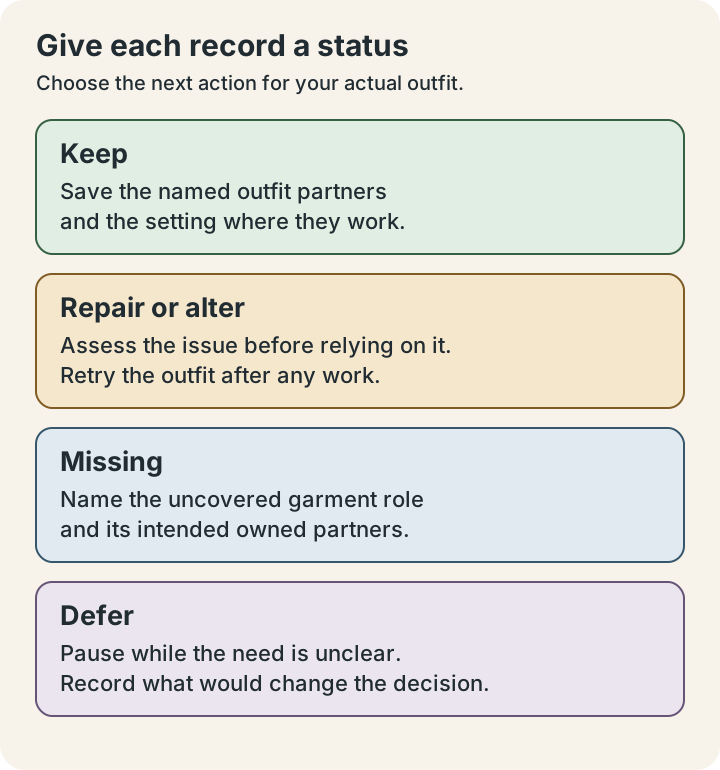
Choose the status that describes the piece in its intended outfit today. Keep an unresolved repair or fit question visible until you have checked it.
| Status | Use it when | Dominant Failure Mode | Prevention |
|---|---|---|---|
| Keep | The owned garment works in a named outfit and setting. | Assuming it works with every other retained piece. | Save the actual partners and note exceptions. |
| Repair or alter | An owned piece needs attention before its intended use. | Treating an unresolved fault as ready to wear. | Record the fault, seek an assessment and retry the outfit after any work. |
| Missing | A needed role remains uncovered in a specific outfit or setting. | Buying a duplicate that leaves the gap open. | Name the role and the owned partners an addition must work with. |
| Defer | The need is unclear, already covered or awaiting a decision. | Letting an attractive item become an assumed necessity. | Record what would justify reconsidering it. |
If a garment needs attention, the clothing repair consultation checklist can help you describe the issue. An assessment may show that the proposed repair or alteration is unsuitable.
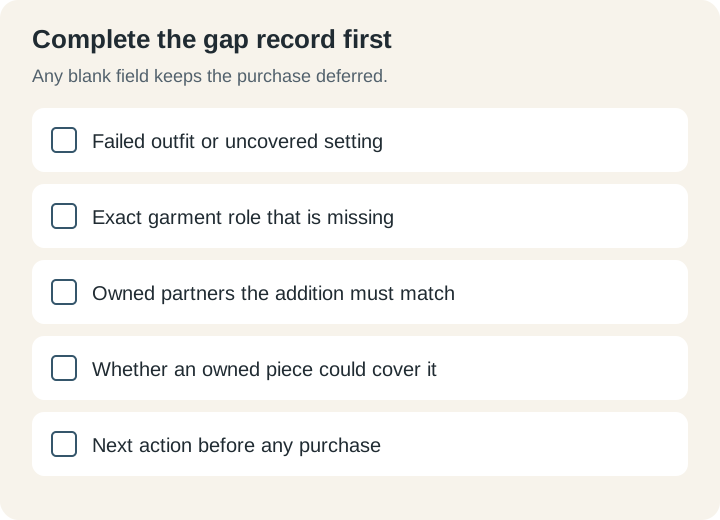
Reusable gap record
Failed outfit or uncovered setting: ______
Exact garment role missing: ______
Owned pieces an addition must work with: ______
Could an owned piece cover it after attention? What needs checking? ______
Next action before purchase: ______
Rule of thumb: A purchase becomes a candidate only when its gap record is complete: it names the failed outfit or uncovered setting, the missing role, the owned partners, whether attention to an owned piece could cover it, and the next action. Until then, mark it defer.
Filled example: the missing role is a wearable layer
This hypothetical example shows how the record separates a working outfit from an unresolved layer. It is an illustration, not a styling-client case.

Base top — keep. The owned piece is a washed graphic tee. Its named partners are indigo jeans and canvas trainers for weekend errands. In this example, sitting and walking feel comfortable. No layer is needed for that particular outing. The care field is filled from the tee’s own label.
Bottom and footwear — keep. The indigo jeans and canvas trainers work with that tee in the same setting. Their records name each other and the tee; each garment’s care information is recorded separately. No claim is made about combinations that have not been tried.
Shirt layer — defer pending assessment. The owned olive overshirt pulls across the upper arms when worn over the graphic tee. It is not recorded as ready for that layered outfit. The next action is to check whether another owned shirt works, then ask whether alteration of this overshirt is feasible. If appropriate work is agreed, its status becomes repair or alter until the result is tried again.
Gap record: The uncovered setting is meeting friends when a removable layer is wanted. The missing role is a comfortable shirt layer over the graphic tee, worn with the indigo jeans and canvas trainers. The existing overshirt might cover that role after attention, but feasibility is unresolved. The next action is the owned-shirt try-on and, if needed, an alteration assessment before considering a replacement.
Duplicate tee — defer. Another tee would leave the layer problem unresolved. Reconsider it only if a separate base-top need appears in the record.
Review the capsule when a setting, fit issue or care requirement changes. It is serving its purpose when your regular settings have workable named outfits and unresolved roles have clear next actions. You can keep your preferred colours, graphics and silhouettes while making those decisions visible.
Sources
- Levi’s: What is a Capsule Wardrobe & How to Build One, published October 2022; accessed October 19, 2026. Supports the interchangeable-collection definition and garment examples.
- Salvation Army Trading Company with Rebekah Roy: How to Shop Second-Hand Like a Pro, accessed October 19, 2026. Physical page 13 supports listing clothes and gaps; page 14 discusses coordinating colour and personal preference; the men’s garment examples are on physical pages 19–20. These are source locators, not wardrobe targets.
For help checking the shape of a combination, see men’s streetwear layering and proportions. Browse the street-style guide index for related outfit decisions.