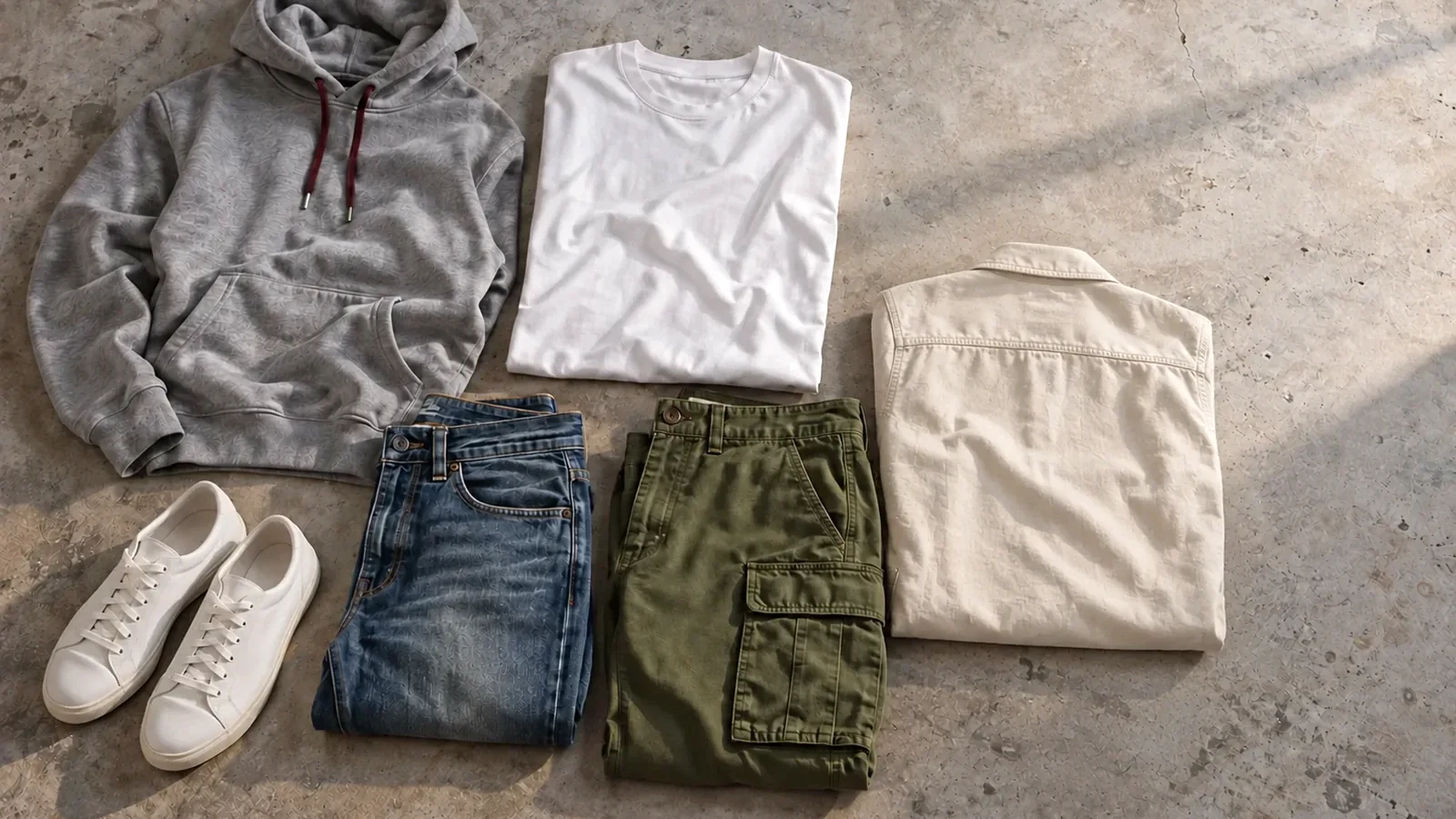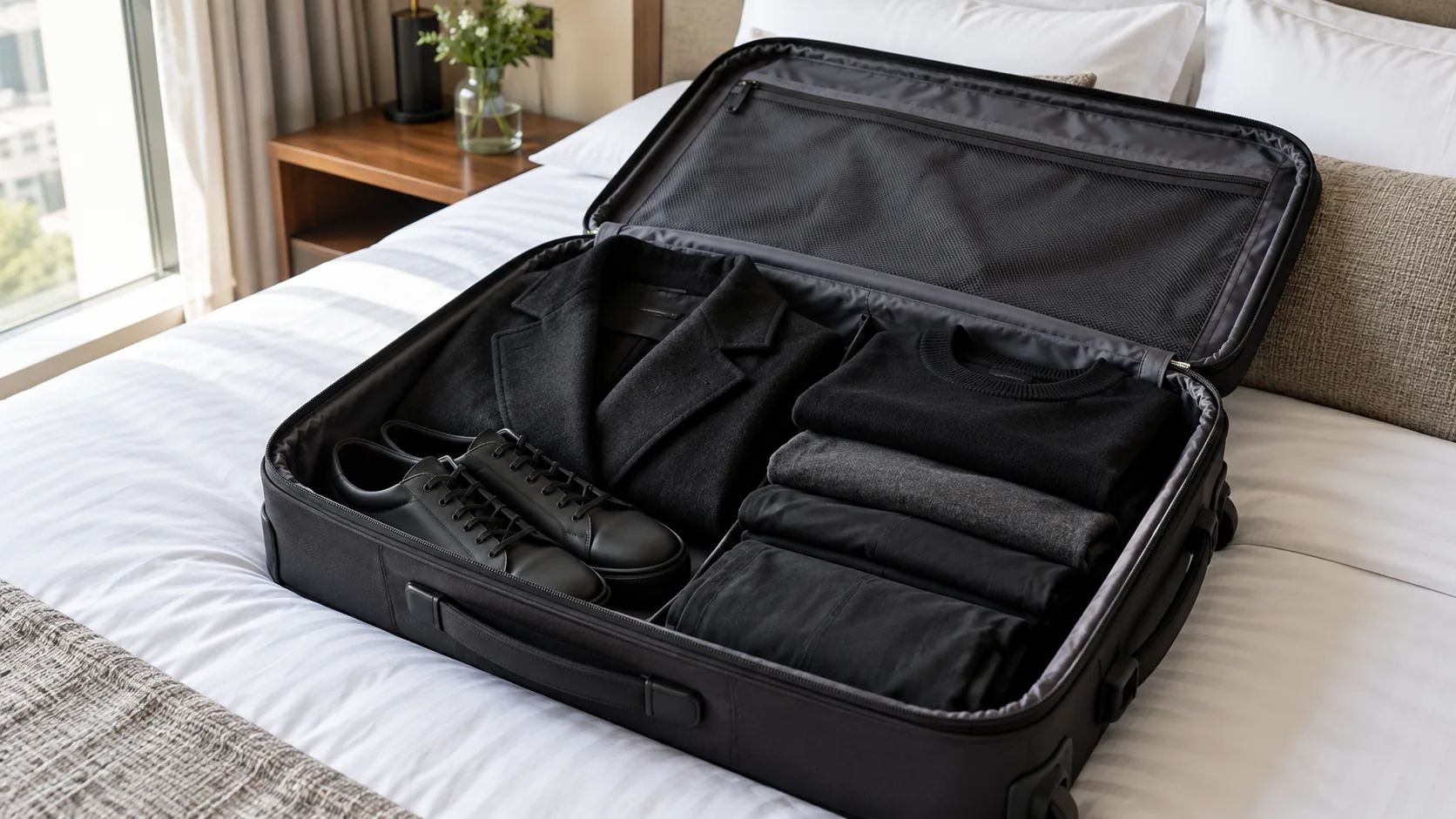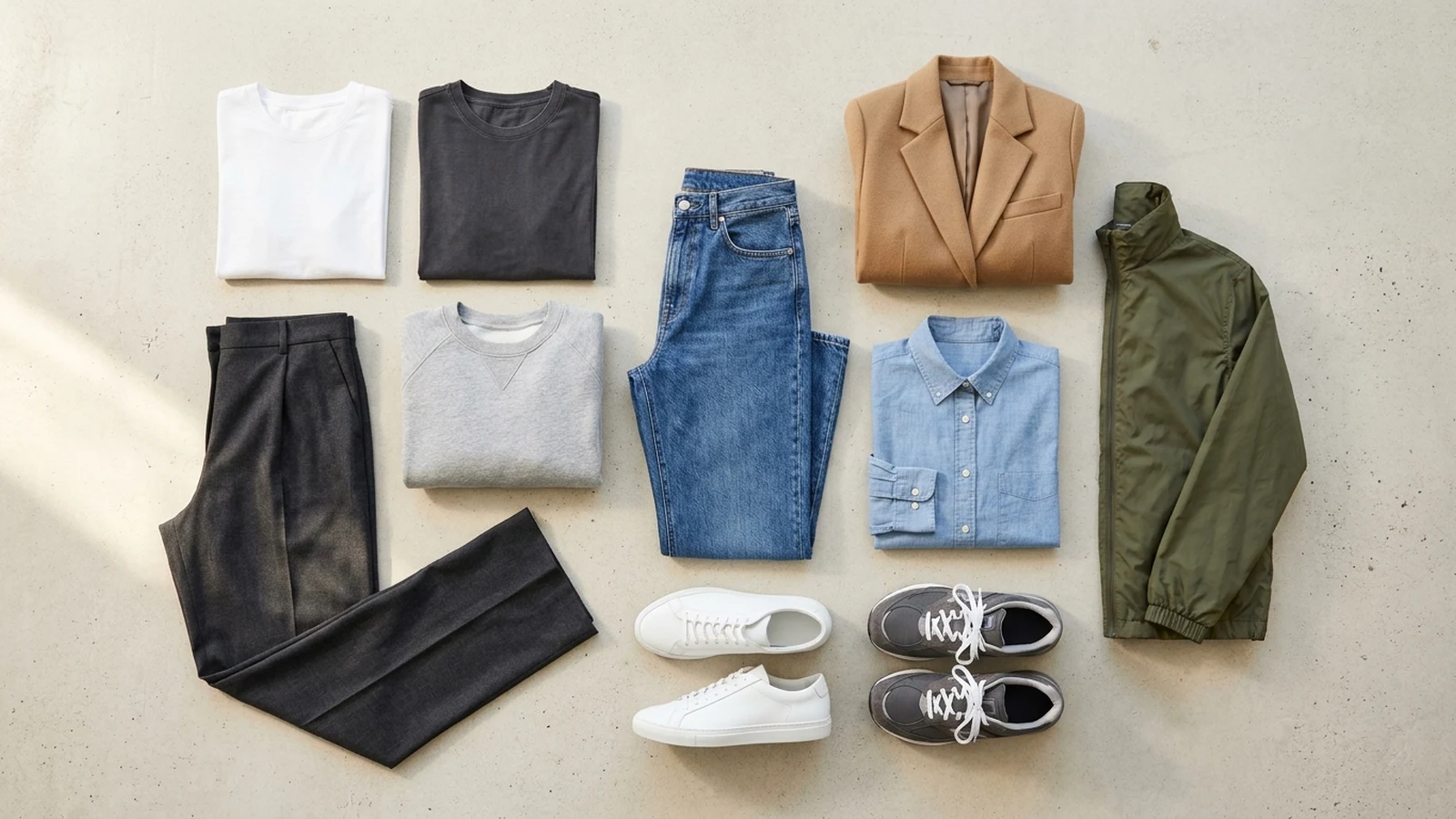
Building a functional capsule wardrobe for women requires matching garment ease, armhole depth, and fabric mass across layering tiers so outer coats never bind over midweight knitwear and commuter basics survive repeated laundering. Standard fitted office blazers allow +5.0 to +7.5 cm (2 to 3 in) of total chest ease and a high armhole that binds immediately over a sweatshirt, whereas a streetwear layering blazer requires +15 to +22 cm (6 to 8.5 in) of chest ease and a +2.5 to +4.0 cm deeper armscye drop to accommodate a 440 GSM hoodie sleeve without bunching at the bicep.
Across knit garment categories, tees run 140-320 GSM, sweatshirts 250-500 GSM, joggers 280-500 GSM, and hoodies 300-800 GSM. Selecting complementary weights across base tops, French terry or woven mid-layers, casual trousers, and wind-resistant outer shells prevents two common commuter wardrobe failures: accumulating duplicate outer coats that cannot layer over boxy sweatshirts, and mixing dry-clean-only wool tailoring into high-frequency machine wash cycles.
Readers exploring our Melbourne street style and wardrobe guides can pair this fabric-weight and layering checklist with sibling resources across our cluster. Detailed vertical torso-to-leg proportion math is covered in our women’s streetwear silhouette guide, menswear garment-role records are detailed in our men’s street-casual capsule wardrobe checklist, and airline baggage weight budgeting is addressed in our carry-on travel capsule packing guide.
| Capsule Layering Tier | Target Fabric Weight or Airflow Spec | Pattern Ease & Geometry Benchmark | Representative Garment Examples |
|---|---|---|---|
| Base Knit & Jersey Tops | 140-180 GSM (4.1-5.3 oz/yd2) Light to 220-260 GSM (6.5-7.7 oz/yd2) Premium tee | Negative 2 inches of hip ease on close-fitting Seamwork Margo knits; drape coefficient under 0.35 below 180 GSM and above 0.55 over 260 GSM | Uniqlo Supima Crew at 180 GSM; Los Angeles Apparel 6.5 oz tee at 220 GSM; 3sixteen 225 gsm and 260 gsm tees |
| Mid-Layer Fleece & Shirting | 320-400 GSM (9.4-11.8 oz/yd2) Light fleece; 7 oz. Cotton Linen Chambray | 3 inches of bust ease on Seamwork York size 8 (40-inch finished bust minus 37-inch body bust) | Champion Reverse Weave at roughly 340 GSM; Reigning Champ midweight terry at 380 GSM; HAVEN Revel S/S tropical wool shirt ($280) |
| Tailored & Casual Bottoms | Leg Opening Width from ~6.3“ to ~8.5“ (8“+ on Straight Fit) | Knee-to-hem taper typically ~2-2.5“ on Slim/Extra Slim, typically ~1.5-2“ on Classic, and 1-1.5“ on Straight Fit | 19 to 22 cm straight hem with a Quarter Break (or cinched ankle toggle on wider pants) for Adidas Samba OG (19.3 mm heel); 23 to 27 cm wide-leg hem in a Half Break to Controlled Stack (1.5 to 3.0 cm fold) with rear hem clearance of heel stack plus a target 10 mm (~47 mm off the floor) for New Balance 9060 (37.3 mm heel) |
| Windproof & Tailored Outerwear | Down-proof shells frequently specified under ~5 CFM | +15 to +22 cm (6 to 8.5 in) chest ease, +2.5 to +4.0 cm armscye drop, and 72 to 78 cm (28.5 to 30.7 in) center-back length | Engineered oversized women’s layering blazer with a 6 to 10 mm (0.25 to 0.40 in) structured shoulder pad |
Garment Ease, Armhole Clearance & Oversized Layering Blazer Geometry
Wearing ease allows movement in garments so a woven pattern does not fit like a second skin with no range of motion, whereas design ease is added to a garment to influence the overall shape and silhouette of the style.
Garment ease is calculated by subtracting body measurements from finished garment measurements: on the Seamwork York size 8, the bust measurement is 37 inches and the finished garment measurement is 40 inches, so 40 minus 37 equals 3 inches of ease in the bust on a size 8.
Negative ease occurs when finished garment measurements are smaller than body measurements, such as on a close-fitting tank top or T-shirt; the Seamwork Margo has negative 2 inches of ease in the hips, meaning the finished garment measurement is 2 inches smaller than the body measurement.
In Tip #2 of Seamwork’s pattern fitting guidance, sizing a pattern up or down for more or less ease affects all pattern measurements simultaneously, including shoulder width, bicep, and sleeve length.
A well-fitted armhole is essential to a top’s ease of movement, and the relationship between sleeve, arm, and shoulder is one of the great challenges a tailor faces in making a jacket and one of the reasons jackets are more expensive to make than trousers.
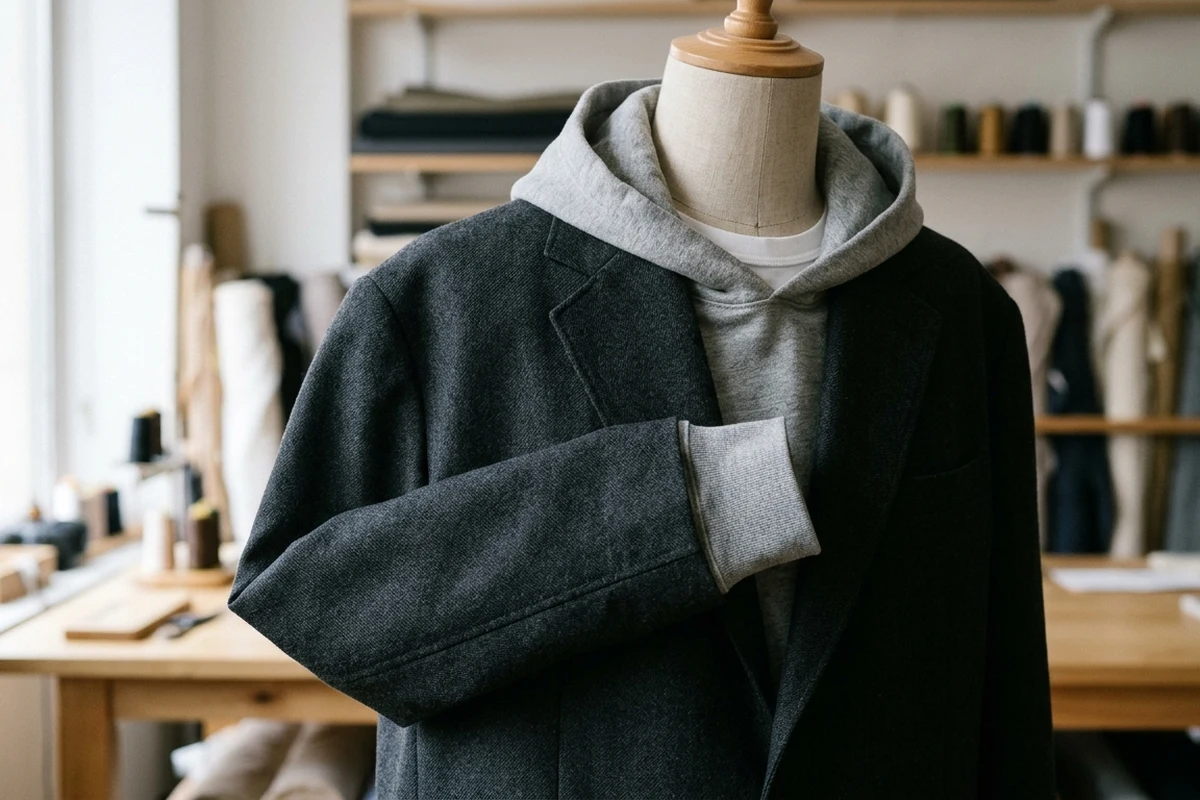
When building a capsule wardrobe for women that layers tailored outerwear over streetwear knitwear, standard fitted office blazers allow +5.0 to +7.5 cm (2 to 3 in) of total chest ease and a high armhole that binds immediately over a sweatshirt, whereas a streetwear layering blazer requires +15 to +22 cm (6 to 8.5 in) of chest ease and a +2.5 to +4.0 cm deeper armscye drop to accommodate a 440 GSM hoodie sleeve without bunching at the bicep.
Measured from the natural acromion bone at the outer bony tip of the shoulder to the jacket’s shoulder seam, an engineered oversized blazer seam extends +2.5 to +4.5 cm laterally and is supported internally by a 6 to 10 mm (0.25 to 0.40 in) structured tailoring pad plus a bias-cut wigan sleeve-head roll so the extended line stays horizontal.
Measured from the center-back neck seam to the bottom hem, a 72 to 78 cm (28.5 to 30.7 in) jacket clears the hip curve cleanly and hits the upper-to-mid thigh, locking into a 2:1 ratio over mini skirts or framing a 1:2 inner crop over wide trousers.
Even on a boxy block, a women’s layering blazer sleeve terminating between the ulnar styloid process at the outer wrist bone and the base of the thumb metacarpal exposes 1.0 to 1.5 cm of an inner ribbed hoodie cuff, or can be shortened from the cuff by 2.0 to 3.5 cm by a tailor.
Cotton Knit & Fleece Fabric Weight Bands (GSM), Drape Coefficients & Mill Tolerances
Fabric weight is measured in grams per square metre (GSM), representing the mass of one square metre of finished cloth determined under EN 12127 for knits and wovens and ISO 3801 for wovens, where one ounce per square yard equals 33.906 GSM so dividing GSM by 33.9 gives the American figure.
ISO 3801 covers woven fabrics only, whereas EN 12127 is the small-sample method used by European mills and labs for knits and wovens alike, and ASTM D3776 is the United States equivalent.
Dividing GSM by 33.9 converts fabric mass to ounces per square yard: 220 GSM equals 6.5 oz, 380 GSM equals 11.2 oz, and 500 GSM equals 14.7 oz.
In cotton knit t-shirt weight bands, 140-180 GSM (4.1-5.3 oz/yd2) is classified as Light for summer tees, base layers, and linings that are slightly sheer in pale colours, while 180-220 GSM (5.3-6.5 oz/yd2) is classified as Standard for the ordinary opaque, soft t-shirt that drapes rather than stands.
Stepping up in jersey density, 220-260 GSM (6.5-7.7 oz/yd2) is classified as a Premium tee for elevated basics that hold a shoulder line and take a boxy cut, whereas 260-320 GSM (7.7-9.4 oz/yd2) is classified as a Heavyweight tee for boxy statement tees that stand away from the body.
In cotton fleece and hoodie weight bands, 320-400 GSM (9.4-11.8 oz/yd2) is classified as Light fleece for spring hoodies, sweatshirts, and light joggers, 400-500 GSM (11.8-14.7 oz/yd2) is classified as Mid fleece for winter hoodies and joggers, and 500-700 GSM (14.7-20.6 oz/yd2) is classified as Heavyweight for streetwear loopback hoodies that feel stiff when new and break in slowly.
| Knit Weight Band | Metric & Imperial Range | Primary Capsule Role & Drape Behaviour |
|---|---|---|
| Light Cotton Knit | 140-180 GSM (4.1-5.3 oz/yd2) | Summer tees, base layers, and linings; slightly sheer in pale colours with a drape coefficient under 0.35 below 180 GSM |
| Standard Cotton Knit | 180-220 GSM (5.3-6.5 oz/yd2) | Ordinary opaque, soft t-shirt that drapes rather than stands; includes Uniqlo Supima Crew at 180 GSM and Los Angeles Apparel 6.5 oz at 220 GSM |
| Premium & Heavyweight Tee | 220-260 GSM (6.5-7.7 oz/yd2) to 260-320 GSM (7.7-9.4 oz/yd2) | Elevated basics that hold a shoulder line and boxy statement tees; drape coefficient exceeds 0.55 above 260 GSM |
| Light to Heavyweight Fleece | 320-400 GSM (9.4-11.8 oz/yd2) to 500-700 GSM (14.7-20.6 oz/yd2) | Spring hoodies and sweatshirts (Champion Reverse Weave ~340 GSM, Reigning Champ 380 GSM) up to 400-500 GSM (11.8-14.7 oz/yd2) Mid fleece and 500-700 GSM loopback hoodies |
According to 2024 Textile Exchange drape-coefficient testing, cotton jersey below 180 GSM shows a drape coefficient under 0.35 (very fluid), while cotton jersey above 260 GSM exceeds 0.55 (structured).
Published brand fabric weights illustrate how these tiers map to real garments: Uniqlo Supima Crew sits at 180 GSM, Los Angeles Apparel 6.5 oz sits at 220 GSM (6.5 x 33.9), Champion Reverse Weave sits at roughly 340 GSM, and Reigning Champ midweight terry sits at 380 GSM.
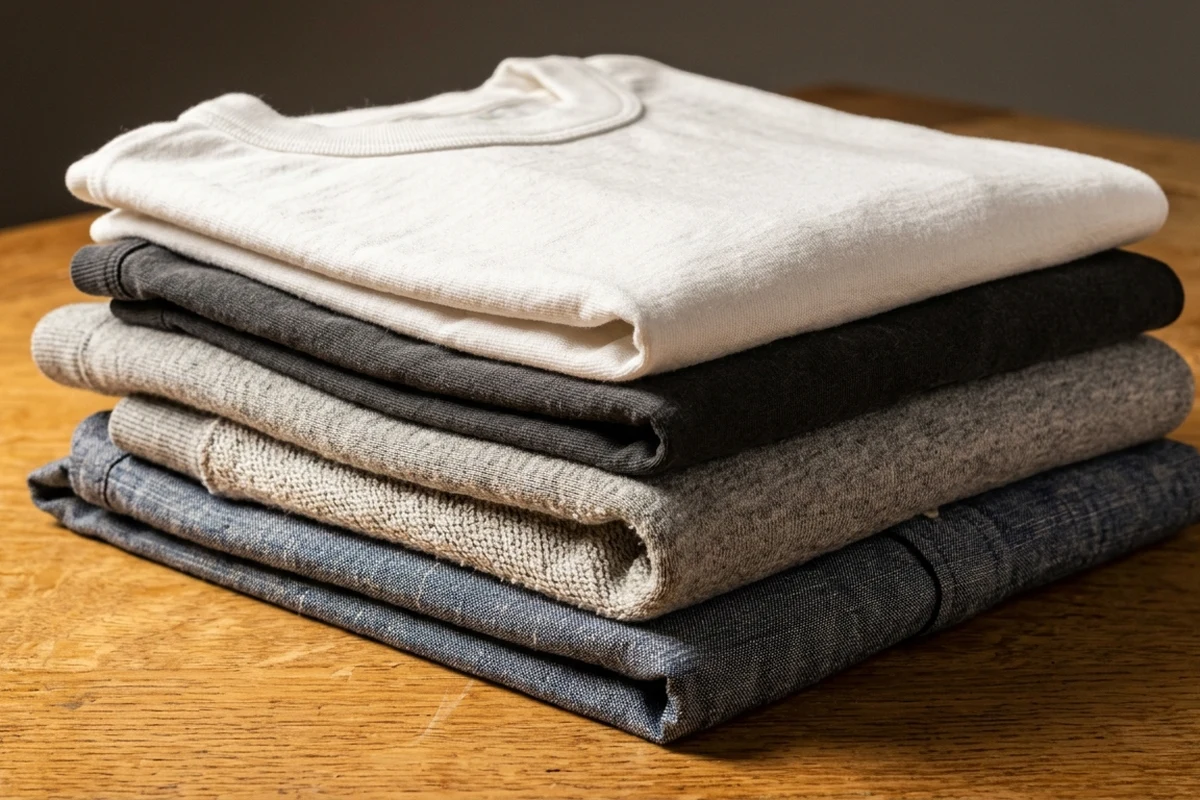
When auditing garment labels against physical hand-feel, common production GSM tolerance ranges are ±10 GSM for jersey and interlock, ±15 GSM for French terry, ±20 GSM for fleece and brushed-back knits, and ±5% of stated GSM for wovens.
Because cotton has a commercial moisture regain of 8.5%, textile labs condition fabric samples at 20 degrees C and 65% relative humidity before weighing under ISO 139.
Capsule Wardrobe Examples: Heavyweight Tees, Summer Shirting & Textile Density Metrics
Beyond area weight in GSM, woven and synthetic capsule pieces are specified by yarn linear density and thread count. Denier (abbreviated D) is a unit of measure for the linear mass density of fibers defined as the mass in grams of 9000 meters (9km) of fiber, based on the natural reference that a single 9000-meter strand of silk weighs about 1 gram.
Thread count or threads per inch (TPI) measures fabric coarseness or fineness by counting both lengthwise warp and widthwise weft threads in one square inch of fabric; for example, 100 threads per inch horizontally and 100 lengthwise yield a thread count of 200. Readers comparing synthetic outer-layer weaves can review our technical breakdown of ripstop nylon fabric weight and weave.
For structured base-layer capsule wardrobe examples, 3sixteen’s heavyweight t-shirts feature a 260 gsm combed cotton jersey custom knit in Canada and cut and sewn in San Francisco, CA, constructed using mill-laundered jersey for minimal shrinkage and a triple needle coverstitched collar.
3sixteen’s garment-dyed 3S Pocket t-shirts ($48) use a 225 gsm jersey custom-knit in Canada with a triple needle coverstitched collar and are garment-dyed in Los Angeles, so there is no shrinkage and an even softer feel.
Lady White Co.’s Rugby T-Shirt, the heaviest jersey in its collection, is knit, cut, and sewn in Los Angeles, CA from preshrunk 100% US cotton in a custom ten-ounce jersey with a boxy, wide fit and set-in high collar.
For warm-weather woven shirting, HAVEN’s Revel S/S shirt ($280, made in Canada) is constructed from two-way stretch Japanese tropical wool that is breathable, moisture-wicking, and wrinkles less than linen, featuring a wide, relaxed fit, camp collar, and gusseted underarms.
Iron Heart’s 7 oz. Cotton Linen Chambray shirts ($375 for the Western shirt and $350 for the Work shirt, made in Japan) use a plain weave blending 65% indigo-dyed cotton warp and 35% light grey linen weft. Additional warm-weather weave comparisons are covered in our guide to streetwear outfits for summer fabric weight.
Outer-Shell Air Permeability & Wind-Blocking Tiers
Adding a windproof outer shell allows a commuter capsule to block convective heat loss without relying on overly thick mid-layers that jam jacket armholes. ASTM D737, the North American air permeability test method, commonly runs at a constant pressure of 125 Pa with results reported in CFM, whereas ISO 9237, the international method widely required for EU/UK and Asia exports, commonly runs at 100 Pa with results reported in cm³/s/cm² or L/m²/s alongside regional equivalents GB/T 5453, DIN 53887, and JIS L1096.
In air permeability test reports, 1 cm³/s/cm² is approximately equal to 10 L/m²/s, and 1 CFM (ft³/min/ft²) is approximately equal to 5.08 cm³/s/cm².
Across garment applications, open knits and mesh for activewear and ventilation panels can run well above 100–150 CFM, whereas buyers often specify a low limit for windproof shells and down-proof fabric, with down-proof shells frequently specified under ~5 CFM so feathers cannot migrate.
Trouser Leg Openings, Footwear Heel Stacks & Melbourne Commute Temperature Swings
In Proper Cloth casual pant fit evaluation, Leg Opening Width ranges from ~6.3“ to ~8.5“, where Slim and Extra Slim fits typically have a taper ~2-2.5“ smaller than the Knee Width, Classic Fit typically has a taper ~1.5-2“ smaller than the Knee Width, and Straight Fit or Boot Cut can have a larger Leg Opening Width (8“+) that remains 1-1.5“ smaller than the Knee Width.
Low-profile court shoes like the Adidas Samba OG have a 19.3 mm heel stack requiring a 19 to 22 cm straight hem with a Quarter Break or a cinched ankle toggle on wider pants, whereas high-stack retro runners like the ASICS Gel-Kayano 14 (32.7 mm heel) and New Balance 9060 (37.3 mm heel) support 23 to 27 cm wide-leg hems in a Half Break to Controlled Stack (1.5 to 3.0 cm fold) with rear hem clearance equal to heel-stack height plus a target 10 mm (43 to 47 mm off the floor).
To size layering tiers for real urban weather swings, climate statistics from Melbourne (Olympic Park) station 086338 across 13 years of data (2013 to 2026) show monthly mean maximum temperatures (°C) of 26.8 in Jan, 25.9 in Feb, 24.3 in Mar, 20.9 in Apr, 17.6 in May, 14.9 in Jun, 14.5 in Jul, 15.6 in Aug, 18.1 in Sep, 20.6 in Oct, 22.2 in Nov, 24.7 in Dec, and 20.5 Annual.
Across the same 13 years of data (2013 to 2026) at Melbourne (Olympic Park) station 086338, monthly mean minimum temperatures (°C) are 16.5 in Jan, 16.0 in Feb, 14.8 in Mar, 12.2 in Apr, 9.8 in May, 7.8 in Jun, 7.6 in Jul, 8.1 in Aug, 9.6 in Sep, 11.0 in Oct, 12.7 in Nov, 14.4 in Dec, and 11.7 Annual. Readers dressing for local seasonal shifts can pair these climate bands with our Melbourne street style guide.
| Melbourne Olympic Park Climate Metric | Summer Months | Autumn & Spring Shoulder | Winter & Cool Months | Annual Mean |
|---|---|---|---|---|
| Mean Maximum Temperature (°C) | 26.8 Jan; 25.9 Feb; 24.7 Dec | 24.3 Mar; 20.9 Apr; 20.6 Oct; 22.2 Nov | 17.6 May; 14.9 Jun; 14.5 Jul; 15.6 Aug; 18.1 Sep | 20.5 °C |
| Mean Minimum Temperature (°C) | 16.5 Jan; 16.0 Feb; 14.4 Dec | 14.8 Mar; 12.2 Apr; 11.0 Oct; 12.7 Nov | 9.8 May; 7.8 Jun; 7.6 Jul; 8.1 Aug; 9.6 Sep | 11.7 °C |
Commuter Laundering Durability, Dimensional Shrinkage & Care Separation
A capsule wardrobe for women only stays interchangeable when high-frequency base layers and low-frequency wool tailoring follow separate care protocols. Cotton is roughly 10 to 20% stronger wet, which is why it survives hot, vigorous laundering.
For heavyweight cotton knits such as the Lady White Co. ten-ounce jersey Rugby T-Shirt, the care specification directs washing inside out in cold water and laying flat or hanging on a drying rack to dry, while remaining suitable for a low tumble dry.
For machine washes, you should always try to use the cold water, gentle cycle, but if you really need to treat stains, hot water for whites and warm water for light colors is often acceptable, while dark colors should always be washed with cold water, followed by hang drying, because machine dryers can take the humidity out of fabrics and leave them dull and brittle.
Controlled textile testing demonstrates how repeated washing alters stretch denim fabric: in stretch denim laundering experiments, specimens underwent five washing cycles in accordance with ISO 6330 using a Type A washing machine with 100 g of standard 3-ECE reference detergent under a 2 kg fabric load at 30 °C for 40 min per cycle, followed by flat-dry conditions.
In those experiments, fabric weight was measured according to TS EN 12127 and post-laundering dimensional shrinkage in both warp and weft directions was determined according to TS EN ISO 5077, while air permeability was measured under TS 391 EN ISO 9237 and relative water vapor permeability (RWVP) under ISO 11092:2014 in standard atmospheric conditions of 20 ± 2 °C and 65 ± 4% Rh.
Across the five tested stretch denim variants, five washing cycles increased mean thermal resistance from 0.0138 to 0.0214 m2 K/W and reduced mean air permeability from 34.6371 to 24.7657 L/m2/s, while Table 4 dimensional shrinkage values (%) ranged from 5.50 weft and 4.83 warp in Material 1 down to 3.00 weft and 1.60 warp in Material 5.
For raw denim jeans, wait until the perennial creases in the lap, behind the knees, and towards the hems have formed before laundering for the first time, because washing too early can soften the fabric to the point where these creases will not form properly; the writer says wait 20-25 wears.
Resolute founder Hayashi-san notes that if dirt containing oil such as sebum is left on denim fabric, it will become brittle and cause tears, requiring washing with detergent rather than water alone.
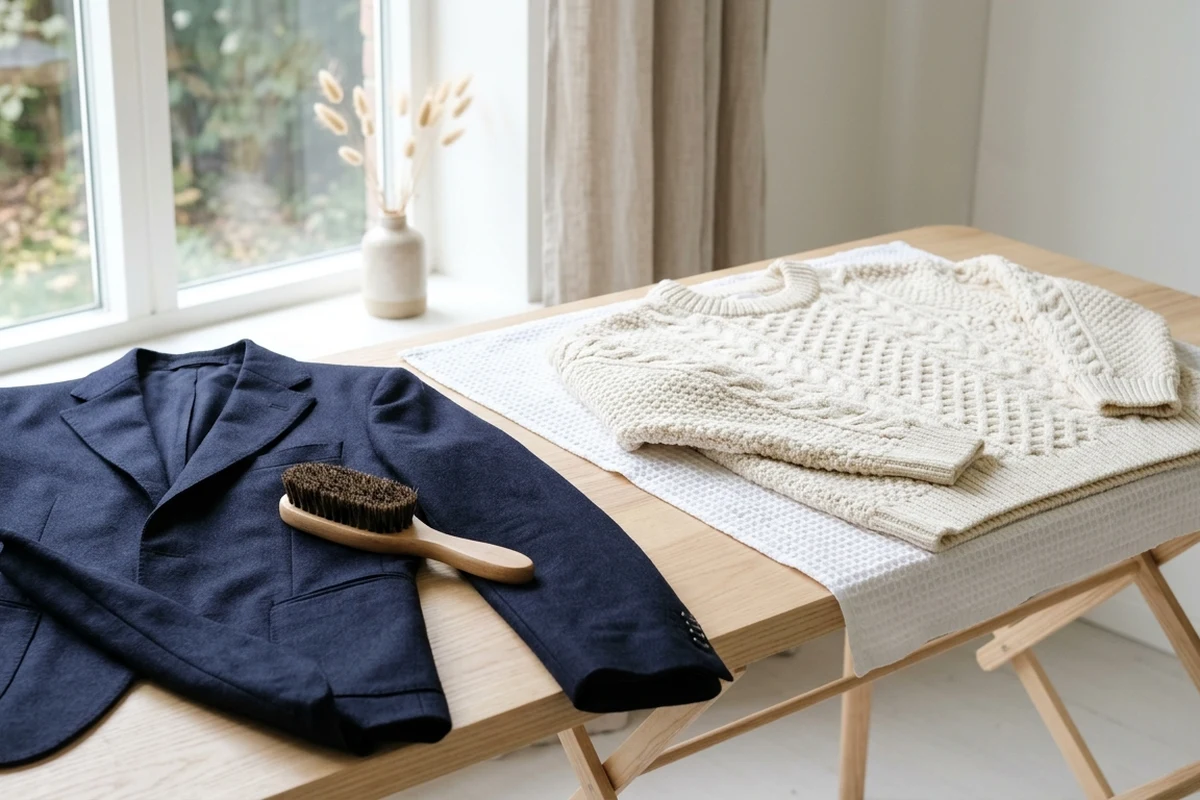
For suits and sport coats worn once or twice a week, dry cleaning twice a year should be sufficient, as sending a jacket in more often than that will shorten its life and ruin its look because most dry cleaners use harsh chemicals and give hard pressings; for everyday care, brush the dirt out with a soft-bristled garment brush.
Similarly, wool and linen trousers go to the dry cleaner three or four times a year with daily garment brushing, whereas casual cotton chinos can be machine washed and most knit sweaters are better served by an at-home hand wash.
Local Melbourne Alterations (Second Stitch Coburg) & Street-Casual Capsule Wardrobe Checklist
When an existing blazer sleeve obscures hoodie cuffs or wide-leg trousers drag behind low-profile sneakers, targeted alterations preserve capsule compatibility without buying replacement garments. At Second Stitch in Coburg, Melbourne, published alteration and repair starting guide prices are $30 to take up pants and jeans hems, $50 for trouser waistband adjustments, $90 to take up jacket and coat cuffs without buttons ($150 with buttons), $85 to shorten shirt sleeves with cuffs ($30 without cuffs), $40 to take up shirt hems, $30 to adjust a sleeve head, $15 to darn knit holes, and $20 to patch woven holes. Before booking a fitting, review our Melbourne clothing repairs consultation checklist.
Use the verification steps below to audit your current pieces before adding new garments:
- Test Three-Layer Armhole Clearance: Put on your heaviest hoodie or crewneck sweatshirt over a base tee, then slip on your structured blazer or trench coat to confirm the outer armscye does not bind at the bicep or pull the collar back.
- Verify Base Tee Opacity and Collar Recovery: Check that everyday crew-neck tees have sufficient jersey density to hang opaque without clinging, and inspect ribbed collars for coverstitched seams that resist throat puckering.
- Separate Machine-Wash Basics from Brushed Wool Tailoring: Group cotton tees, French terry sweatshirts, and cotton chinos into cold gentle machine wash and hang-dry loads while keeping wool blazers and pleated wool trousers on a garment-brush and seasonal dry-cleaning schedule.
- Match Trouser Hem Break to Daily Footwear: Try each pair of trousers with its paired court shoe or retro runner to confirm the back hem clears the pavement cleanly.
To tailor this capsule wardrobe checklist to your own routine, record four personal parameters before shopping: your daily commute temperature swing between morning transit and afternoon highs, your weekly walking and public-transit exposure time, your primary sneaker or boot heel stack profile, and the chest ease and armhole depth of your existing outer coats.
Sources
- Seamwork — Understanding Ease: Wearing Ease, Design Ease, and Negative Ease in Patternmaking
- Put This On — A Well-Fitted Armhole Is Essential To A Top’s Ease Of Movement and Proper Garment Care
- Portugal Clothing Factory — GSM Meaning in Fabric: Weight Chart for Tees and Hoodies
- Heddels — The Fundamental Ways to Measure Textiles, Heavyweight T-Shirts Garment Dye Review, HAVEN Revel S/S Shirt in Tropical Wool, Iron Heart Cotton/Linen Chambray Shirting, and In Defense of the Frequent Wash
- 3sixteen — Heavyweight Plain T-Shirt White Product Specification
- Lady White Co. — Rugby T-Shirt White Heavyweight Jersey Specification
- Nantong Huayuan Textile Co., Ltd. — Fabric Air Permeability Guide
- Materials (Basel) / National Center for Biotechnology Information — Influence of Washing on Thermal Comfort and Dimensional Shrinkage of Denim Fabrics
- TextileSchool — Cotton Fibre & Fabric Weight Properties Reference
- Australian Bureau of Meteorology — Climate Statistics for Australian Locations: Melbourne (Olympic Park)
- Proper Cloth — How to Evaluate Your Casual Pant Fit
- Second Stitch (Coburg, Melbourne) — Clothing Alterations and Repair Service Menu