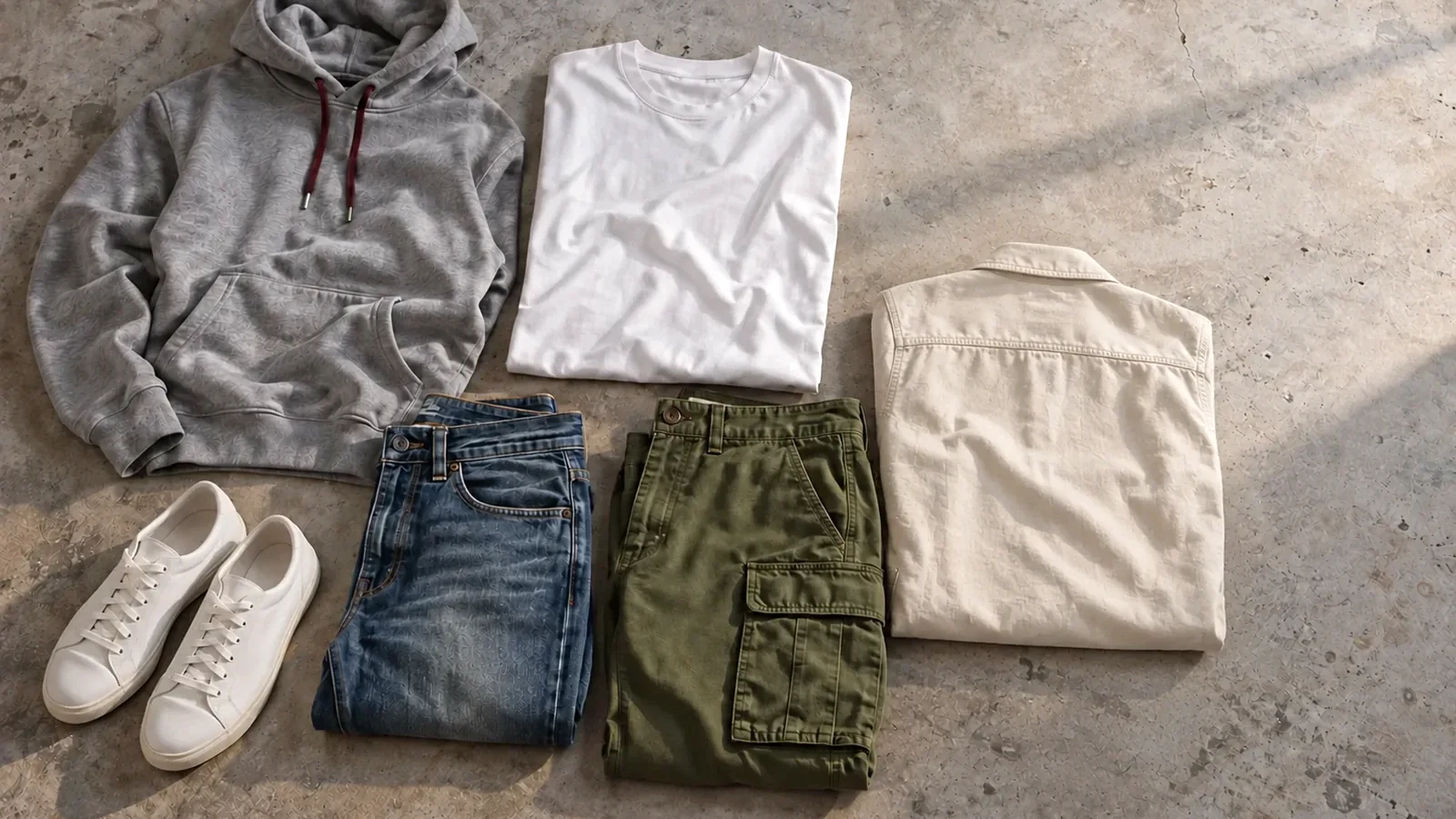
Building streetwear outfits for summer starts with matching fabric weight and weave openness to temperature: in the Hot band at 80°F and above (27°C+), a loose short-sleeve tee or tank in cotton or linen worn with no outer layer or an open short-sleeve shirt and low-top sneakers or slides keeps air moving, while the Warm band at 65–79°F (18–26°C) supports a boxy tee or long-sleeve tee under a light overshirt or open camp-collar shirt.
When selecting street style clothes for men and women, cotton knit T-shirt bands divide into 140-180 GSM (4.1-5.3 oz/yd2) Light summer tees and base layers, 180-220 GSM (5.3-6.5 oz/yd2) Standard opaque tees that drape softly, 220-260 GSM (6.5-7.7 oz/yd2) Premium tees that hold a shoulder line and boxy cut, and 260-320 GSM (7.7-9.4 oz/yd2) Heavyweight boxy statement tees that stand away from the body.
Readers browsing our streetwear and fabric guides and our Melbourne street style guide will see how local summer heat and humidity turn fabric selection into a practical comfort decision.
Summer Heat Index, Sweat Evaporation & Cellulose Moisture Regain
At Melbourne (Olympic Park) station 086338, the mean maximum temperature (°C) across 13 years of data (2013 to 2026) is 26.8 in Jan, 25.9 in Feb, 24.3 in Mar, and 24.7 in Dec.
Across those same 13 years of data (2013 to 2026) at Melbourne (Olympic Park) station 086338, the mean minimum temperature (°C) is 16.5 in Jan, 16.0 in Feb, 14.8 in Mar, and 14.4 in Dec.
When the human body gets too hot, it begins to perspire or sweat to cool itself off by evaporation; when atmospheric relative humidity is high, the rate of evaporation from the body decreases so the human body feels warmer in humid conditions.
At an air temperature of 100 F and a relative humidity of 55%, the National Weather Service heat index reaches 124 F, whereas at an air temperature of 100 F and a relative humidity of 15%, the heat index is 96 F.
Published heat index chart values apply to shady locations, and exposure to direct sunlight can increase the heat index value by up to 15°F.
A cotton fiber dries into a flat, twisted ribbon of about 95% cellulose at maturity and 99% cellulose after scouring and bleaching, with global production reaching 24.5 million tonnes in 2023/24 (about 19% of all fibre produced).
American Upland cotton (G. hirsutum) accounts for about 95% of world production with US Upland fibre lengths normally between 1.0 and 1.25 inches, whereas extra-long staple (ELS) G. barbadense reaches up to 1.6 inches for Pima cotton, and ELS and long-staple cotton together represent around 1% to 2% of total world production (390,000 tonnes in 2024/25).
Observed under a microscope, a cotton fiber is a flat, twisted ribbon with 50 to 100 convolutions per inch (about 20 to 39 twists a centimetre).
Cotton has a commercial moisture regain of 8.5%, and textile labs condition fabric samples at 20 degrees C and 65% relative humidity under ISO 139 before weighing GSM so that a 220 GSM fabric is measured consistently.
Air Permeability, Yarn Twist & Open-Weave Physics
Air permeability is the volume of air that passes through a fabric per unit area, per unit time, under a fixed pressure difference, and is tested separately from moisture-vapour transmission rate (MVTR) and evaporative resistance (Ret), which govern how sweat vapour escapes.
In air permeability test reporting, 1 cm³/s/cm² in ISO 9237 metric units approximately equals 10 L/m²/s, and 1 CFM (ft³/min/ft²) approximately equals 5.08 cm³/s/cm².
ASTM D737, the North American air permeability method, commonly runs at a constant pressure of 125 Pa with results reported in CFM, whereas ISO 9237 commonly runs at 100 Pa with results reported in cm³/s/cm² or L/m²/s, alongside regional equivalents GB/T 5453, DIN 53887, and JIS L1096.
Open knits and mesh for activewear and ventilation panels can run well above 100–150 CFM in air permeability, whereas down-proof shells are frequently specified under ~5 CFM.
| Textile Standard or Experimental Protocol | Test Conditions & Parameters | Airflow, Weight, or Moisture Benchmark |
|---|---|---|
| ASTM D737 & ISO 9237 Standard Methods | 125 Pa in ASTM D737; 100 Pa in ISO 9237 | Reported in CFM or metric cm³/s/cm² and L/m²/s (equivalents GB/T 5453, DIN 53887, JIS L1096) |
| Apparel Category Airflow Targets | Well above 100–150 CFM for open knits and mesh | Under ~5 CFM for down-proof shells |
| Multi-Structured Cotton Woven Trials | 17.2 tex cotton warp and weft (0.263 mm and 0.282 mm diameters) | Tested under ISO 9237:1995(E) across a 20 cm 2 test area at 200 Pa |
| Cotton Thermal Comfort Conditioning | TS 391 EN ISO 9237 and ISO 11092:2014 on Permetest | Measured at 20 ± 2 °C and 65 ± 4% Rh standard atmosphere |
Effective porosity governing airflow through a fabric consists of three components: intrafiber porosity within the fiber walls, interfiber porosity between fibers in the yarn, and inter-yarn porosity created by the interstices between the yarns.
In multi-structured cotton woven fabric experiments using 17.2 tex cotton warp and weft yarns with diameters of 0.263 mm and 0.282 mm, air permeability testing was conducted in compliance with ISO 9237:1995(E) across a 20 cm 2 test area under a pressure difference of 200 Pa.
In cotton denim laundering experiments, specimens underwent five washing cycles under ISO 6330 in a Type A washing machine with 100 g of standard 3-ECE reference detergent and a 2 kg load at 30 °C for 40 min per cycle, with fabric weight measured under TS EN 12127 and dimensional shrinkage under TS EN ISO 5077.
In thermal comfort evaluation of cotton fabrics, air permeability was measured under TS 391 EN ISO 9237 and relative water vapor permeability (RWVP) was determined using a Permetest instrument in accordance with ISO 11092:2014 under standard atmospheric conditions of 20 ± 2 °C and 65 ± 4% Rh.
Tighter yarn structure produces smaller airflow penetration within the yarn but greater penetration between the yarns, and yarn twist, count, and spinning method—whether Ring spinning, Open end, Air textured, or condenser spinning—directly impact fabric air permeability.
Under constant temperature, fabric air permeability decreases with increasing relative humidity due to hygroscopic expansion of the fibres, which reduces internal fabric voids while moisture blocks the passage.
Fabric porosity (or void volume fraction) is expressed as a coefficient ranging between 0 and 1 or a percentage between 0% and 100%, defined as the ratio of total void space volume to total bulk body volume.
Our breakdown of ripstop nylon fabric weight and weave explores how synthetic filament grid weaves differ from porous natural-fiber shirting when wind protection takes priority over convective airflow.
T-Shirt GSM Bands for Summer Streetwear
Mills measure GSM using a round GSM cutter that punches out a 100 cm2 disc of fabric and multiplies by 100; at the sample verification stage, a 10 cm x 10 cm square weighed on a scale accurate to 0.1 grams is multiplied by 100, or a 20 cm x 20 cm square is multiplied by 25.
Fabric weight in GSM (grams per square metre) is determined under EN 12127 for knits and wovens, ISO 3801 for woven fabrics, and ASTM D3776 in the United States, while dividing GSM by 33.9 converts to ounces per square yard (220 GSM = 6.5 oz, 380 GSM = 11.2 oz, 500 GSM = 14.7 oz).
Above T-shirt weights, fleece and hoodie knit bands span 320-400 GSM (9.4-11.8 oz/yd2) Light fleece for spring hoodies, sweatshirts, and light joggers, 400-500 GSM (11.8-14.7 oz/yd2) Mid fleece for winter hoodies, 500-700 GSM (14.7-20.6 oz/yd2) Heavyweight streetwear loopback hoodies, and 700-800 GSM (20.6-23.6 oz/yd2) Heirloom hoodies.
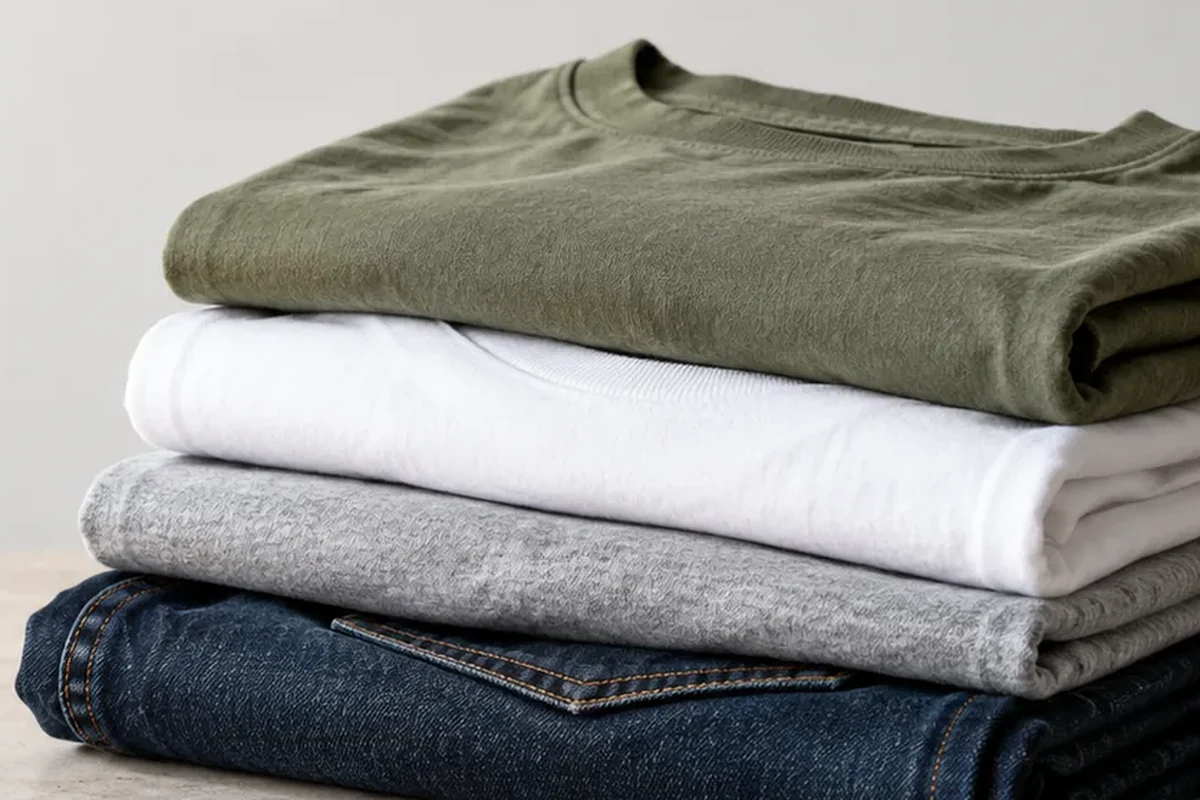
At the same 320 GSM weight, a 320 GSM French terry reads lighter than a 320 GSM brushed fleece because the brushed nap traps air that the French terry does not.
According to Textile Exchange (2024) drape-coefficient testing, cotton jersey below 180 GSM shows a drape coefficient under 0.35 (very fluid), while cotton jersey above 260 GSM exceeds 0.55 (structured).
Our women’s streetwear silhouette guide examines how jersey drape and fabric structure interact with cropped boxy tops and wide-leg trousers.
| Knit or Woven Weight Classification | Metric & Imperial Weight Tiers | Garment Application & Drape Behaviour |
|---|---|---|
| BLUORNG Streetwear GSM Tiers | 100-150 GSM ultra-light; 150-200 GSM light; 200-300 GSM midweight | 300-400 GSM heavyweight hoodies and joggers; 400+ GSM premium hoodies and jackets |
| SANVT Seasonal Garment Benchmarks | 120-160 g/m2 Summer Tee; 160-190g/m2 Regular Tee; 200-300 g/m2 Winter Tee | 250-300 g/m2 Classic Chino; 350-450 g/m2 Winter Chino; 300-400 g/m2 Sweatshirt |
| Published Brand Reference Weights | Uniqlo Supima Crew at 180 GSM; Los Angeles Apparel 6.5 oz tee at 220 GSM (6.5 x 33.9) | Reigning Champ midweight terry at 380 GSM; Champion Reverse Weave at roughly 340 GSM |
| SANVT Chino & T-Shirt Comparison | Lightweight T-Shirt at 160 g/m2 vs Heavyweight T-Shirt at 235 g/m2 | Smart Chino at 290 g/m2 vs Heavyweight Chino at 420 g/m2 |
Common manufacturing GSM tolerance ranges are ±10 GSM for jersey and interlock, ±15 GSM for French terry, ±20 GSM for fleece and brushed-back fabrics, and ±5% of stated GSM for wovens.
Zuni Sportswear notes that the best fabric weight for summer streetwear is generally 170 to 200 GSM made from high-quality combed ringspun cotton, and that most oversized tees begin losing their signature shape below 150 to 160 GSM as the fabric drapes closer to the body.
Across men’s cotton T-shirt tiers, lower GSM options around 160–180 GSM feel breathable and soft for warm climates, 180–190 GSM balances daily comfort especially in Indian weather, 220 GSM offers noticeable thickness, and 240 GSM often provides a structured heavyweight option that sits away from the body in oversized streetwear.
The Heavyweight T-Shirt White (2 Pack, $98) features a 260 gsm combed cotton jersey custom knit in Canada and cut and sewn in San Francisco, CA with a triple needle coverstitched Never Sag collar and mill-laundered jersey for minimal shrinkage.
3sixteen’s garment-dyed 3S Pocket T-shirts ($48, in olive, purple, and charcoal) use a 225 gsm jersey custom-knit in Canada with a triple needle coverstitched collar, garment-dyed in Los Angeles for zero shrinkage and a softer hand.
At the top of the heavyweight spectrum, the Rugby T-shirt is a boxy, heavyweight t-shirt with a set-in high collar knit, cut, and sewn in Los Angeles, CA from 100% US cotton in a tightly knit ten-ounce jersey with a rigid drape and firm hand.
Postwash Density & Construction Benchmarks Across Crew-Neck T-Shirts
When comparing street style outfits for men, postwash fabric linear density (measured in grams per linear inch) and postwash total garment weight show how different crew-neck tees behave after laundering.
| T-Shirt Model | Postwash Density & Total Weight | Construction & Origin | Shrinkage, Weight Loss & Price |
|---|---|---|---|
| Lady White Co. Tee | 1.81g/LI (Heavy); 186g total weight | 100% cotton; Tubeknit construction | 2.8% shrinkage; 4.1% weight loss; $49 per shirt ($112 at Lost & Found) |
| Uniqlo Supima Tee | 1.41g/LI (Midweight); 154g total weight | 100% cotton made in Vietnam; Overlock side seams | 2.23% shrinkage; 4.35% weight loss; $9.90 per shirt ($20 pack) |
| Kirkland Signature Tee | 2.03g/LI (Heavy); 224g total weight | 100% combed ringspun cotton made in Vietnam; Tubeknit | 5.35% shrinkage; 3.45% weight loss; $4.17 per shirt ($38.24 at Amazon) |
| Dehen Heavy Duty Tee | 1.97g/LI (Heavy); 221g total weight | 100% cotton made in USA; Overlock side seams | 2.39% shrinkage; 4.33% weight loss; $45 per shirt ($58 retail) |
| Left Field Tee | 1.67g/LI (Heavy); 182g total weight | 100% cotton made in USA; Tubeknit | 4.79% shrinkage; 1.62% weight loss; $37.50 per shirt |
| American Apparel Fine Jersey Tee | 1.44g/LI (Midweight); 152g total weight | 100% cotton; Tubeknit construction | 7.25% shrinkage; 1.3% weight loss; $18 per shirt |
| Hanes Comfortsoft Tee | 1.56g/LI (Midweight); 166g total weight | 100% cotton made in Haiti; Tubeknit | 6.58% shrinkage; 4.05% weight loss; $3.66 per shirt |
| Knickerbocker Mfg. Co. Tee | 1.40g/LI; 105g total weight | 100% cotton made in USA; Tubeknit blind stitch | 2.33% shrinkage; 3.92% weight loss; $40 per shirt |
In postwash testing, the Lady White Co. 100% cotton tubeknit tee measured a postwash fabric density of 1.81g/LI (Heavy), a postwash total weight of 186g, shrinkage of 2.8%, weight loss of 4.1%, and a price of $49 per shirt ($112 at Lost & Found).
The Kirkland Signature 100% combed ringspun cotton tubeknit tee (made in Vietnam) recorded a postwash fabric density of 2.03g/LI (Heavy), a postwash total weight of 224g, shrinkage of 5.35%, weight loss of 3.45%, and a price of $4.17 per shirt ($38.24 at Amazon).
Among USA-made side-seamed options, the Dehen Heavy Duty 100% cotton tee with overlock side seams measured a postwash fabric density of 1.97g/LI (Heavy), a postwash total weight of 221g, shrinkage of 2.39%, weight loss of 4.33%, and a price of $45 per shirt ($58 retail).
The Left Field 100% cotton tubeknit tee (made in USA) measured a postwash fabric density of 1.67g/LI (Heavy), a postwash total weight of 182g, shrinkage of 4.79%, weight loss of 1.62%, and a price of $37.50 per shirt.
For lighter summer base layers, the Uniqlo Supima 100% cotton tee (made in Vietnam with overlock side seams) measured a postwash fabric density of 1.41g/LI (Midweight), a postwash total weight of 154g, shrinkage of 2.23%, weight loss of 4.35%, and a price of $9.90 per shirt ($20 pack).
The Hanes Comfortsoft 100% cotton tubeknit tee (made in Haiti) measured a postwash fabric density of 1.56g/LI (Midweight), a postwash total weight of 166g, shrinkage of 6.58%, weight loss of 4.05%, and a price of $3.66 per shirt.
The American Apparel Fine Jersey 100% cotton tubeknit tee measured a postwash fabric density of 1.44g/LI (Midweight), a postwash total weight of 152g, shrinkage of 7.25%, weight loss of 1.3%, and a price of $18 per shirt, where unshrunk collar ribbing stitched to a shrinking body left intense puckering around the throat.
As the lightest tested option, the Knickerbocker Mfg. Co. 100% cotton tubeknit blind stitch tee (made in USA) measured a postwash fabric density of 1.40g/LI, a postwash total weight of 105g, shrinkage of 2.33%, weight loss of 3.92%, and a price of $40 per shirt.
For deeper guidance on balancing tee length and sleeve drop under an open shirt, see our guide to men’s streetwear layering proportions.
Open-Weave Overshirts & Summer Shirting: Linen, Chambray, Seersucker, Gauze & Tropical Wool
Linen is made from the fibers of the flax plant, and because natural flaxen fibers are hollow, 100% linen provides superior airflow over the body and dries quickly, though it is also blended with cotton to create more affordable garments.
Originating in 14th century France, chambray is a plain weave cotton fabric woven with a colored indigo or blue yarn in the warp and a white or natural yarn in the weft, creating a lightweight summer alternative to heavy denim such as ONI Denim 022-SVCH 8.5oz Selvage Chambray Relax Straight Jeans ($237).
Seersucker is a thin, puckered cotton summer fabric woven so that threads bunch together into a crinkled surface that stops the fabric from clinging to the body and encourages heat distribution and air circulation, whereas blending polyester into seersucker reduces its breathability.
Gauze provides high summer breathability through a loose weave in which weft yarns are arranged in pairs and crossed before and after each warp yarn to hold the weft firmly in place, even when doubled into lightweight double cotton gauze.
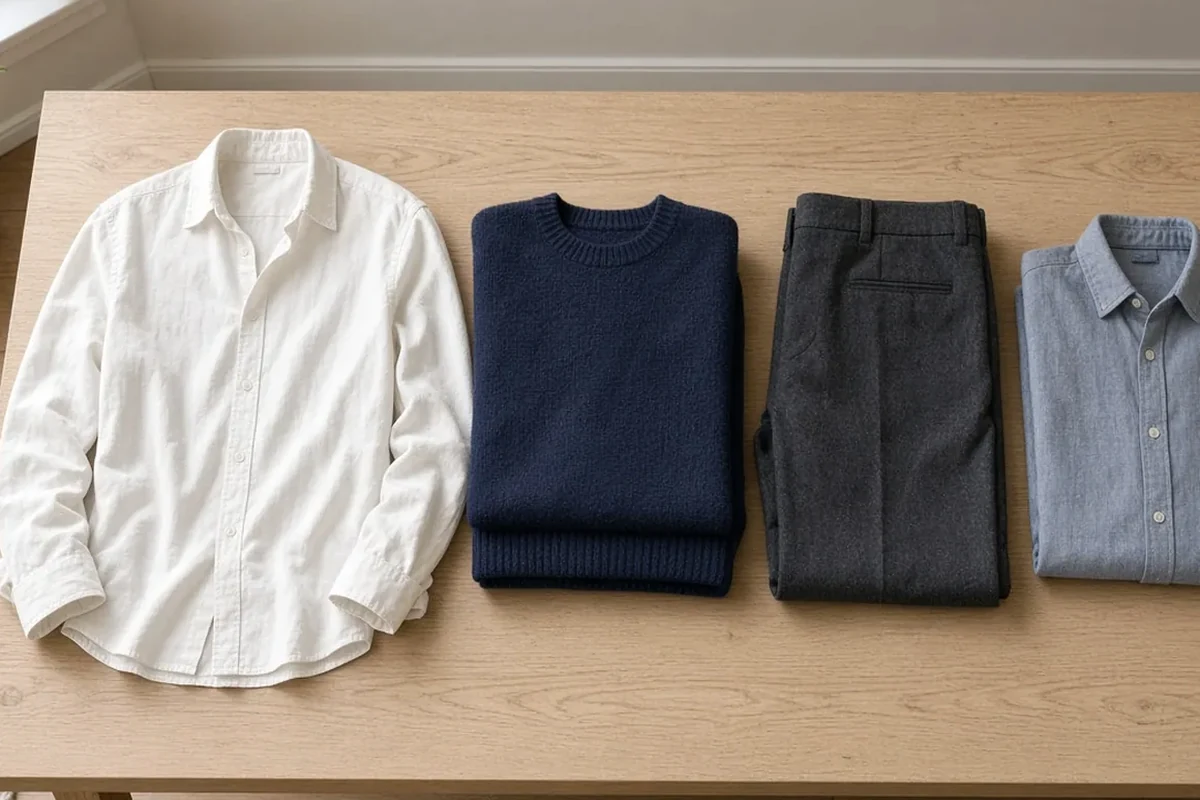
3sixteen’s spring/summer Utility Shirt ($265, made in Portugal) is constructed from a double-layered check gauze in a blend of 60% cotton and 40% linen that is garment-rinsed and finished with corozo nut fisheye buttons.
HAVEN’s Revel S/S summer camp-collar shirt ($280, made in Canada) uses two-way stretch Japanese tropical wool—a breathable, moisture-wicking hot-climate fabric that wrinkles less than linen—cut in a wide, relaxed fit with underarm gussets.
Iron Heart’s summer Western shirt ($375) and Work shirt ($350), made in Japan, use a 7 oz. plain weave Cotton Linen Chambray blending 65% indigo-dyed cotton warp and 35% light grey linen weft.
When lightweight synthetic shells or windshirts enter a summer rotation, Cotton Incorporated’s Textile Yarns technical bulletin defines denier as the number of grams in 9,000 metres of yarn (Denier (D) = 9,000 × yarn mass (g) ÷ yarn length (m)), while GSM = fabric mass (g) ÷ fabric area (m²).
Named supplier specifications compare Flagship 7020-T1 (30D × 30D, 36 g/m² parachute fabric), Ottertex Nylon Ripstop DWR (70D, 70 GSM for jackets, windbreakers and tracksuits), Paskal 70 Denier Ripstop Nylon (70D, 80 gsm PU-coated and FR-treated), and Flagship NR210CP (210D × 210D, 185 g/m² coloured PU-coated raincoat fabric, with a ±3% fabric-weight tolerance).
Temperature-Band Outfit Formulas for Street Style Clothes for Men and Women
Adapting our broader streetwear outfit ideas for summer requires stripping away closed mid-layers as ambient temperatures climb from the Warm band into the Hot band.
| Temperature Band | Ambient Range | Base Layer Specification | Outer Layer & Footwear Pairing |
|---|---|---|---|
| Hot Band | 80°F and above (27°C+) | Loose short-sleeve tee or tank in cotton or linen | None, or an open short-sleeve shirt with low-top sneakers or slides |
| Warm Band | 65–79°F (18–26°C) | Boxy tee or long-sleeve tee | Light overshirt or open camp-collar shirt with low-top sneakers |
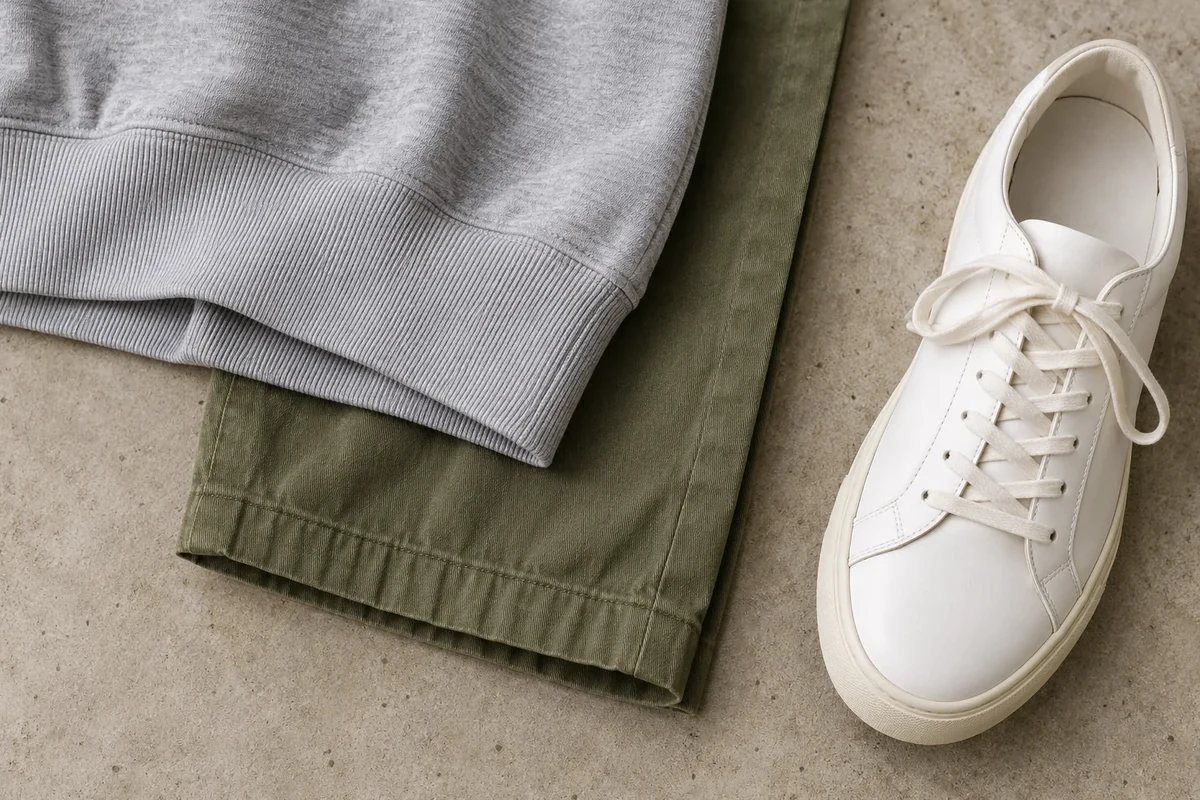
When pairing wide-leg summer trousers with low-top sneakers, low-profile court shoes like the Adidas Samba OG have a 19.3 mm heel stack requiring a 19 to 22 cm straight hem with a Quarter Break, whereas high-stack retro runners like the ASICS Gel-Kayano 14 (32.7 mm heel) and New Balance 9060 (37.3 mm heel) support 23 to 27 cm wide-leg hems in a Half Break 10 mm off the pavement.
Summer Streetwear Fabric & Fit Selection Checklist
Before stepping out into direct sun or afternoon humidity, run through these garment checks to keep your summer rotation sharp and breathable:
- Verify T-Shirt GSM Against Your Layering Plan: Choose a lighter combed cotton tee when wearing an overshirt, or step up to a structured midweight-to-heavyweight jersey when wearing the tee solo so the torso does not cling.
- Inspect Collar Ribbing and Construction: Look for a bound or coverstitched collar rib that lies flat at the neckline without differential shrinkage puckering after repeated summer washes.
- Hold Woven Shirting Up to Light for Open Porosity: Favor loose gauze, seersucker, linen, chambray, or tropical wool weaves with visible inter-yarn spacing over tightly beaten plain weaves.
- Drop Brushed Fleece and Coated Shells in Daytime Heat: Leave heavy brushed-back hoodies and polyurethane-coated nylon shells out of daytime summer rotations so sweat can evaporate freely.
- Match Trouser Hem Width to Sneaker Stack Height: Pair wider breathable chinos or utility trousers with higher-stack runners, or taper the hem opening when wearing flat court sneakers.
Sources
- Australian Bureau of Meteorology — Climate Statistics for Australian Locations: Melbourne (Olympic Park)
- National Weather Service (NOAA) — Heat Forecast Tools and Apparent Temperature Chart
- Nantong Huayuan Textile Co., Ltd. — Fabric Air Permeability Guide
- National Center for Biotechnology Information (PMC / Textile Research) — Air Permeability, Water Vapor Permeability, and Porosity of Woven Cotton Fabrics
- TextileSchool — Cotton Fibre & Fabric Weight Properties Reference
- Portugal Clothing Factory — GSM Meaning in Fabric: Weight Chart for Tees and Hoodies
- SANVT — What Does GSM Mean in Clothing? Fabric Weight Benchmarks for T-Shirts, Chinos, and Sweatshirts
- Zuni Sportswear, The Litt & BLUORNG — Streetwear T-Shirt GSM Weight Ranges and Climate Selection Guides
- Heddels — Great White T-Shirt Review and Open-Weave Summer Shirting Guide: Linen, Chambray, Seersucker, Gauze, and Tropical Wool
- Lady White Co. — Rugby T-Shirt Heavyweight Cotton Jersey Specification
- Cotton Incorporated — Textile Yarns Technical Bulletin: Denier and Linear Density Definitions