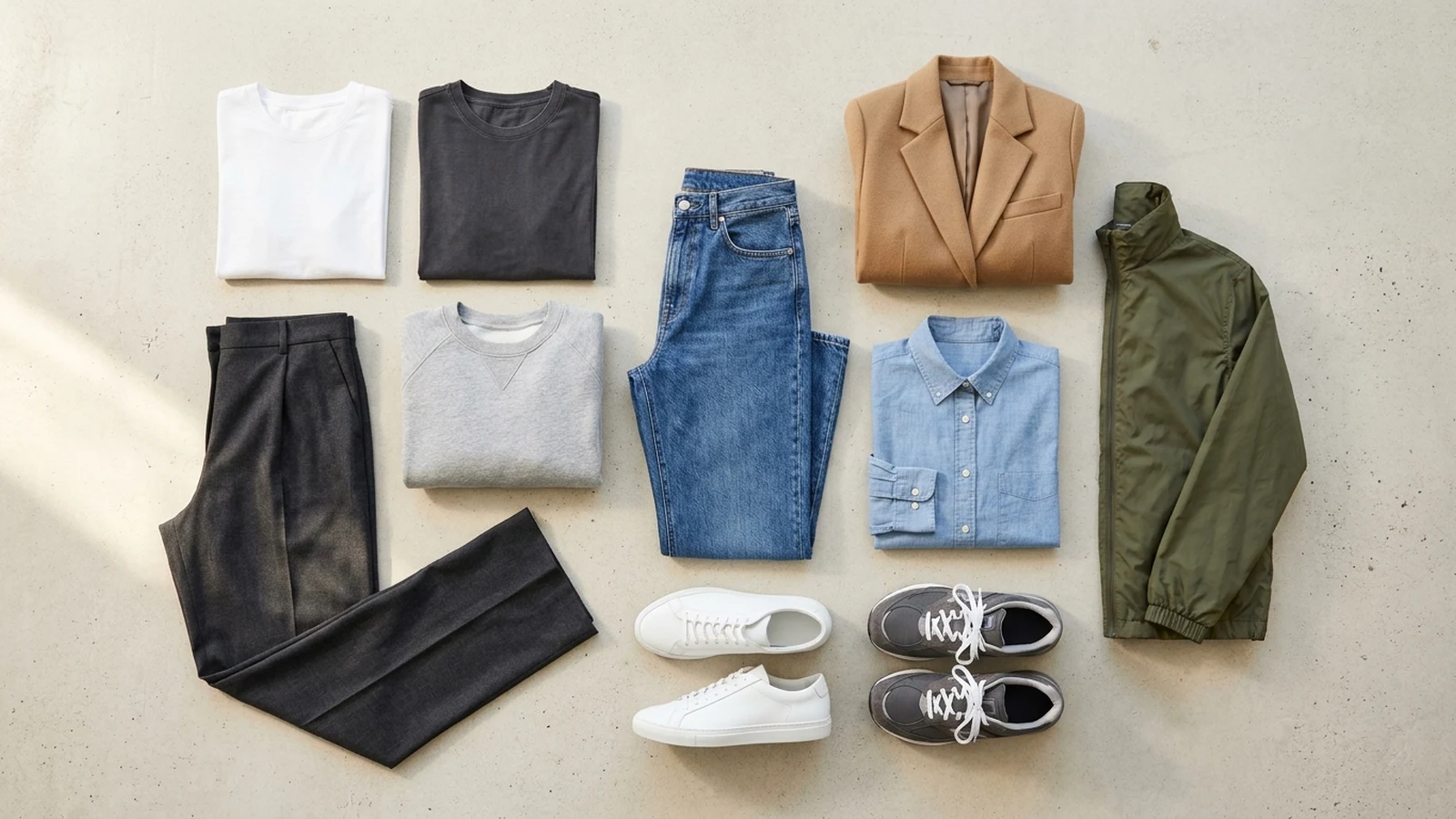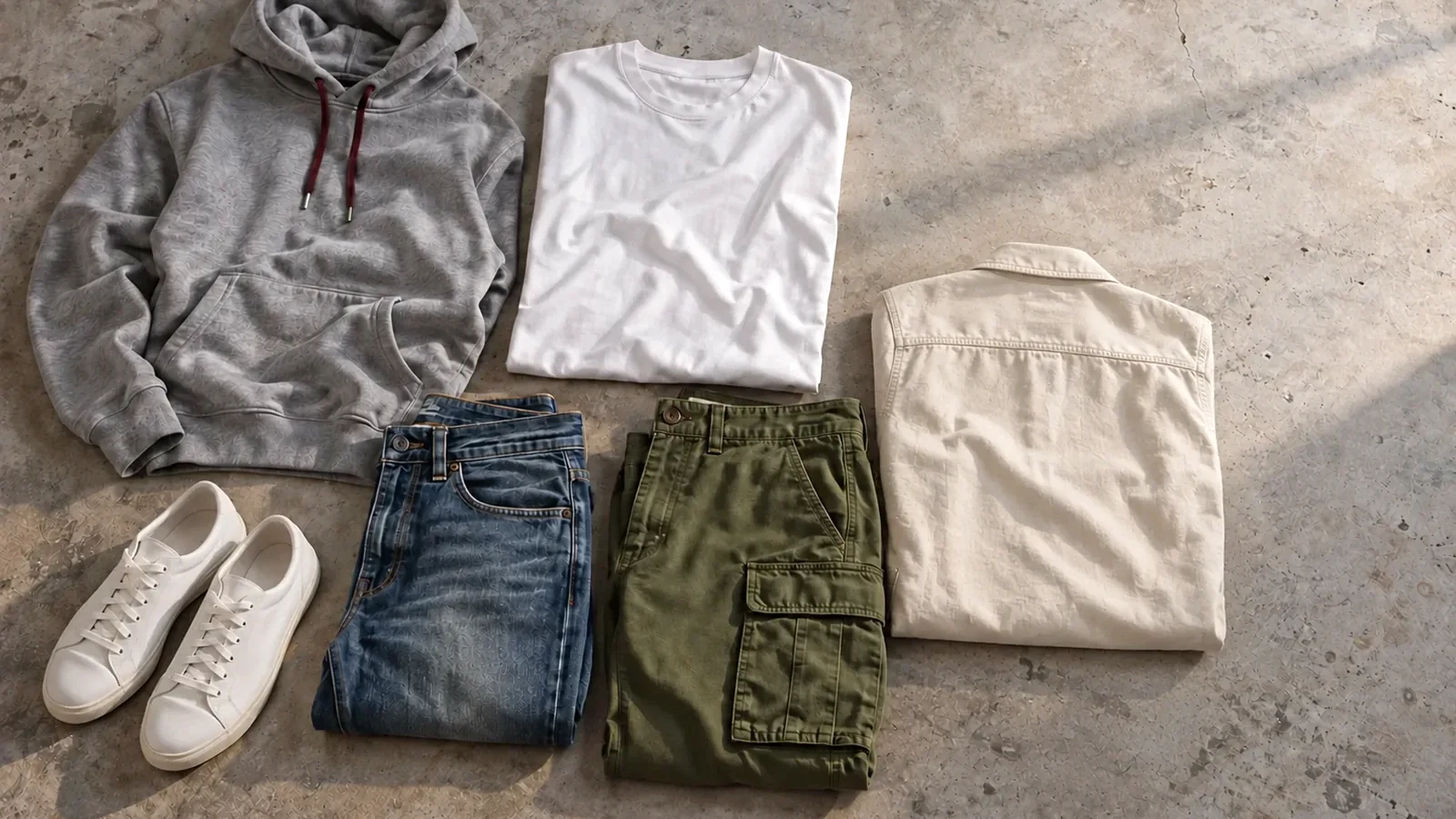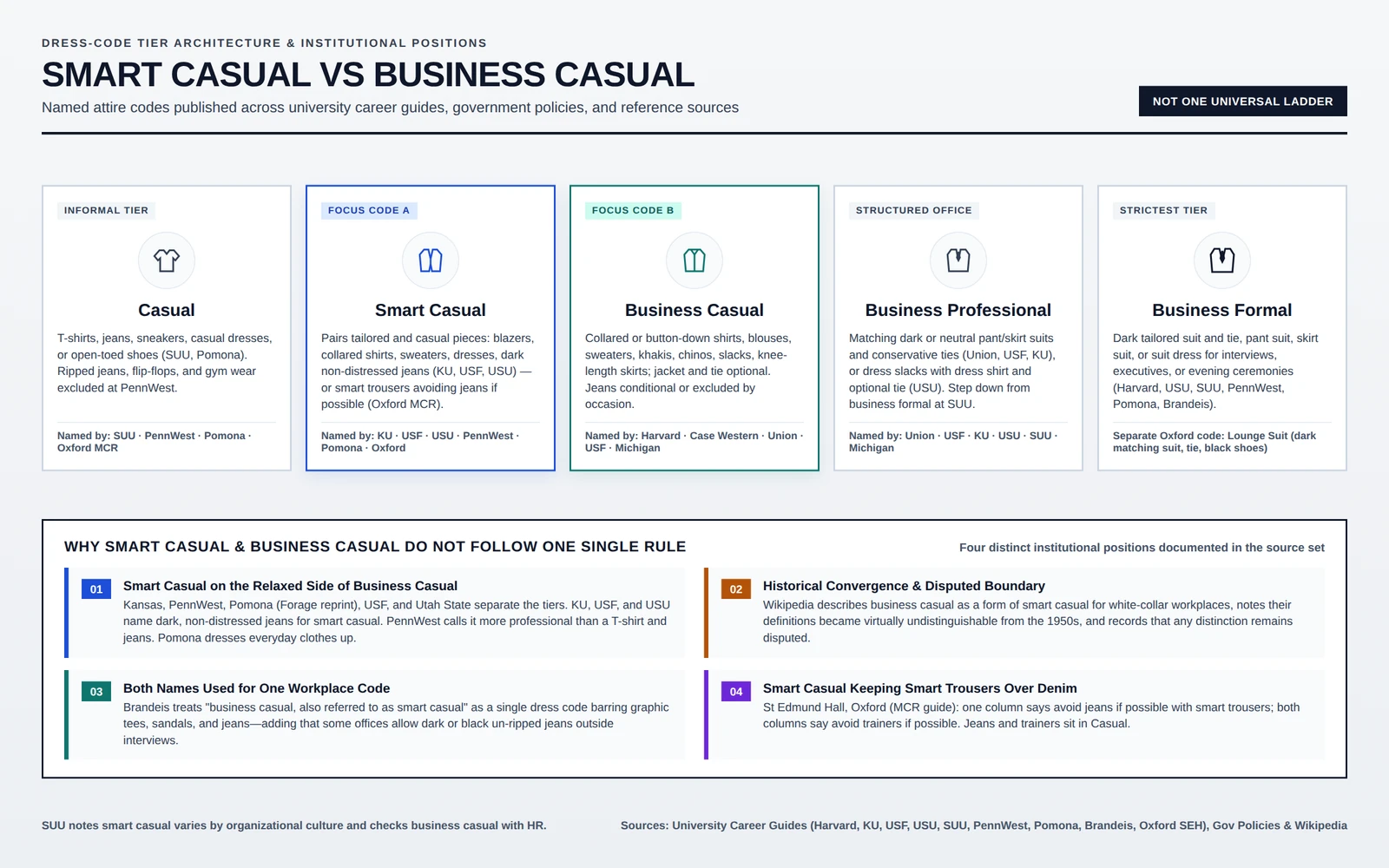
Smart casual and business casual do not follow one universal boundary across workplaces or universities: the University of Kansas, Pennsylvania Western University, Pomona College, the University of San Francisco, and Utah State University separate the two codes, with Kansas, the University of San Francisco, and Utah State admitting dark, non-distressed jeans on the smart-casual side, while Brandeis uses both names for one code, Wikipedia notes that the definitions became virtually undistinguishable, and the St Edmund Hall MCR guide says to avoid jeans if possible.
Short answer: when an institution defines both tiers separately—such as the University of Kansas, Pennsylvania Western University, Pomona College, the University of San Francisco, and Utah State University—business casual centers on collared or button-down shirts, blouses, sweaters, slacks, khakis, or knee-length skirts, whereas smart casual pairs tailored pieces with relaxed garments, and dark, unripped jeans are named by Kansas, the University of San Francisco, and Utah State, with San Francisco also listing clean plain T-shirts. That order is not universal: Brandeis treats business casual and smart casual as one dress code, Wikipedia reports that their definitions became virtually undistinguishable from the 1950s, and the St Edmund Hall MCR guide at Oxford says to avoid jeans if possible in the collared-shirt and smart-trousers column and to avoid trainers if possible in both smart-casual columns.
Readers browsing our outfit ideas category or the full wardrobe and style guide index can use the institutional comparisons below to match collar structure, trousers, and footwear to a stated invitation or office rule without guessing.
| Institutional Position | Published Guides Holding That Position | Key Garment Boundary Between the Codes |
|---|---|---|
| Smart casual is more relaxed than business casual | University of Kansas, PennWest, Pomona College, USF, Utah State | Business casual focuses on collared shirts, blouses, khakis, and slacks; smart casual admits dark, non-distressed jeans (KU, USF, USU) or clean plain T-shirts (USF). |
| Definitions converged and distinction is disputed | Wikipedia on business casual and Wikipedia on smart casual | Calls business casual a form of smart casual for business, states there is no generally agreed definition of business casual, and notes the two definitions became virtually undistinguishable from the 1950s. |
| One workplace code under two names | Brandeis International Business School | Uses business casual, also referred to as smart casual, for one code that excludes graphic t-shirts, sandals, and jeans, with a footnote that some offices accept dark or black un-ripped jeans outside interviews. |
| Smart casual keeps smart trousers and avoids denim | St Edmund Hall, Oxford MCR guide | One column asks for a collared shirt and smart trousers and says to avoid jeans if possible; the other allows a smart top or blouse with smart trousers or a skirt; both say to avoid trainers if possible, and jeans and trainers belong to its casual tier. |
| Smart casual left to workplace culture | Southern Utah University | Divides work clothes into business formal, business professional, business casual, and casual, notes smart casual varies by organizational culture without giving it a separate garment list, and advises checking with HR. |
What Is the Difference Between Smart Casual and Business Casual?
Published dress-code guides split into four distinct positions rather than one shared ladder, so the difference depends on which institution wrote the rule.
Among American university career centers that separate the two tiers, the University of Kansas School of Business describes three levels—business professional, business casual, and smart casual—calling smart casual the most relaxed of the three levels and explaining that business casual combines elements of business professional and smart casual into a tailored look. Kansas says smart casual combines professional clothing with more casual pieces by pairing formal and casual items, and it lists dark and non-distressed jeans as a smart-casual item.
At Pennsylvania Western University, the career center calls smart casual a form of casual business attire with a more elevated or stylish twist, describing the style as more professional than a t-shirt and jeans, but not as traditional as business casual. PennWest’s smart-casual examples include blazers, sports jackets, ties, button-down and collared shirts, dresses, sweaters, trousers, khakis, skirts, blouses, heels, flats, dress shoes, sandals, and clean sneakers, while its business-casual examples center on pencil skirts, slacks, khakis, trousers, blouses, collared shirts, button-down shirts, sport coats, blazers, and sweaters, with a blazer or suit jacket not required.
On the Pomona College Career Development Office page, which reprints a Forage post titled A Beginner’s Guide to Business Attire, smart casual dresses up an everyday wardrobe—for example by adding a blazer to a t-shirt and jeans or wearing a more refined sweater and nicer accessories—whereas business casual dresses down a formal dress code. Pomona notes that blouses, dress shirts, slacks, dress pants, and blazers are staples in business casual, and that neither jeans nor suits are typical in business casual unless the jeans are dressed up or the suit is dressed down. On that same Pomona page, Amanda Wood is quoted saying smart casual has become the norm, with fewer suits, sneakers fine when wearing a suit, jogger-style office pants, and nice jeans, while Angela Denae Lynch is quoted advising people to avoid ripped jeans or any jeans, hoodies, and graphic t-shirts unless told those are already the office norm.
The University of San Francisco Career Services guide names three main categories—Business Professional, Business Casual, and Smart Casual—notes that there are no absolute rules regarding attire before giving guidelines, and defines smart casual as anything listed under business casual plus jeans without rips or holes (with darker washes generally considered more professional) and clean, plain T-shirts. For business casual, USF specifies that shirts should be collared, either a polo or a button-down. Utah State University’s Huntsman School likewise places dark-wash jeans without distressing at the smart-casual level, describing smart casual as a modern, stylish approach suitable for creative or client-facing roles.
Commercial apparel blogs summarize a related contrast in everyday retail language: My Garment Factory describes smart casual as elevated casual wear featuring well-fitted trousers or jeans, tasteful dresses and skirts, sweaters, cardigans, blazers, and button-down shirts while avoiding jeans and trainers for business casual, and Kute Tailor states that compared to smart casual, business casual focuses on which outfit looks more professional. Those retail summaries do not override institutional rules where denim or collared tops carry specific office, interview, or college restrictions.
Three institutional sources break away from the relaxed-smart-casual hierarchy altogether:
- Oxford collegiate smart casual: In the St Edmund Hall postgraduate freshers guide, created by the MCR, casual attire means you can wear what you like within reason and jeans and trainers are acceptable. One St Edmund Hall smart-casual column asks for a collared shirt, smart trousers (avoid wearing jeans if possible), black or brown shoes (avoid trainers if possible), and a jacket or plain jumper if you like, noting a tie is not necessary. Its other smart-casual column allows a smart top or blouse, an optional jacket or cardigan, smart trousers or a skirt to match the jacket, and tidy shoes or boots (avoid trainers if possible).
- Wikipedia’s historical synthesis: Wikipedia’s Business casual article defines business casual as an ambiguously defined Western dress code that is a form of smart casual wear for business purposes, replacing traditional business wear for white-collar workplaces, and states that there is no generally agreed definition of business casual. Wikipedia’s Smart casual article describes smart casual as casual wear with well-dressed components of a proper lounge suit, states that the definitions of smart casual and business casual became virtually undistinguishable from the 1950s as a more casual suit than a dark suit in heavy cloth, and notes that which clothing pieces count as smart casual—and any distinction from business casual—is disputed.
- Brandeis’s combined code: Brandeis International Business School treats “business casual dress, also referred to as smart casual” as a single work attire that allows personal style while maintaining professionalism, bars graphic t-shirts, sandals, and jeans in the main rule, and adds in a footnote that some offices may consider dark or black un-ripped jeans business casual while suggesting candidates avoid jeans for interviews until they see what coworkers wear.
When a dress code remains unclear on an invitation or job notice, Southern Utah University notes that business casual is one of the most common dress codes in offices today, means different things in different organizations, and advises checking with HR or asking what the dress code is when in doubt.
How Do Smart Casual and Business Casual Differ for Men?
For men, published business-casual lists center on a collared button-down or dress shirt—or a polo where the workplace permits—paired with khakis, chinos, or dress slacks and closed-toe shoes, whereas smart casual either relaxes the trouser and shoe options toward dark undistressed denim and clean sneakers on American campus guides or retains collared shirts and smart trousers on Oxford’s college list and Wikipedia’s suit-derived interpretation.
On Wikipedia’s Business casual page, men’s business casual consists of some components of a business suit—typically a dress shirt and trousers, without a matching suit jacket, and with neckties optional—while a coordinating, non-matching sport coat or blazer may be worn or omitted, or replaced by a sweater or vest. Wikipedia also quotes a Financial Times line stating that ordinary business casual for men is chinos, a blazer, and a good shirt with no tie, alongside University of Toronto Dress for Success advice naming slacks or khakis, polos or collared shirts without a necktie, some sweaters, and closed-toe shoes.
University career guides align closely on those men’s business-casual staples while differing on polos, jackets, and ties:
- Collared shirts and polos: Case Western Reserve University suggests business casual for employer information sessions unless indicated otherwise, describing it for men or women as khakis or nice dress pants and a nice button-down shirt, with no jeans. Southern Utah University lists neat, pressed slacks, chinos, or khakis with collared button-ups in any color for men’s business casual, adding that polo shirts may be acceptable after checking with HR. USF, Utah State, Purdue Global, and Michigan LARA include polo shirts directly alongside collared or dress shirts.
- Optional ties and jackets: Wearing a tie is optional for business casual at Union College, USF, Michigan LARA, and SUU (where conservative patterns are fine and novelty ties are excluded), as well as in Utah State’s business-professional tier. Blazers and sport coats are optional rather than required in business casual at Union College, USF, and PennWest.
- Where men’s smart casual shifts: At Utah State, smart casual pairs chinos or well-fitted dress pants with a button-down shirt, a stylish sweater, and loafers, dress shoes, or sometimes nice sneakers, and makes dark-wash jeans without distressing appropriate at that level. USF adds clean, plain T-shirts and darker-wash unripped jeans under smart casual, noting that one blazer can pair with jeans for smart-casual events or with dress pants for formal interviews. By contrast, St Edmund Hall’s MCR smart-casual column keeps a collared shirt, smart trousers (avoid wearing jeans if possible), and black or brown shoes (avoid trainers if possible), while Wikipedia’s Smart casual page records a traditional menswear interpretation featuring a dress shirt, necktie, trousers, and dress shoes, possibly with an odd-coloured blazer or sports coat.
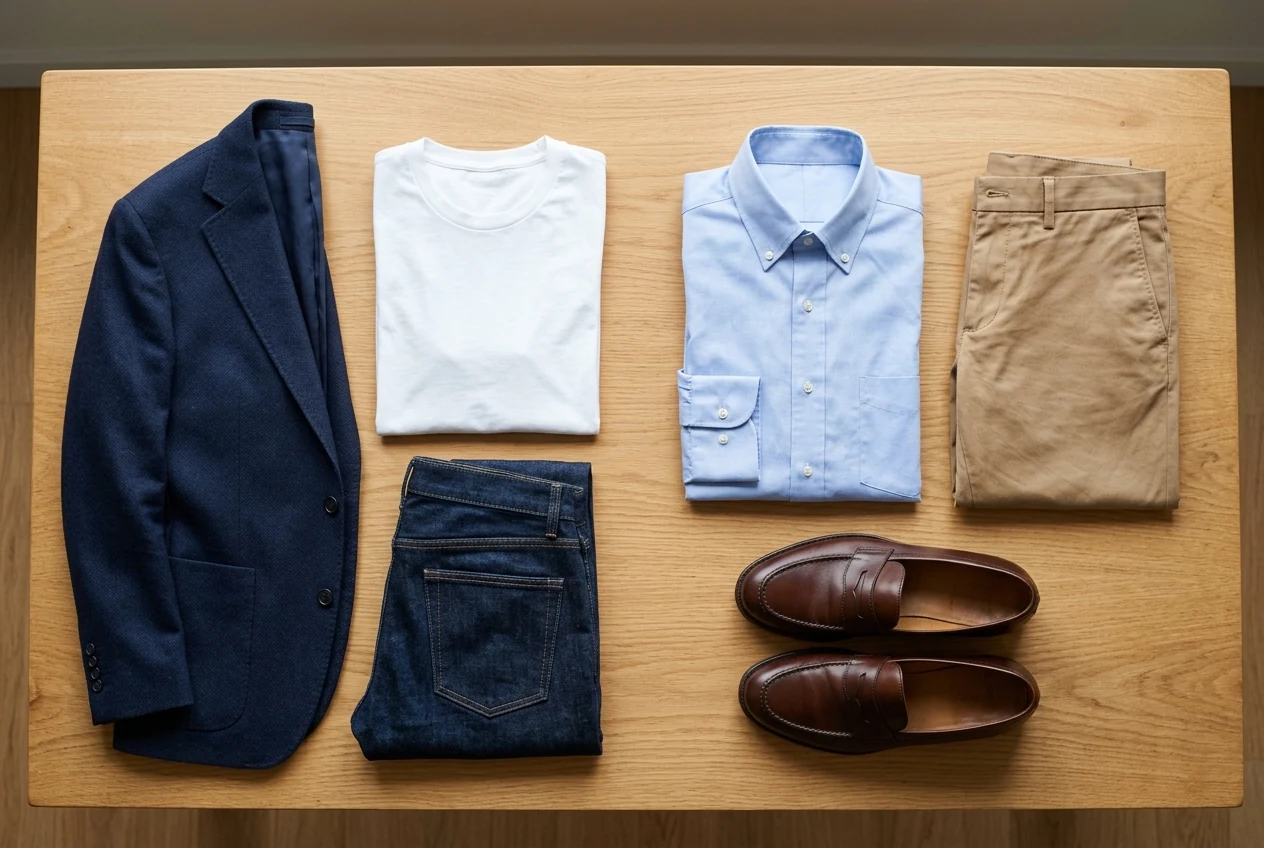
Readers organizing everyday casual separates outside office hours can record owned pairings using our men’s street-casual capsule wardrobe checklist without mixing weekend denim into strict interview rotations.
How Do Smart Casual and Business Casual Differ for Women?
For women, business-casual guides focus on blouses, collared shirts, polished or tailored sweaters, slacks, khakis, knee-length or pencil skirts, and tailored dresses, while smart casual widens the mix on campus guides to dark non-distressed jeans or casual separates paired with blazers—though sundresses remain excluded on multiple lists and Oxford’s MCR guide keeps smart trousers or a skirt.
On Wikipedia’s Business casual page, women can wear the same components as men—dress shirt, trousers, and optional coat—usually in a women’s style such as a blouse instead of a shirt, or replace them with a dress or skirt generally at or just above the knee. University and agency guides specify how hemlines, dresses, and separates shift across tiers:
- Business-casual tops, skirts, and dresses: Harvard FAS, which recommends business casual as the default attire for career fairs and employer networking events, includes button-down or collared shirts, polished sweaters, khakis, dress slacks, and a tailored dress or skirt. Union College—where business casual applies to interview information sessions when instructed by the employer or daily business-casual workplaces—lists khaki or solid-colored pants or slacks, knee-length skirts and dresses, tailored knit sweaters, optional jackets and blazers, and neat closed-toe loafers, flats, or shoes. SUU lists skirts, slacks, or khakis for women’s business-casual bottoms, PennWest includes pencil skirts, trousers, blouses, and sweaters, and Utah State notes that blouses, sweaters, and casual dresses are acceptable business-casual options.
- Sundress and legging exclusions: USF states that dresses or skirt-and-blouse combinations are appropriate for business casual while sundresses are not appropriate, and its dress-pant list of slacks, khakis, and chinos excludes leggings. The University of Kansas repeats that sundress exclusion inside smart casual, listing a dress while advising students to avoid sundresses.
- Women’s smart-casual rules across settings: St Edmund Hall’s MCR guide at Oxford lists a smart top or blouse, an optional jacket or cardigan, smart trousers or a skirt to match the jacket, and tidy shoes or boots while advising to avoid trainers if possible. Wikipedia’s Smart casual page also records a cruise-line dining rule that accepts a dress, casual dresses, or pantsuits for women. By contrast, stricter codes tighten both hemlines and suit matching: Utah State’s business-formal tier places a skirt or dress hem at or below the knee, USF’s business-professional tier puts skirt length to the knee or close to it depending on what works, and SUU’s business-formal tier for women calls for a conservative pant suit, skirt suit, or suit dress in black, gray, or navy with a white collared button-up blouse, shirt, or top.
For fabric density, knitwear drape, and outer-coat armhole clearance across blazers and trousers, see our women’s capsule wardrobe fabric-weight and layering checklist. If you are dressing for a ticketed play, opera, or ballet rather than an office or campus recruiting event, presenter entry rules live in our Melbourne theatre dress guide.
Are Jeans Considered Business Casual Attire?
Jeans have no single business-casual verdict: several university career centers, interview guides, and government sheets exclude denim from business casual outright, others admit dark, unripped jeans only when no external meetings or interviews are scheduled, and multiple career guides place dark, non-distressed jeans in smart casual instead.
Published policies sort denim into five distinct buckets:
- Excluded from the business-casual setting: Case Western Reserve University tells students attending business-casual employer information sessions not to wear jeans, shorts, flip-flops, or casual clothing. Purdue Global advises that it is safest to stay away from jeans for an interview. The Utah National Guard business-casual guidelines (marked as of 13 Mar 2024)—which describe business casual as professional-looking, neat, clean, pressed, and typically more classic than trendy—list jeans, sweatpants, exercise pants, and shorts as what business casual is not. At Purdue University Convocations, which publishes a venue ushering dress code rather than a general office policy, acceptable business-casual attire for ushers covers collared and button-down shirts, black, tan, or grey dress pants, and closed-toed heels or dress shoes, while denim jeans sit under unacceptable attire.
- Not typical in business casual unless dressed up: On Pomona College’s Forage reprint, jeans are not typical in business casual unless dressed up.
- Conditional admission inside business casual: Under the Michigan LARA employee dress code policy (effective 02-25-2020), where business professional and/or business casual clothing is expected, business-casual clothing including jeans may be worn on any day of the week if the employee has no external meetings—alongside acceptable examples such as capris, slacks, khakis, corduroys, conservative-length dresses and skirts, dress shirts or blouses, sweaters, polo shirts, and blazers—provided clothing is neat, clean, wrinkle-free, and not excessively worn, faded, ripped, frayed, or full of holes. Similarly, Brandeis excludes jeans in its main rule while noting that some offices consider dark or black un-ripped jeans business casual, and advises waiting to see what coworkers wear rather than wearing jeans to interviews.
- Assigned to smart casual rather than business casual: USF places jeans without rips or holes (darker washes generally considered more professional) in smart casual; the University of Kansas lists dark and non-distressed jeans under smart casual; Utah State states dark-wash jeans without distressing are most appropriate at the smart-casual level; and SUU places jeans, T-shirts, and open-toed shoes in casual attire rather than its business-casual lists.
- Disputed even inside smart casual: St Edmund Hall’s MCR guide advises avoiding jeans if possible in smart casual and puts jeans in casual. Wikipedia’s Smart casual article records four separate stances that remain distinct: a note that jeans are usually not an option except in a Burnt Hills variation allowing crisp blue jeans with no holes and no heel-trodden places; a cruise-line smart-casual dining rule that accepts blazers, trousers, neckties, or shirts for men while rejecting shorts, jeans, or T-shirts; recruitment consultants quoted via The Guardian who say smart, plain, and straight jeans are acceptable; and a Canadian broadcast explanation stating that jeans are not recommended for smart casual, depending on the workplace.
What Items Are Not Acceptable for Business Casual?
Across university career guides and public-agency policies, ripped or frayed garments, athletic and gym wear, sweatpants, shorts, flip-flops, hoodies, and graphic t-shirts are repeatedly excluded from business casual, while sneakers and open-toed sandals depend on the specific institution’s policy.
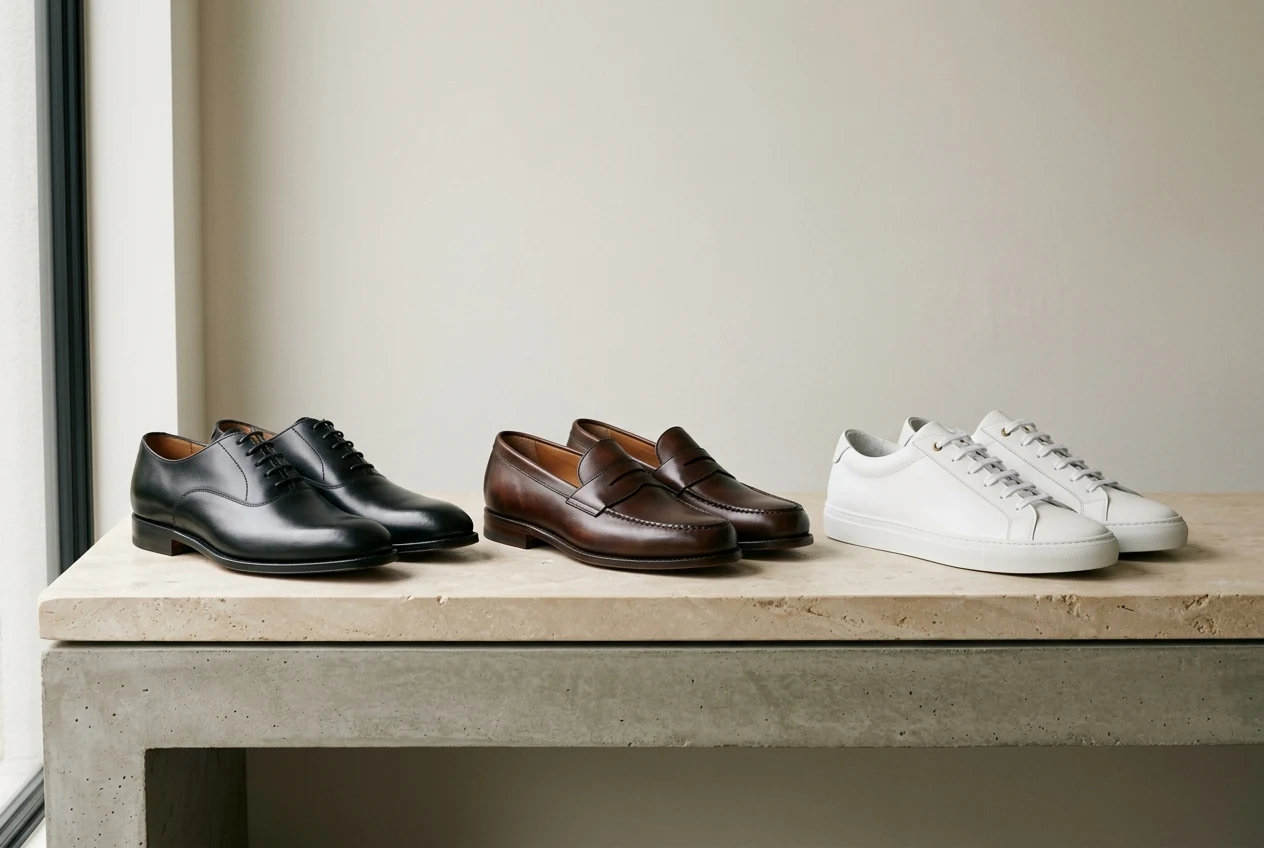
Keep each exclusion tied to the guide that states it, especially on footwear where rules diverge:
- Sneakers—athletic, casual, and fashion rules kept separate: Harvard FAS says to avoid sneakers and informal sandals like flip-flops for its business-casual default. Purdue Global instructs interviewees to wear closed-toe shoes and not athletic shoes or sneakers for a business-casual interview look (a polo, blouse, or button-down paired with a sports jacket or sweater, plus khakis, chinos, relaxed slacks, dresses, or skirts). Purdue University Convocations puts casual sneakers and open-toed shoes (such as flip-flops) under unacceptable attire for venue ushers. At USF, the shared baseline across business professional, business casual, and smart casual says to avoid dirty or wrinkled clothes, scuffed shoes, athletic clothing, sneakers, hiking boots, flip-flops, athletic sandals, and shorts, skirts, or tops that are too short or tight for the office—yet USF’s own business-casual shoe line explicitly allows loafers, flats, wedges, low heels, climate-appropriate sandals that are not flip-flops, or fashion sneakers, and its smart-casual shoe line allows sandals while barring athletic sneakers and flip-flops. Meanwhile, PennWest allows clean lower-profile leather or canvas sneakers alongside flats, Oxfords, loafers, mules, boots, or heels in business casual, and SUU says dressy sneakers or boots may be acceptable for men’s business casual only after checking with HR or a supervisor.
- Flip-flops versus dress or open-toed sandals: Flip-flops are excluded at Harvard FAS, Case Western, USF, Purdue Global, Purdue Convocations ushering, PennWest (even in casual attire), and Michigan LARA. Open-toed sandals vary by venue and employer: Michigan LARA lists slippers or flip-flops as unacceptable while explicitly allowing open-toed sandals and dress sandals alongside loafers, boots, flats, heels, and leather shoes, whereas Brandeis bars sandals, Purdue Global bars sandals at summer interviews, and Purdue Convocations bars open-toed shoes for venue ushers.
- Sweatshirts, hoodies, graphic tees, and activewear: SUU allows men to wear sports jackets and sweaters—not sweatshirts—over a collared shirt. Wikipedia records a definition of business casual that includes khaki pants, slacks, skirts, short-sleeved polos, and long-sleeved shirts while excluding tight or short skirts, T-shirts, and sweatshirts. Brandeis excludes graphic t-shirts, and Angela Denae Lynch on the Pomona page advises avoiding ripped jeans or any jeans, hoodies, and graphic t-shirts unless those are already the office norm. Michigan LARA lists sweatpants, sweatshirts or hoodies, exercise clothing, wind or track suits, shorts, yoga pants, casual t-shirts, and logoed athletic wear as unacceptable. Even in smart casual, USF excludes athleisure, spaghetti straps or camisoles, and tops that reveal too much bare skin, while PennWest notes that even casual work attire excludes ripped jeans, flip-flops, and athletic or gym clothes, and Pomona’s casual business description bars profane graphics, ripped jeans, and athleisure despite allowing t-shirts, jeans, sneakers, and casual dresses.
- Shorts, tank tops, leggings, and sundresses: Shorts are excluded at Case Western information sessions, USF interviews, Michigan LARA, the Utah National Guard sheet, and Purdue Global summer interviews (which also exclude flip-flops, tank tops, sandals, and anything revealing). USF excludes leggings from dress pants and sundresses from business casual.
How Do Both Codes Compare With Business Formal?
On the university and career pages that use the term, business formal sits at the strict top of the professional dress scale—requiring dark tailored suits, conservative pant suits, skirt suits, or formal dresses with little variation—above business professional (where listed separately), business casual, and smart casual.
Each institution defines when business formal applies and what separates it from everyday office codes:
- Interviews and industry expectations: Harvard FAS recommends business formal—a suit or a dress or set with a jacket—for interviews unless the employer instructs otherwise, contrasting tech startups where many employees wear t-shirts with corporate finance where business-formal expectations and colleagues in suits are common. Guides that use the name business professional instead of business formal for standard interviews draw a similar suit requirement: Union College says business professional is normally required for interviews and conservative industries, calling for solid dark or neutral pant suits or knee-length skirt suits, conservative ties coordinated with the suit, and clean dress shoes with no marks or scuffs; USF lists a two-piece suit and tie in solid neutral colors; and the University of Kansas calls business professional the most formal of its three levels for interviews, career fairs, and more formal events, specifying matching jackets and pants or skirts just above the knee or longer plus a button-up collared shirt and tie.
- Boardroom, executive, and high-stakes settings: Utah State University calls business formal the pinnacle of professionalism for high-stakes meetings, conferences, and formal events—a tailored navy or charcoal suit with a tie and crisp dress shirt, or a skirt or dress hem at or below the knee—above its business-professional tier (dress slacks, dress shirt, optional tie, dress shoes, subtle accessories). Southern Utah University calls business formal boardroom attire and the highest level of professional dress, worn daily by executives, those who meet executives, and people in law or politics (with business professional a step down): men wear a conservative one-, two-, or three-button suit in black, gray, or navy without novelty ties, women wear a conservative pant suit, skirt suit, or suit dress in black, gray, or navy with a white collared button-up, and brown shoes are not worn with a black suit.
- Ceremonies, conservative offices, and Oxford’s lounge suit: PennWest places business formal at the top of a range running from casual to business formal, reserving it for award ceremonies, special dinners, benefits, and important evening events, calling it similar to black tie while maintaining professionalism through a dark pants suit, dark suit and tie, black suit with a light button-down shirt, skirt suit, or suit dress. Pomona describes business formal as suits, pantsuits, and formal dresses common in traditional, conservative workplaces, and Brandeis notes that business formal is stricter and has little variation compared with business casual. At Oxford, the St Edmund Hall MCR guide uses a different named code—lounge suit, which requires a dark suit with matching jacket and trousers, a collared shirt, a tie that is not a bow tie, and black shoes (distinct from academic sub-fusc, which includes a plain white collared shirt or blouse)—rather than calling that tier business formal.
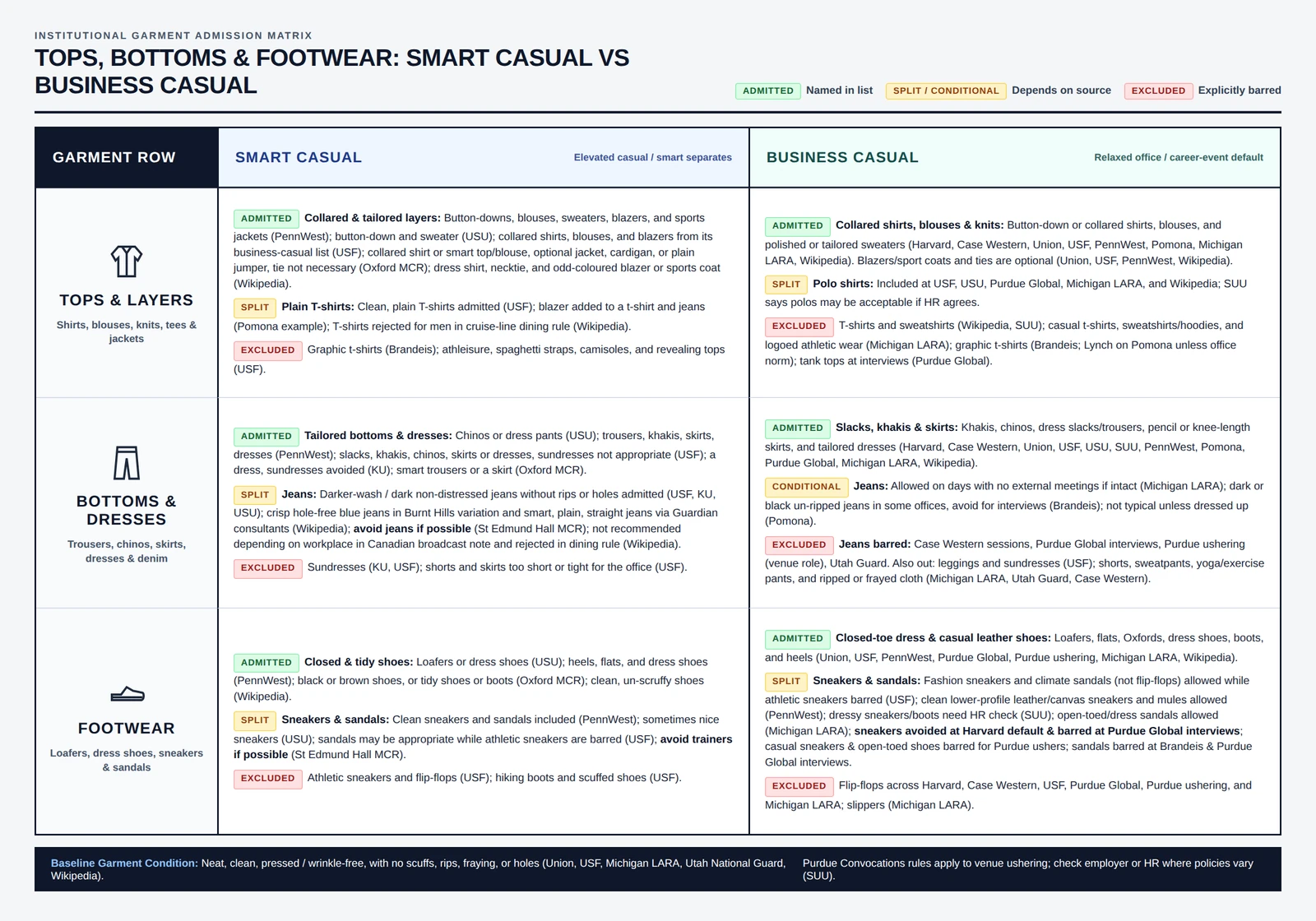
Smart Casual vs Business Casual Garment Admission Matrix
Use the garment admission matrix below to check tops, bottoms, and footwear across smart casual and business casual while keeping conflicting institutional rules visible rather than collapsing them into a single yes or no.
| Garment Category | Smart Casual Admission & Institutional Exceptions | Business Casual Admission & Institutional Exceptions |
|---|---|---|
| Tops & Outer Layers | Button-down and collared shirts, blouses, sweaters, blazers, sports jackets, and ties (PennWest); a button-down shirt and a stylish sweater (USU); collared shirts, blouses, and sport coats or blazers carried from its business-casual list (USF); collared shirt or smart top or blouse with optional jacket, cardigan, or plain jumper and tie not necessary (St Edmund Hall MCR); dress shirt, necktie, and odd-coloured blazer or sports coat (Wikipedia). Clean, plain T-shirts admitted at USF and a blazer over a t-shirt and jeans in Pomona’s example, whereas a cruise-line dining rule on Wikipedia rejects T-shirts for men. Graphic t-shirts excluded at Brandeis; athleisure, spaghetti straps, camisoles, and revealing tops excluded at USF. | Button-down or collared shirts, blouses, and polished or tailored sweaters across Harvard FAS, Case Western, Union College, USF, PennWest, Pomona, Purdue Global, Michigan LARA, and Wikipedia; blazers or sport coats and ties optional (Union, USF, PennWest, Wikipedia, SUU). Polos included at USF, USU, Purdue Global, Michigan LARA, and Wikipedia, or with HR agreement at SUU. Excluded: T-shirts and sweatshirts (Wikipedia, SUU); casual t-shirts, sweatshirts or hoodies, and logoed athletic wear (Michigan LARA); graphic t-shirts (Brandeis; Lynch on Pomona unless office norm); tank tops at interviews (Purdue Global). |
| Bottoms, Skirts & Dresses | Chinos or well-fitted dress pants (USU); trousers, khakis, skirts, and dresses (PennWest); slacks, khakis, chinos, and dresses or a skirt and blouse, with sundresses not appropriate, carried from its business-casual list (USF); a dress, with sundresses avoided (KU); smart trousers, or a skirt to match the jacket (St Edmund Hall MCR). Dark or darker-wash non-distressed jeans without rips or holes admitted at USF, KU, and USU; crisp hole-free blue jeans in the Burnt Hills variation and smart, plain, straight jeans via Guardian recruitment consultants on Wikipedia; St Edmund Hall MCR says avoid wearing jeans if possible; Wikipedia’s Canadian broadcast note does not recommend jeans depending on the workplace, and its dining rule rejects jeans and shorts for men while accepting dresses or pantsuits for women. | Khakis, chinos, slacks or dress trousers, pencil or knee-length skirts, and tailored dresses (Harvard FAS, Case Western, Union, USF, USU, SUU, PennWest, Pomona, Purdue Global, Michigan LARA, Wikipedia). Jeans allowed at Michigan LARA on days without external meetings if intact and wrinkle-free, noted as accepted in dark or black un-ripped form by some offices at Brandeis (avoid for interviews), and called not typical unless dressed up at Pomona. Jeans excluded at Case Western sessions, Purdue Global interviews, Purdue Convocations venue ushering, and Utah National Guard; leggings and sundresses excluded at USF; shorts, sweatpants, yoga or exercise pants, and ripped or frayed cloth excluded at Michigan LARA and Utah Guard. |
| Footwear | Loafers or dress shoes (USU); heels, flats, and dress shoes (PennWest); black or brown shoes, or tidy shoes or boots (St Edmund Hall MCR); clean and un-scruffy shoes (Wikipedia). Clean sneakers and sandals included at PennWest; sometimes nice sneakers at USU; sandals may be appropriate while athletic sneakers and flip-flops are barred at USF; St Edmund Hall MCR says avoid trainers if possible; hiking boots and scuffed shoes barred at USF. | Closed-toe loafers, flats, Oxfords, dress shoes, boots, and heels (Union, USF, PennWest, Purdue Global, Purdue Convocations ushering, Michigan LARA, Wikipedia). Fashion sneakers and climate sandals (no flip-flops) allowed at USF while athletic sneakers are barred; clean lower-profile leather or canvas sneakers and mules allowed at PennWest; dressy sneakers or boots require HR or supervisor check at SUU; open-toed and dress sandals allowed at Michigan LARA. Sneakers avoided at Harvard’s default and barred at Purdue Global interviews; casual sneakers and open-toed shoes barred for Purdue venue ushers; sandals barred at Brandeis and Purdue Global interviews; flip-flops barred across Harvard, Case Western, USF, Purdue Global, Purdue ushering, and Michigan LARA. |
| Baseline Condition | Clean, un-scruffy shoes and intact, unripped cloth without dirty or wrinkled garments or scuffed footwear (USF, Wikipedia). | Neat, clean, pressed, and wrinkle-free clothing without marks, scuffs, fading, rips, fraying, or holes (Union College, USF, Michigan LARA, Utah National Guard). |