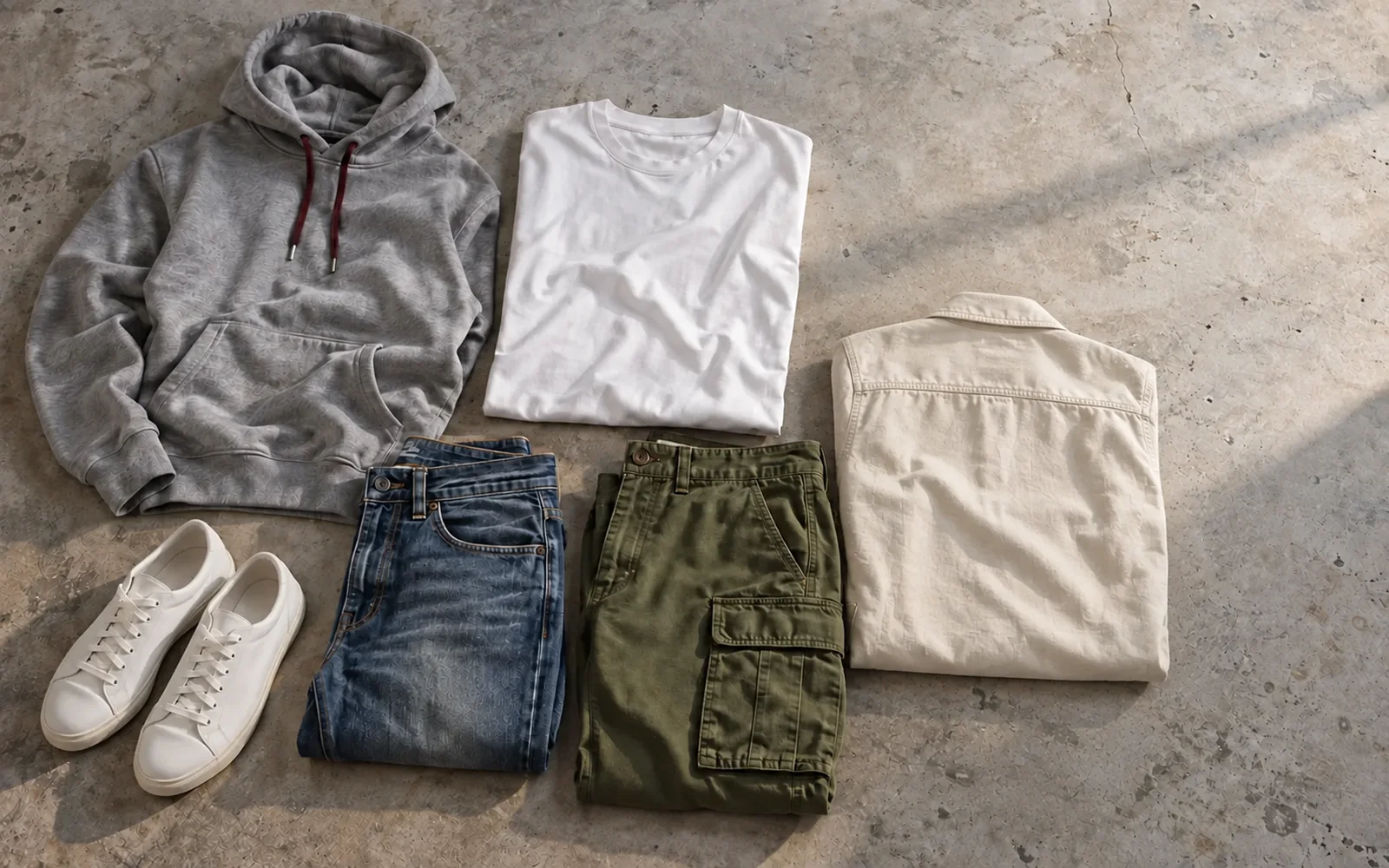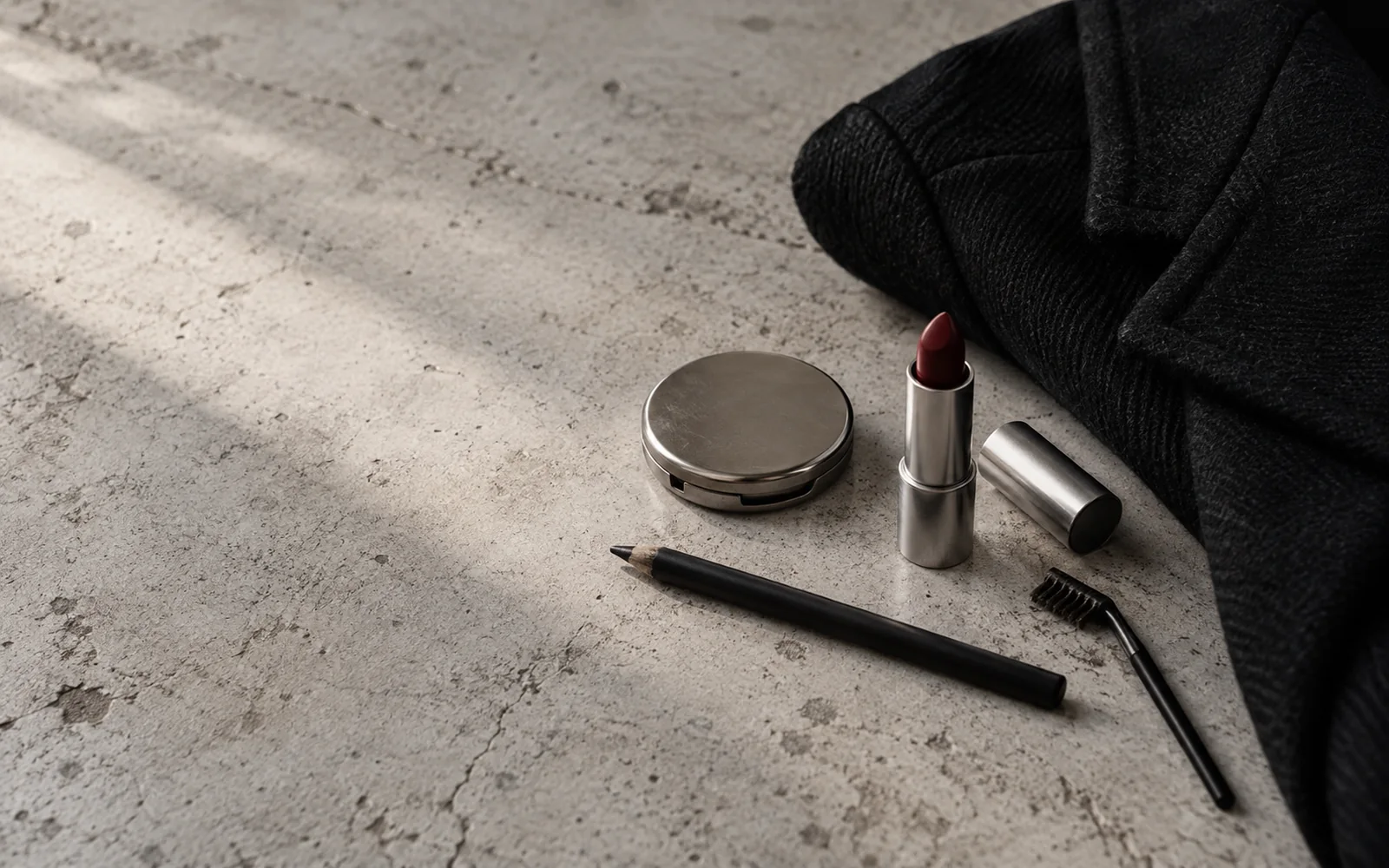
The wrong makeup look fights the outfit: heavy glam with a hoodie and cargos, or bare skin with a sharp all-black look that wanted one strong accent. Pick the makeup by the outfit type, give the whole look one visual focus, and keep everything else a step quieter.
Short answer: street style makeup is makeup chosen to match how you dress in the city, not a single trend. This guide uses six looks that pair with street outfits: bare skin, graphic liner, a bold lip with clean skin, a smudged eye, monochrome colour and dewy skin with one colour accent. Match the look to the outfit with the pairing matrix below, apply in a set order, and follow two safety basics: the American Academy of Dermatology recommends a broad-spectrum, water-resistant sunscreen of SPF 30 or higher, and the FDA advises against sharing eye cosmetics.
The look groupings, pairings and difficulty ratings are editorial judgments; safety lines quote the AAD and FDA. If you are still choosing the outfit, start with the streetwear outfit matrix and come back.
Key points:
- Choose one focus: skin, eyes or lips.
- Match the look to the outfit type, not to a trend list.
- Sunscreen goes on before makeup when you will be outdoors.
- Eye products are the ones to replace and never share.
Six makeup looks that read as street style
This guide groups street style makeup into six looks: bare skin, graphic liner, a bold lip with clean skin, a smudged eye, monochrome, and dewy skin with one accent. They differ in where the focus sits and how much practice they take; the table gives each look’s key steps, the outfits it suits and our beginner-friendliness rating.
| Look | Focus | Key steps | Suits these outfits | Difficulty (editorial) |
|---|---|---|---|---|
| Bare skin | Skin | Light base or none, brushed-up brows, balm | Minimal, workwear, sportswear | Easy |
| Graphic liner | Eyes | Clean skin, one sharp liner shape, lashes optional | Streetwear, layered and avant-garde | Harder |
| Bold lip, clean skin | Lips | Even base, groomed brows, one strong lip colour | Tailored mix, all-black outfits | Easy to medium |
| Smudged eye | Eyes | Pencil smudged along the lash line, little else | Subculture, layered dark outfits | Medium |
| Monochrome | Colour | One tone on eyes, cheeks and lips | Vintage, tonal outfits | Medium |
| Dewy skin, one accent | Skin plus a colour | Glow base, coloured liner or mascara as the only colour | Weekend streetwear, summer outfits | Easy to medium |

Our pairings follow one rule: give the whole look, outfit and face together, one visual focus. Graphic liner goes with streetwear built on plain pieces because the liner becomes the shape the outfit lacks; a bold lip suits plain dark outfits because it supplies the single accent. For a city example of dark outfits with one moveable accent, see the Melbourne guide. For the full list of outfit types the pairings refer to, see the main types of street style.
Common mistake: Stacking two focus looks, such as graphic liner and a bold lip, on a busy outfit. The face and the clothes then compete; keep one focus and let the rest stay quiet.
How to do each look (editorial steps, no timing or wear claims):
- Bare skin. Even out only where you want to, brush brows up, finish with balm. Check in daylight before you leave.
- Graphic liner. Keep the rest of the face plain, draw one shape, such as a straight wing or a single line above the crease, and match both sides in a mirror before you add anything else. Carry a cotton bud for small fixes.
- Bold lip, clean skin. Outline first, fill, blot, then reapply; check the edges after eating or drinking.
- Smudged eye. Draw pencil close to the lash line and soften it with a brush or fingertip; the aim is a blurred edge, not a line.
- Monochrome. Pick one colour family for eyes, cheeks and lips. Coordination is about colour only: around the eyes, use products intended for the eye area.
- Dewy skin, one accent. Keep the base light and add one colour only, such as coloured liner or mascara.
Takeaway: Pick one of six looks by where you want the focus, and start with an easy one.
Pairing makeup with your outfit
Pair the makeup with where the outfit’s focus already sits: strong colour, pattern or a graphic on the clothes means a quieter face; plain or tonal clothes leave room for one strong feature. The matrix below is our editorial guide to which looks suit which outfit types.
| Outfit type | Best first choice | Also works | Keep it quiet when |
|---|---|---|---|
| Minimal (plain pieces, neutral palette) | Bold lip, clean skin | Graphic liner | The outfit already has a bright colour accent |
| Streetwear and sportswear | Bare skin or dewy skin with one accent | Graphic liner | The outfit already has a loud graphic or colour |
| Workwear and utility | Bare skin | Smudged eye | The jacket or trousers carry strong colour |
| Tailored mix | Bold lip, clean skin | Monochrome | Patterned tailoring is the focus |
| Subculture and layered dark | Smudged eye | Graphic liner | The layers add bold pattern, print or colour |
| Vintage and thrift | Monochrome | Bold lip | The vintage piece is very bright or patterned |

The occasion adjusts the pairing. For school and the commute, the easier looks are simpler to touch up during a long day; for a night out, move one step stronger, for example from bare skin to a smudged eye. The night-out column of the temperature × occasion matrix gives the outfit side of that same shift. Weather matters too: on a rainy day, a look that is meant to be soft, such as the smudged eye, leaves less to go wrong than a precise wing. For how one city’s seasons change the outfit side, see Melbourne’s climate table.
Takeaway: One visual focus for the whole look: strong outfit, quiet face; quiet outfit, one strong feature.
A basic application order
Apply makeup in a set order so each step sits on the one before it: skin care and sunscreen first, then base, brows, eyes, cheeks and lips, and setting last. The order below is a common editorial sequence, not a rule; skip any step your chosen look does not use.

- Cleanse and moisturise. Start from clean skin.
- Sunscreen, if you will be outdoors. The AAD says to apply it about 15 minutes before going outside.
- Base. Skin tint, foundation or concealer only where you want it.
- Brows. Brush up or fill; they frame the look.
- Eyes. Liner, shadow or smudge, depending on the look.
- Cheeks. Blush or bronzer, or skip for bare skin.
- Lips. Balm, colour or both; the AAD suggests a lip balm with SPF 30 or more for sun protection.
- Set. Powder or spray where the look needs to last.
For the six looks, the order changes only in emphasis: bare skin stops after brows and lips, graphic liner spends its time on step 5, and the bold lip spends it on step 7.
Takeaway: Keep the order fixed and change only which step gets the time.
Skin prep and sun protection
If your street look keeps you outdoors, sunscreen is part of the makeup routine. The American Academy of Dermatology’s guidance gives the basics in four lines.
| AAD guidance | What it means for a makeup routine (our suggestion) |
|---|---|
| Use broad-spectrum sunscreen, SPF 30 or higher, water resistant, on all skin not covered by clothing | Keep it as its own step, after moisturiser and before base, as in the order above |
| Apply about 15 minutes before going outdoors | Plan your routine so sunscreen goes on at least 15 minutes before you leave |
| Use at least 1 teaspoon for the face | Roughly the length of your index and middle fingers, per the AAD |
| Reapply every two hours outdoors, and after swimming or sweating | Plan for it on long days outside, such as a street style walk |
The AAD also notes that no sunscreen filters out 100% of UVB rays and recommends shade and sun-protective clothing, which brings the outfit back in: a cap, a wide-brimmed hat and sunglasses do part of the job. Those pieces already feature in the hot-band streetwear formulas. New products are the other skin-prep question: the AAD’s method for testing skin care products is to apply the product to a quarter-sized spot on the inner arm or the bend of the elbow twice a day for seven to ten days, and to stop if the skin turns red, itchy or swollen.
Takeaway: Sunscreen first when you are outdoors, and test new skin care before it reaches your face.
Eye makeup safety basics
Eye products need the most care because they sit closest to the eye. The FDA’s eye cosmetic safety page lists a short set of rules that apply to every eye look in this guide.

- Do not share eye cosmetics. The FDA says, “Another person’s bacteria may be hazardous to you.”
- Replace mascara. “Manufacturers usually recommend discarding mascara two to four months after purchase.”
- Do not add saliva or water to dried-up mascara; discard it instead.
- Never apply or remove eye makeup in a moving vehicle, which is easy to forget on a commute.
- Skip eye makeup during an eye infection or when the skin around the eye is inflamed, and throw out products used during the infection.
- Avoid colour additives not approved for the eye area, as the FDA advises; around the eyes, use products intended for that area.
These rules apply whenever you use eye cosmetics, whatever the look. If a look needs a touch-up while you are out, wait until you have stopped, not on a moving tram or bus.
Takeaway: Replace, do not share, and never apply eye makeup on the move.
When this does not apply
This guide pairs makeup with outfits. It does not:
- Give medical or skin-condition advice. For rashes, reactions or skin conditions, see a board-certified dermatologist.
- Recommend products or brands. No product here is tested or endorsed.
- Set face-shape or age rules. We found no reliable source for them, so the guide does not invent any.
- Track this season’s trends. Trend lists change quickly; the pairings are meant to outlast them.
- Cover stage, film or special-effects makeup. Those have different products and rules.
The definitions of the outfit types sit in the Street Style section, and more outfit pairings sit in the Outfit Ideas section.
Takeaway: Use the looks and pairings as a starting point, and take skin problems to a dermatologist.
How this guide was put together
The six looks, the pairing matrix, the difficulty ratings and the application order are this site’s editorial guidance, compiled for matching makeup with city outfits; they are not test results, and no products were tested. Sun-protection and product-testing lines come from the American Academy of Dermatology’s public pages, and eye-safety lines quote the U.S. Food and Drug Administration’s Eye Cosmetic Safety page (content current as of 28 June 2022). Teen Vogue’s fall 2026 trend list is cited only as an example of trend coverage. All sources were accessed on 7 October 2026 and are listed under References. Updated October 2026.
Takeaway: Check the AAD and FDA pages directly if you want the full guidance behind the safety lines.
Related reading
Pick the next read by what you are planning: the outfit, the style type, or the city.
- Streetwear outfits by temperature and occasion — Choose the outfit first, then match the makeup here.
- What is street style? — Learn the outfit types the pairing matrix refers to.
- Melbourne street style — See the dark-palette, one-accent look that suits a bold lip.
- All articles — Browse every guide on the site.