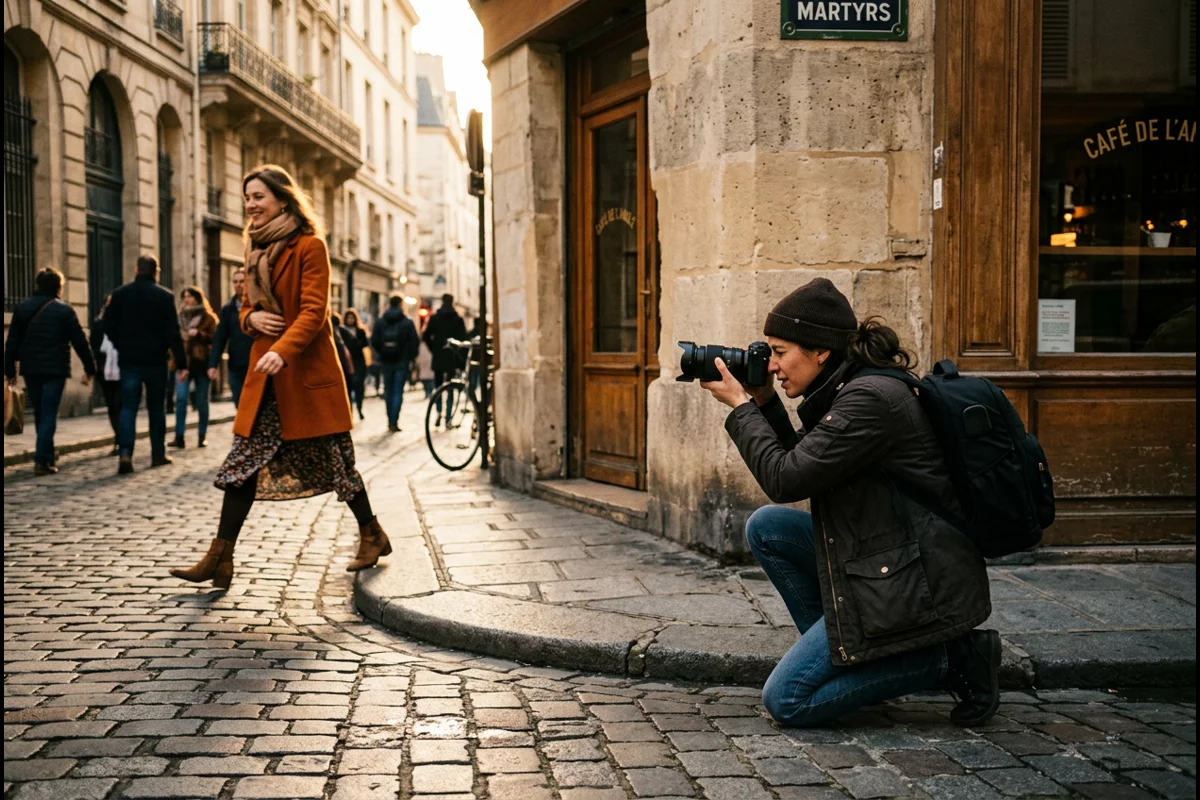
Street style fashion photography requires calibrating four physical parameters to the urban environment: matching full-frame lens working distance (3.1 m at 35mm, 4.4 m at 50mm, or 7.5 m at 85mm) to sidewalk clearance, lowering camera elevation to 1.00 to 1.15 m at a 0° plumb sensor pitch to preserve vertical garment ratios, locking shutter speed at >= 1/500 s with f/2.8 to f/4.0 continuous autofocus to freeze a 3.5 to 4.5 m/s swinging stride across 0.75 to 1.05 m of axial depth, and applying -0.3 to -1.7 EV exposure compensation when metering 3% to 7% reflectance matte black layers in open shade. Shooting from a standing 1.60 m eye level at 1/250 s and 0.0 EV auto metering fails by foreshortening 1:2 high-rise trouser proportions into a stubby 1:1 split, smearing moving footwear across 14 to 18 mm of motion blur, and washing matte black wool into noisy middle-grey charcoal.
While our Melbourne street style guide examines how 7 to 10°C daily temperature swings shape the city’s dark-base layered wardrobe, and our foundational guide to what street style means traces the genre from Bill Cunningham’s 1978 newspaper columns to contemporary runway sidewalks, this technical manual covers the optical, kinematic, photometric, and legal execution on the pavement. Whether you are documenting a 1:2 high-rise silhouette from our women’s streetwear silhouette and GSM guide or checking cuff and trouser breaks from our men’s layering proportions guide, the matrix below maps focal length selection to Melbourne’s street geometry.
Focal Length (35mm Full-Frame) |
Diagonal / Vertical / Horizontal AoV (Portrait) |
Full-Body Working Distance (2.10 m Frame) |
Background Wall Swath (4.0 m Behind Subject) |
Perspective & Garment Proportion Behavior | Entrance Pupil at f/2.8 & Bokeh Scale |
Optimal Melbourne Street & Venue Fit |
|---|---|---|---|---|---|---|
35mm Wide-Environmental Prime |
63.4° diag / 54.4° vert / 37.8° horiz |
3.05–3.10 m (~10.0 ft) |
1.40 m at subject expanding to 4.8 m wall width |
Slight magnification on forward shoe or bag; demands strict 0° plumb pitch at 1.05 m waist height |
12.5 mm (1.00× baseline blur disk) |
Narrow 3.5–6.0 m laneways & arcades: Degraves St, Hosier Ln, Centre Pl, Manchester Ln, Somerset Pl, Block & Royal Arcades |
50mm Standard Neutral Prime |
46.8° diag / 39.6° vert / 27.0° horiz |
4.35–4.40 m (~14.4 ft) |
1.40 m at subject expanding to 3.3 m wall width |
Matches natural extra-macular human magnification; negligible nose-to-ankle distortion with clear city context | 17.9 mm (1.43× pupil diameter) |
Medium-width ‘Little’ streets & plazas: Flinders Ln, Little Bourke St, Little Collins St, QV Albert Coates Ln |
85mm Short-Telephoto Prime |
28.6° diag / 23.9° vert / 16.1° horiz |
7.40–7.50 m (~24.6 ft) |
1.40 m at subject expanding to 2.5 m tight tunnel |
<2% lens-to-nose vs lens-to-heel variance; renders 1:2 and 2:1 garment splits with orthographic accuracy |
30.4 mm (2.43× pupil; 2.0–2.5× blur disk) |
Wide Hoddle Grid boulevards & festival forecourts: Collins St, Bourke St Mall, Swanston St, Royal Exhibition Building |
Focal Length Geometry (35mm vs. 50mm vs. 85mm) and 0° Plumb Sensor Elevation
On a standard 35mm full-frame digital sensor measuring 36.0 mm × 24.0 mm (3:2 aspect ratio, diagonal d_sensor = 43.27 mm), rotating the camera 90° into portrait orientation assigns the 36.0 mm dimension to vertical frame height (h_sensor = 36.0 mm) and the 24.0 mm dimension to horizontal frame width (w_sensor = 24.0 mm). As established in Cambridge in Colour’s optical focal length reference, rectilinear angle of view (AoV) and subject working distance (D_working) follow two trigonometric equations:
AoV = 2 * arctan(d_sensor / (2 * f))
D_working = f * (H_subject_frame / h_sensor)
W_background_swath = W_subject_frame + (2 * D_bg_behind_subject * tan(AoV_horizontal / 2))
To frame a 1.70 m (5 ft 7 in) standing subject from head to toe without clipping their footwear outsole or crowding the top of the head, a street style frame requires 18 to 20 cm of headroom above the crown and 18 to 20 cm of bluestone pavement breathing room below the sole (15% to 20% total vertical padding). That sets the target vertical field height at the subject plane to H_subject_frame = 2.10 m and the horizontal field width at the subject plane to W_subject_frame = 1.40 m.
Optical Breakdown Across 35mm, 50mm, and 85mm Primes
35mmWide-Environmental Prime (D_working = 3.05 to 3.10 m/10.0 ft): Substitutingf = 35 mmandh_sensor = 36.0 mmyieldsD_working = 35 * (2.10 / 36.0) = 2.04 mfor an edge-to-edge2.10 mheight, or3.05 to 3.10 mwhen allowing standard framing margin and post-crop latitude. The horizontal angle of view in portrait orientation isAoV_horizontal = 2 * arctan(24.0 / 70) = 37.8°(54.4°vertical,63.4°diagonal).- Environmental Swath vs. Perspective Stretch: Four meters behind the subject (
D_bg = 4.0 m), that37.8°horizontal cone expands to capture4.8 mof architectural wall width. Inside narrow routes from the City of Melbourne’s iconic laneways and arcades walk, such as Degraves Street, Hosier Lane, Centre Place, Manchester Lane, and Somerset Place (where wall-to-wall or cafe-table clearance is only3.5 to 6.0 m),35mmis the only focal length that fits a full-length outfit without backing into a brick wall. However, because3.1 mis relatively close to the body, a leading sneaker extended45 cmforward or a structured leather handbag appears12% to 15%larger relative to the torso.
- Environmental Swath vs. Perspective Stretch: Four meters behind the subject (
50mmStandard Neutral Prime (D_working = 4.35 to 4.40 m/14.4 ft): In portrait orientation, a50mmprime projects a27.0°horizontal angle of view (39.6°vertical,46.8°diagonal) and requires stepping back4.35 to 4.40 mfor a full-length frame. Four meters behind the subject, the background swath narrows to3.3 m.- Garment Fidelity & Sidewalk Safety: At
4.4 m, perspective magnification closely mirrors natural human vision outside the central macula. It eliminates wide-angle toe elongation while preserving identifiable heritage brickwork on medium-width ‘Little’ streets (Flinders Lane,Little Bourke Street,Little Collins Street) andQV Melbourne's Albert Coates Lane, where stepping back7.5 mwith an85mmlens would push the photographer off the curb into an active roadway or tram corridor.
- Garment Fidelity & Sidewalk Safety: At
85mmShort-Telephoto Isolation Prime (D_working = 7.40 to 7.50 m/24.6 ft): An85mmlens compresses the portrait horizontal angle of view to a tight16.1°tunnel (23.9°vertical,28.6°diagonal), requiring a7.40 to 7.50 mworking distance for a2.10 mvertical frame.- Orthographic Garment Rendering & Bokeh Physics: When the camera sits
7.50 mfrom the subject’s torso and7.35 mfrom their leading toe or nose tip, the relative distance differential across the human body drops below2%. As a result,+2.5 to +4.5 cmoversized blazer shoulder extensions, coat hem lengths, and1:2or2:1vertical waistline splits render with blueprint geometric accuracy. Simultaneously, the16.1°horizontal cone captures only2.5 mof background wall4 mbehind the subject, allowing the photographer to slide30 cmlaterally to erase a street sign, wheelie bin, or parked delivery van from the frame. Atf/2.8, the85mmphysical entrance pupil (d_pupil = 85 / 2.8 = 30.4 mm) is2.43×wider than the35mmentrance pupil (35 / 2.8 = 12.5 mm), rendering background blur disks15 maway at2.0× to 2.5×the diameter on the sensor. Reserve the85mmfor wide Hoddle Grid boulevards (Collins Street,Bourke Street Mall,Swanston Street,Exhibition Street) and Australian Fashion Festival forecourts at theRoyal Exhibition Building.
- Orthographic Garment Rendering & Bokeh Physics: When the camera sits
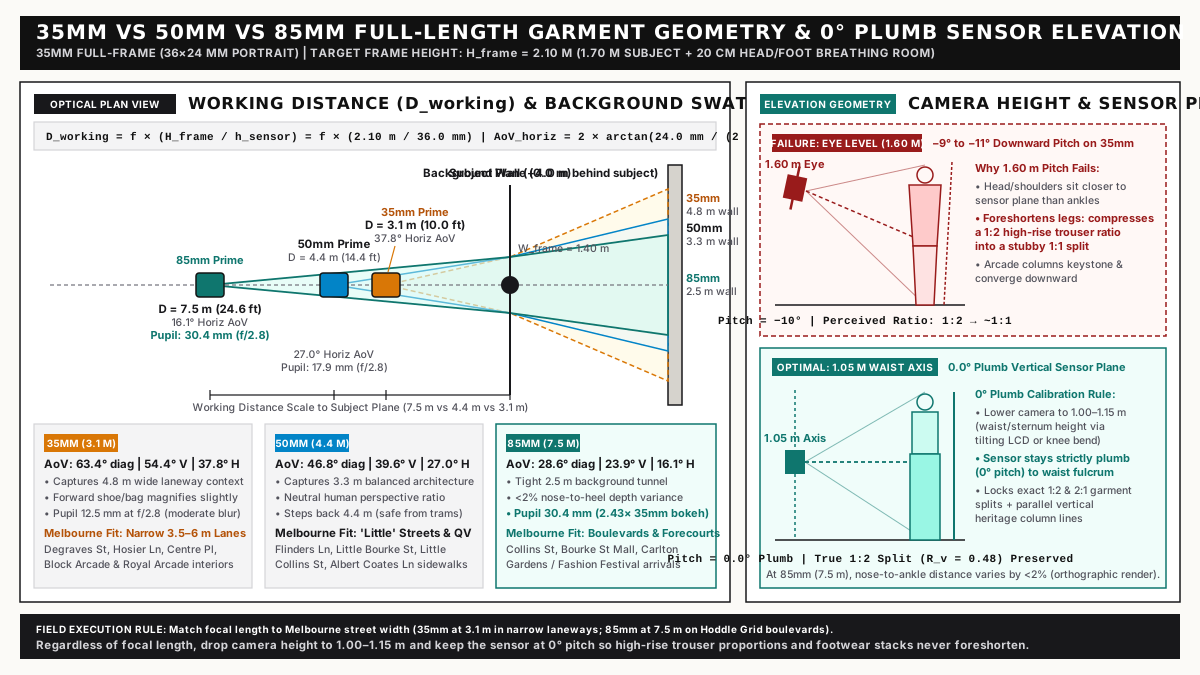
Camera Elevation (1.00–1.15 m) and the 0° Plumb Sensor Rule
Focal length alone does not cause the “big head, short legs” distortion common in amateur street style photography; camera elevation and downward sensor pitch tilt are the primary culprits.
- Why
1.60 mEye-Level Shooting Fails on35mm: When a photographer stands upright atD = 3.1 mholding a35mmcamera at eye level (1.60 mabove the pavement), centering a1.70 mpedestrian requires pitching the lens barrel downward by-9° to -11°. Tilting the sensor plane out of vertical plumb places the subject’s head and shoulders35 to 45 cmcloser to the sensor plane than their ankles and shoes. That geometry magnifies the upper chest and foreshortens the lower leg column, compressing an engineered1:2high-rise wide-leg trouser split (R_vertical = 0.48) into a stubby1:1midpoint split while causing vertical heritage arcade columns to converge downward (keystoning). - The
1.05 mPlumb Calibration Standard: Drop the camera to1.00 to 1.15 mabove the pavement (waist-to-sternum height, using a tilting rear LCD or bending at the knees) so the optical axis points horizontally into the subject’s mid-hip or natural waist fulcrum. Keeping the sensor plane at0.0°pitch tilt (strictly plumb to gravity) ensures the head, waist, and sneaker outsole sit at equal perpendicular distances from the sensor, locking true1:2and2:1garment proportions and keeping architectural verticals parallel to the frame borders.
Walking-Stride Kinematics, Shutter Speed Thresholds (1/500 s Minimum), and AF-C Depth of Field
Posed, flat-footed sidewalk portraits often make structured coats and wide-leg trousers hang lifelessly. Capturing authentic street photography techniques in motion requires calibrating shutter speed and autofocus depth of field to the biomechanics of the human walking gait.
Limb & Garment Velocity Vectors in a Natural Urban Stride
A pedestrian walking down Flinders Lane or across a Swanston Street crosswalk at a natural, confident cadence (105 to 115 steps/min) alternates each leg between a stance phase (~60% of the gait cycle, where the planted shoe outsole has velocity v_planted = 0 m/s against the bluestone) and a swing phase (~40% of the cycle):
- Torso and Head Center of Mass (
v_torso = 1.3 to 1.5 m/s): The head, shoulders, and upper chest advance forward at a steady1.3 to 1.5 m/s(4.7 to 5.4 km/h). - Swinging Sneaker and Flowing Hem Peak (
v_swing = 3.5 to 4.5 m/s): Because the swinging foot must travel from behind the trailing hip to ahead of the leading hip in0.40 seconds, it accelerates through mid-swing to2.5× to 3.0×torso speed, peaking at3.5 to 4.5 m/s(12.6 to 16.2 km/h). Simultaneously, unbuttoned longline wool coat panels,135 GSMripstop nylon parachute hems, and swinging crossbody bag straps whip forward at3.0 to 4.5 m/s. - The Apex / Front Heel-Strike Capture Window: Rather than firing randomly during peak mid-swing, trigger an
8 to 12 fpscontinuous burst just as the leading leg reaches full forward extension and the heel touches or hovers1 to 2 cmabove the pavement prior to weight transfer. At this micro-instant, the stride opens the garment silhouette, outer coat lapels flare back to expose the inner waist tuck, and the leading sneaker decelerates toward0 m/s.
d_displacement_mm = v_part_m_s * t_exposure_s * 1000
d_sensor_blur_mm = d_displacement_mm / M_magnification_factor   (where M ≈ 58 at 2.10 m frame)
Shutter Speed & Exposure Time (t) |
Torso Displacement (v = 1.4 m/s) |
Swinging Foot & Hem Displacement (v = 3.5–4.5 m/s) |
Sensor-Plane Blur (1:58 Frame Scale) |
Garment & Footwear Visual Resolution |
|---|---|---|---|---|
1/250 s (t = 4.0 ms) - Below Walking Threshold |
5.6 mm real-world travel |
14.0-18.0 mm mid-swing travel |
0.24-0.31 mm (8-10× CoC limit) |
Fails on walking shots: 14-18 mm smear erases sneaker midsole lug geometry, blurs metallic lace eyelets, and wipes out 3×1 twill weave on moving trouser hems. Use only for stationary posed stops. |
1/500 s (t = 2.0 ms) - Shaded Laneway Baseline |
2.8 mm real-world travel |
7.0-9.0 mm mid-swing (<2.0 mm at heel-strike apex) |
0.03-0.05 mm at apex (Sharp) |
The Street Style Minimum: Reliably freezes torso, face, lapels, and the leading sneaker during the heel-strike apex window while keeping ISO at 400-800 inside shaded Melbourne laneways. |
1/800 s to 1/1000 s (t = 1.25-1.0 ms) - High-Velocity Freeze |
1.4-1.8 mm real-world travel |
3.5-4.5 mm even at peak mid-swing |
<0.025 mm across entire body |
Full Kinetic Freeze: Arrests mid-air swinging sneakers, wind-whipped hair, pleated mini skirts, and billowing 135 GSM nylon or wool coat tails on bright avenues and festival crosswalks. |
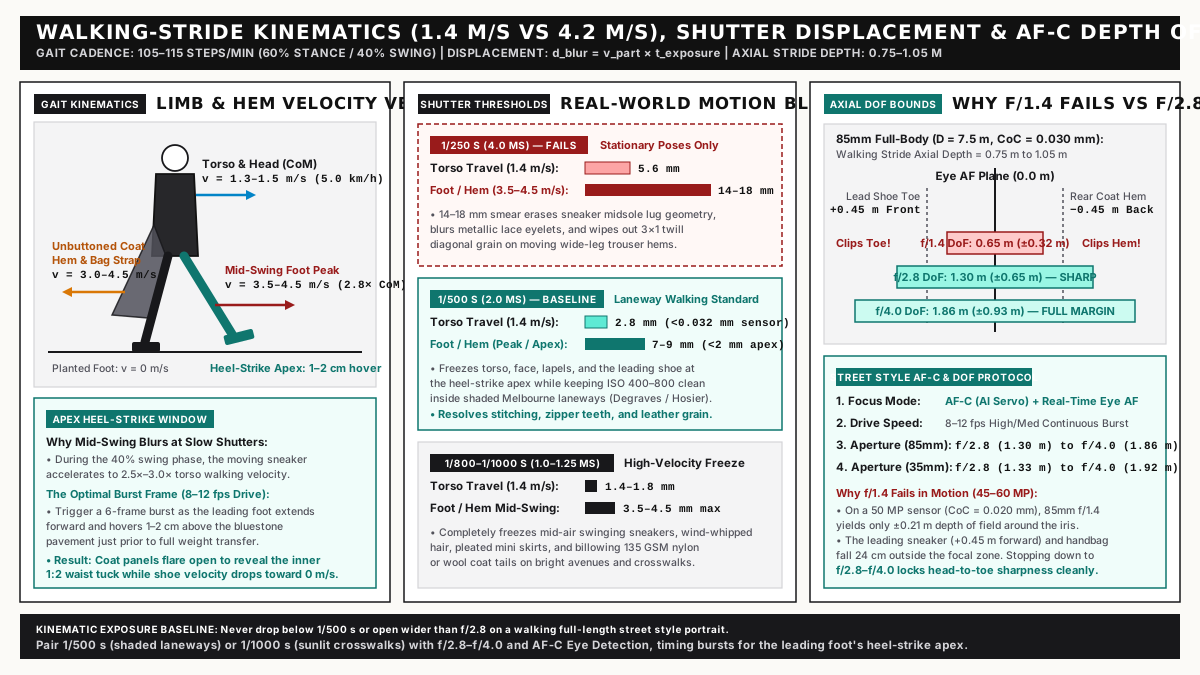
Axial Stride Depth (0.75–1.05 m) and Why f/1.4 Fails on Walking Full-Body Shots
A common technical mistake in street style photography is shooting a fast prime lens wide open at f/1.4 or f/1.8 while a subject walks toward the camera.
- Axial Depth of a Mid-Stride Pedestrian: When a subject walks toward the lens, their body is no longer a flat coronal plane. The leading sneaker toe box or forward-extended handbag sits
35 to 55 cm(+0.35 to +0.55 m) in front of the coronal plane of the eyes, while the trailing heel and flaring coat tail sit35 to 50 cm(-0.35 to -0.50 m) behind the eyes, creating a total front-to-back subject depth of0.75 to 1.05 m. - The
f/1.4Eye-AF Trap: Modern mirrorless cameras using Real-Time Eye AF lock critical focus directly on the subject’s iris (0.00 mfocus plane). With an85mmlens atD = 7.5 m, the standard full-frame Circle of Confusion (CoC = 0.030 mm) yields a total depth of field atf/1.4of only0.65 m(±0.32 mfront and back). On a high-resolution45 to 60 MPsensor (CoC = 0.020 mm), acceptable depth of field at85mm f/1.4shrinks to0.42 m(±0.21 m). Consequently, while the subject’s eyelashes are razor-sharp, their leading sneaker outsole (+0.45 mforward) and trouser hem break fall13 to 24 cmoutside the focal zone, rendering expensive footwear and hem tailoring visibly soft. - The
f/2.8 to f/4.0AF-C Protocol: Stop the aperture down tof/2.8tof/4.0with Continuous Autofocus (AF-C/AI Servo) and Human Eye Detection enabled. At85mm(D = 7.5 m,CoC = 0.030 mm),f/2.8expands total depth of field to1.30 m(±0.65 m) andf/4.0expands it to1.86 m(±0.93 m). At35mm(D = 3.1 m),f/2.8provides1.33 mandf/4.0provides1.92 m. Both settings encapsulate the entire0.75 to 1.05 mwalking stride from toe bumper to trailing coat hem while still throwing backgrounds10 to 20 mdown the street into smooth out-of-focus separation.
Melbourne Urban Canyon Open-Shade Lighting and 18% Grey Metering for Dark Fabrics
Melbourne’s central business district presents two simultaneous photometric challenges: a rotated street grid swept by high-contrast northern sunlight, and a local wardrobe dominated by light-absorbing matte black wool, charcoal fleece, and dark denim.
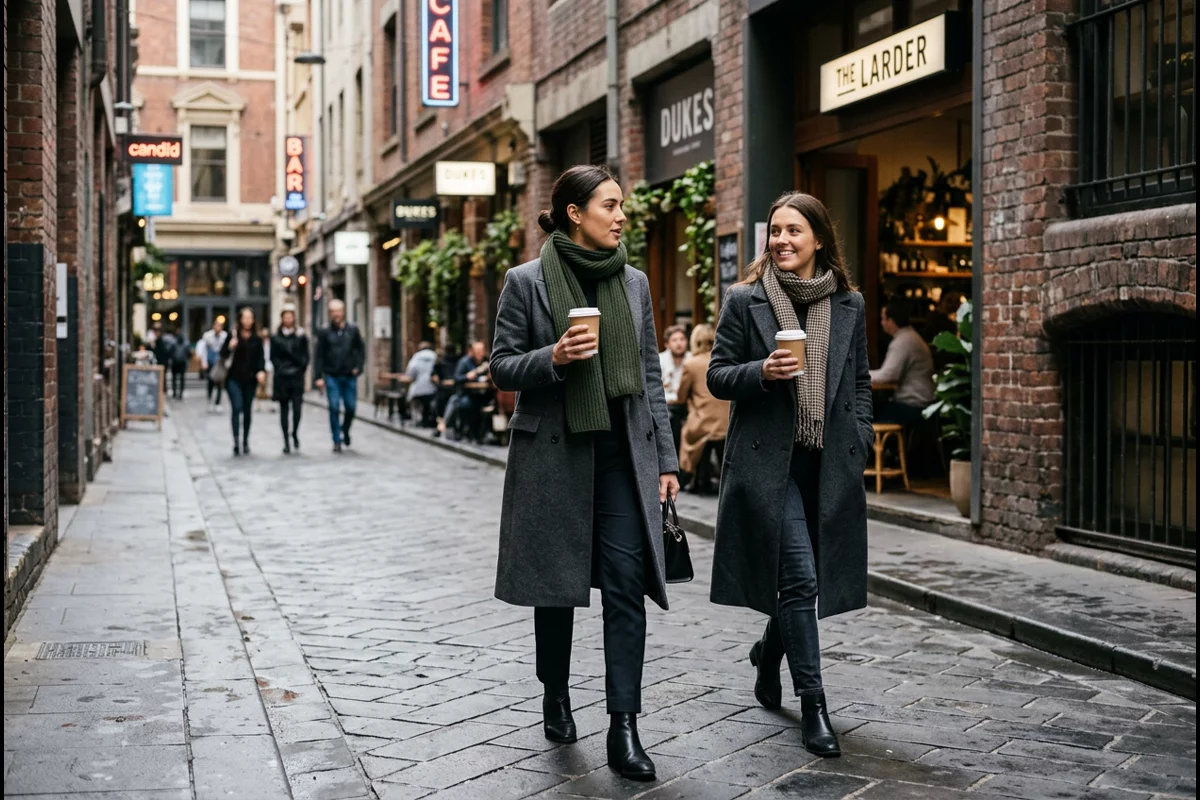
Hoddle Grid Canyon Physics and the Opposite-Wall Bounce Formula
Melbourne’s central Hoddle Grid is rotated 28° counter-clockwise from true cardinal axes: main thoroughfares and ‘Little’ lanes (Flinders Lane, Collins Street, Little Collins Street, Bourke Street, Little Bourke Street) run West-Southwest to East-Northeast (WSW–ENE), while cross streets (Swanston Street, Elizabeth Street, Russell Street, Exhibition Street) and offshoot laneways (Degraves Street, Centre Place, Manchester Lane) run North-Northwest to South-Southeast (NNW–SSE). Because Melbourne sits at 37.8°S latitude, the sun tracks across the northern sky at midday, peaking at ~75° solar altitude in summer (December–January) and ~29° in winter (June–July).
- Why Direct Midday Sun Fails Fashion: Unfiltered overhead sunlight creates a harsh
5 to 7 EVcontrast ratio between specular highlights and deep shadows. It casts vertical “raccoon-eye” brow and nose shadows across the face, clips specular highlights on street style makeup finishes, patent leather, and technical nylon, and crushes dark garment folds into featureless silhouettes. - The Open-Shade Sandstone Bounce Setup: Position the subject
1.0 to 2.5 minside the shadow line (“open shade”) on the shaded footpath of a street or laneway mouth, facing outward toward a sunlit sandstone, limestone, cream brick, or pale render facade across the street. This urban canyon geometry acts as a calibrated two-source studio:- Overhead Sky Dome (
6500 to 7500 K): The open patch of sky directly above the laneway provides soft, diffused cool top fill across the hair and shoulders. - Sunlit Opposite Wall (
4800 to 5200 K): The15 to 25 mtall sunlit heritage facade across the street acts as a massive warm horizontal bounce reflector, projecting directional, eye-level light into the shaded footpath. - Combined Result (
5500 to 6200 K,1.5 to 2.5 EVRatio): The mix of6500 Ksky fill and5000 Ksandstone bounce yields a natural5500 to 6200 Kdaylight white balance, clean horizontal catchlights in the eyes, and a gentle1.5 to 2.5 EVkey-to-shadow ratio.
- Overhead Sky Dome (
- Heritage Arcade Glass Canopies (
The Block Arcade&Royal Arcade): Inside Melbourne’s glazed Victorian arcades, the continuous overhead glass vaults (1893in The Block Arcade;1870in Royal Arcade) transform direct sunlight into soft overhead bank lighting. When shooting inside arcades, keep the subject at least1.5 maway from illuminated boutique display windows so warm2800 to 3200 Ktungsten retail spotlights do not contaminate5600 Kdaylight skin tones and charcoal wool.
The 18% Middle-Grey Metering Trap and Dark-Fabric Exposure Compensation
As explained in Cambridge in Colour’s camera metering and exposure technical guide, every built-in reflective camera meter (Evaluative/Matrix, Center-Weighted, and Spot) is calibrated to ANSI/ISO standard 18% middle-grey reflectance (Zone V in the Adams Zone System).
When a Melburnian wears a signature monochrome layered outfit, such as a 350 GSM matte black wool overcoat over a 440 GSM brushed black cotton hoodie and black rigid denim, those matte dark textiles reflect only 3% to 7% of incident light (1.5 to 2.5 stops darker than 18% middle grey):
Delta_EV_meter_error = log2(R_meter_target / R_black_garment)
For R_black_garment = 4.5% and R_meter_target = 18.0%:
Delta_EV_meter_error = log2(18.0 / 4.5) = log2(4.0) = +2.0 EV overexposure tendency
If you shoot at 0.0 EV in auto or aperture-priority mode when dark garments fill 50% to 75% of the frame, the camera’s meter assumes the scene is underexposed and automatically slows the shutter speed or boosts ISO by +1.0 to +1.7 EV. That uncompensated shift washes rich Zone II–III black wool into muddy, noisy Zone V charcoal, erases the subtle surface contrast between ultra-matte cotton fleece and semi-sheen twill, and blows out facial skin highlights and silver zipper hardware.
| Metering Scenario & Frame Composition | Recommended Metering Mode & EV Dial | Adams Zone System Placement | Technical Effect on Textiles & Skin Tones |
|---|---|---|---|
1. Dark Outfit in Open Shade (40%–60% of Frame) |
Evaluative / Matrix Metering at -0.3 EV to -0.7 EV |
Black wool in Zones II–III; Caucasian/medium skin in Zone VI | Prevents auto-brightening washout; preserves deep black dye density alongside visible 3×1 twill and 1×1 rib shadow detail without clipping cheek highlights. |
2. Tight Crop or Head-to-Toe Matte Black (>75% of Frame) |
Center-Weighted / Spot on Coat at -1.0 EV to -1.7 EV (or Spot on Cheek Highlight at +0.7 to +1.0 EV + AE-L) |
Black coat locked in Zone II.5; facial highlight anchored at Zone VI.5 | Overrides the meter’s attempt to force 4% reflectance wool to 18% grey. Locking manual exposure off the cheek highlight keeps exposure constant as the subject walks past varying walls. |
3. Sunlit Backlight, Glossy Leather, 135 GSM Nylon & Wet Bluestone |
Highlight-Weighted Metering (or Manual ETTR with Zebras at 95%–100% IRE) + Circular Polarizer (CPL) |
Specular peaks held below Zone VIII (<250 RGB); glare-free black grain |
Protects patent leather boots, DWR ripstop parachute pants, and jewellery from 255 clipping; rotating a CPL filter (-1.0 to -1.5 EV transmission factor) strips polarized sky glare off leather and wet cobbles. |
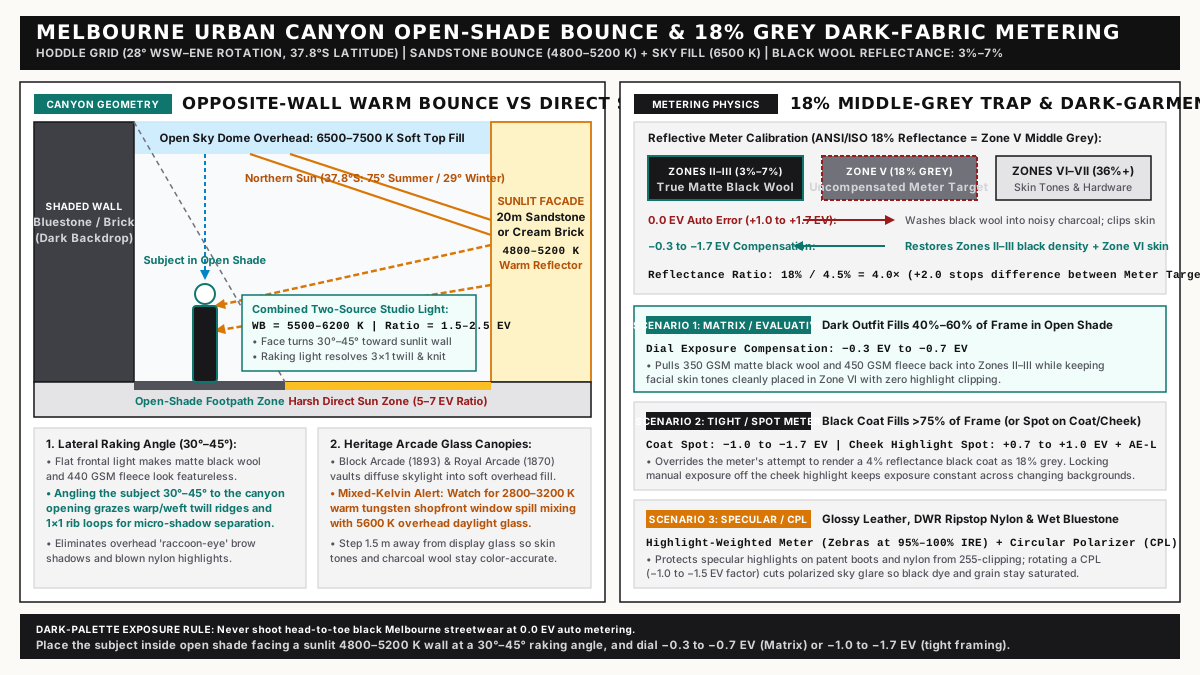
The 30°–45° Lateral Raking Light Rule for Black-on-Black Texture
Even with accurate -0.7 EV exposure compensation, flat frontal lighting (where the light source sits directly behind the photographer’s back) eliminates micro-shadows across dark clothing, making a black cashmere coat and black denim trousers merge into a single flat shape.
Position the camera and subject so the open-shade canyon opening or sunlit opposite wall strikes the outfit at a 30° to 45° lateral raking angle. Grazing light skims across the raised warp and weft ridges of 460 GSM rigid 3×1 denim, the vertical wales of 220 GSM 1×1 cotton rib, and the natural grain of full-grain leather, generating microscopic highlight-and-shadow relief that separates adjacent dark layers visually.
Sidewalk Approach Protocols and Australian Public vs. Commercial Image Rules
Consistent street style fashion photography depends on low-friction interpersonal communication on the sidewalk and strict adherence to Australian public, property, and commercial image rules.
Two Repeatable Sidewalk Approach Workflows
Workflow 1: The 30-Second Stopped Editorial Portrait
- Approach Within the Front-Diagonal Sightline: Step into the pedestrian’s peripheral vision from a
30° to 45°front-diagonal angle with the camera held low at waist level. Never tap a stranger from behind or step abruptly in front of them to block the footpath. - Lead With a Specific Garment Observation and Project Context: State immediately what caught your eye and why you are shooting: “Excuse me, the proportion of that long charcoal overcoat with the wide-leg denim and runners looks sharp; I am documenting Melbourne street style for an editorial series.” Naming the exact garment pairing builds immediate trust.
- Make a Time-Bounded Ask in Pre-Metered Open Shade: Ask for a concrete, brief commitment: “Do you have 30 seconds for three quick frames right here in the shade?” Guide them two steps into the open-shade spot you have already metered (
-0.3 to -0.7 EV,1/500 s,f/2.8) facing the sunlit opposite wall. - Give Simple Kinetic Direction: Avoid stiff, passport-style posing. Ask the subject to shift their weight onto one back hip, place one hand in a coat pocket to break the outer lapel line, or take three natural walking steps toward your
1.05 mwaist-level lens so you can capture the heel-strike apex. - Show the Rear LCD and Exchange Contact Cards: Immediately display the captured sequence on the rear monitor, hand over a printed contact card (or QR code) with your portfolio URL and email address, and record their name or social handle if they want a copy of the high-resolution file.
Workflow 2: Candid Crosswalk Stride Followed by Courtesy Check
When capturing unposed kinetic movement across a wide intersection (Collins Street or Bourke Street) or outside a fashion-week venue, pre-focus on the crosswalk zone and shoot the 2-second walking burst first (1/800 to 1/1000 s, f/2.8 to f/4.0, 85mm at 7.5 m) so the pedestrian’s gait and coat drape remain completely natural. Whenever foot traffic permits as the subject finishes crossing, lower the camera, make eye contact, show the frame on the LCD, and offer to send the image. If any pedestrian expresses discomfort or requests that a candid frame not be kept, delete the file on the spot as a non-negotiable professional standard.
Australian Public, Private-Arcade, and Commercial Image Rules
Operating professionally in Melbourne and across Australia requires distinguishing between four statutory and common-law boundaries documented by the Arts Law Centre of Australia, the Office of the Australian Information Commissioner (OAIC), and Victorian legislation:
- Public Footpaths & Editorial Publication (Common Law Baseline):
Under Australian common law (Victoria Park Racing and Recreation Grounds Co Ltd v Taylor (1937) 58 CLR 479; R v Sotheren [2001] NSWSC 204), there is no general standalone right to privacy or right of publicity that prohibits photographing a person standing on a public street, council footpath, or public park. As confirmed by the Arts Law Centre of Australia’s Street Photographer’s Rights sheet, a handheld photographer standing on a public Melbourne footpath (
Degraves Street,Flinders Lane,Collins Street,Hosier Lane) without obstructing pedestrian traffic with tripods or light stands requires no council permit and no signed model release to take photographs or publish them in editorial articles, documentary blogs, newspapers, photobooks, gallery exhibitions, or portfolios. - Scope of the Federal Privacy Act 1988 (Cth):
While a clear photograph of an identifiable person can qualify as personal information, the OAIC guidance on photos and video in public places specifies that the Australian Privacy Principles (APPs) under the Privacy Act 1988 (Cth) bind Australian Government agencies and private-sector “APP entities” (businesses with an annual turnover exceeding
AUD $3,000,000, plus regulated health or data-trading entities). Individual photographers shooting in a personal capacity (section 16household/personal exemption) and media organisations engaged in journalism while committed to published privacy standards are exempt from APP collection rules. - Privately Managed Heritage Arcades, Retail Centres & Summary Offences Act 1966 (Vic):
Several iconic Melbourne fashion backdrops are privately owned or statutory-managed semi-public land rather than council footpaths, including The Block Arcade, Royal Arcade, Emporium Melbourne, QV Melbourne, Melbourne Central, and Flinders Street Station concourses. Property owners and managers regulate photography under their Conditions of Entry. Under section
9(1)(e)of the Summary Offences Act 1966 (Vic) (wilful trespass), if an owner, centre manager, or authorized security officer asks a photographer to stop shooting or leave private premises and the photographer refuses to leave, remaining on site constitutes criminal trespass. Comply immediately and step back onto the public council footpath; note also that private security guards and members of the public have zero legal authority to confiscate camera gear or force the deletion of digital files from a memory card. - Commercial Advertising, Brand Lookbooks & Mandatory Model Releases (Australian Consumer Law):
As detailed in the Arts Law Centre of Australia’s Unauthorised Use of Your Image guide, the legal classification changes immediately when a street photograph crosses from editorial documentation into commercial promotion. Under Schedule 2 of the Competition and Consumer Act 2010 (Cth), the Australian Consumer Law (ACL), sections
18and29(prohibiting misleading or deceptive conduct and false representations of sponsorship, approval, or affiliation) and the common-law tort of passing off, using an identifiable person’s street photograph in a brand lookbook, paid social media advertisement, e-commerce product page, or retail campaign without a signed written Model Release exposes both the photographer and the brand to statutory liability because consumers infer that the subject endorses or is commercially associated with the product. (On Meet Me On The Streets, our editorial policy goes even further than the statutory editorial baseline by using only illustrative visuals and never publishing photographs of identifiable passers-by.)
| Publication or Shooting Context | Melbourne Location Category | Council Permit or Venue Permission Required? | Signed Written Model Release Required? | Governing Australian Legal Authority |
|---|---|---|---|---|
| 1. Editorial Blog, Newspaper Fashion Column, Photobook, Gallery Exhibition, or Portfolio | Public council footpath or park (Flinders Ln, Degraves St, Hosier Ln, Collins St, Carlton Gardens) |
No for handheld shooting (tripods/lighting stands obstructing foot traffic require a City of Melbourne permit) | No under Australian law (verbal courtesy consent and card exchange remain best field practice) | Australian common law (Victoria Park Racing v Taylor (1937) 58 CLR 479); Arts Law Centre (Street Photographer’s Rights) |
| 2. Handheld Shooting Inside Heritage Arcades, Shopping Centres, or Rail Concourses | Privately owned or statutory semi-public land (The Block Arcade, Royal Arcade, Emporium, QV, Flinders St Station) |
Yes / Subject to Conditions of Entry: Must stop shooting or exit to the public footpath immediately if directed by management or security | No for non-commercial editorial or personal display; Yes for any commercial brand use | Summary Offences Act 1966 (Vic) s 9(1)(e) (wilful trespass after warning to leave) |
| 3. Commercial Brand Lookbook, Paid Social Ad, E-Commerce Page, or Retail Promotion | Any public council street or private venue | Yes: Commercial filming/still-shoot council permit (where applicable) + written venue authorisation on private land | Yes: Mandatory Written Model Release signed by the identifiable subject prior to commercial publication | Australian Consumer Law (Competition and Consumer Act 2010 (Cth) Sch 2, ss 18 & 29), common-law Passing Off, & Arts Law (Unauthorised Use) |
Six-Point Field Calibration Checklist Before You Shoot
Before stepping into a Melbourne laneway or positioning yourself outside a fashion-week venue, run this six-step camera and lighting setup:
- Mount the focal length that matches curb-to-wall clearance: Fit a
35mmprime (D = 3.1 m,37.8°horizontal AoV) for narrow3.5 to 6.0 mlaneways like Degraves Street and Hosier Lane, a50mmprime (D = 4.4 m) for Flinders Lane and Little Bourke Street, or an85mmprime (D = 7.5 m,16.1°horizontal AoV) for wide boulevards like Collins Street. - Drop camera height to
1.00–1.15 mat0°pitch: Flip out the waist-level LCD or bend your knees so the lens aligns horizontally with the subject’s mid-hip/waist fulcrum. Verify in your electronic level that vertical building columns stay strictly parallel to the frame edges so temperature-layered streetwear proportions never foreshorten. - Lock shutter speed at
>= 1/500 s(1/1000 sin sun): Prevent14 to 18 mmof motion smear on3.5 to 4.5 m/sswinging sneakers and coat hems by never dropping below1/500 son a walking subject. - Set aperture to
f/2.8–f/4.0withAF-CEye Detection and8–12 fpsburst: Expand axial depth of field to1.30 to 1.92 mso both the eyes and the+0.45 mleading sneaker toe box stay tack-sharp during the heel-strike apex. - Scout the open-shade shadow line opposite a sunlit
4800–5200 Kfacade: Place your target zone1 to 2 minside open shade facing a sunlit sandstone or cream brick wall at a30° to 45°lateral raking angle. - Dial
-0.3 to -0.7 EV(-1.0 to -1.7 EVtight) for dark fabrics: Override the18%middle-grey meter error so3% to 7%reflectance matte black wool, heavy cotton fleece, and dark denim retain rich Zone II–III shadow density. Explore more urban wardrobe and visual guides in our Street Style section, our Melbourne city archive, or the complete Blog index.