Selvedge denim and raw denim describe two independent manufacturing choices rather than opposite fabric types. Selvedge tells you how the cloth was woven on a shuttle loom with continuous, self-finished edges, whereas raw denim tells you the fabric has never been washed, sanded, or garment-treated after weaving and sewing. Jeans can be both, either, or neither.
- Weaving dimension (selvedge vs. non-selvedge): Shuttle looms weave narrow bolts around 30 inches (760 mm) wide with clean self-finished outseams; shuttleless looms weave 60-inch (1,500 mm) or wider bolts with cut edges.
- Finishing dimension (raw vs. pre-washed): Raw (dry or unwashed) denim skips factory garment washing so ring-dyed indigo fades to your movement; pre-washed denim arrives soft and pre-shrunk.
- Sizing dimension (sanforized vs. unsanforized): Mechanical pre-shrinking can stabilize raw denim without washing the finished pair.
Are selvedge denim and raw denim the same thing?
No: selvedge describes how the fabric was woven, while raw denim describes cloth that has not been washed after it was woven and finished. Because both appeal to wearers who value texture and gradual fading, raw denim is not automatically selvedge, and selvedge denim is not automatically raw.
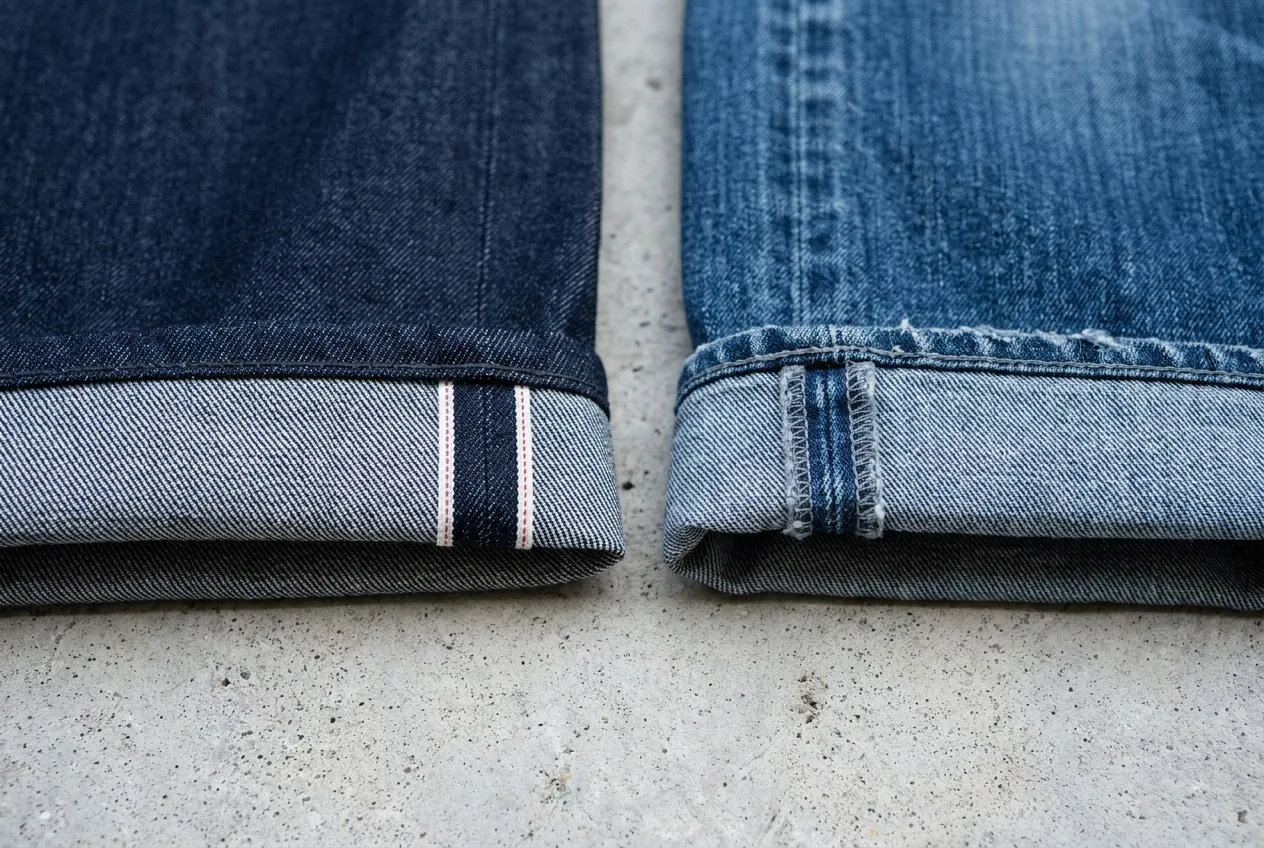
Checking the cuff of a pair of jeans proves only one variable at a time. Seeing a clean white-and-colored strip along the inside outseam confirms that the cloth came off a shuttle loom as selvedge denim, yet it does not tell you whether the jeans are raw or factory-washed, heavy or light, or properly cut for your legs. Conversely, an overlocked non-selvedge seam can still belong to stiff, unwashed raw indigo jeans that will bleed dye and develop crisp wear creases.
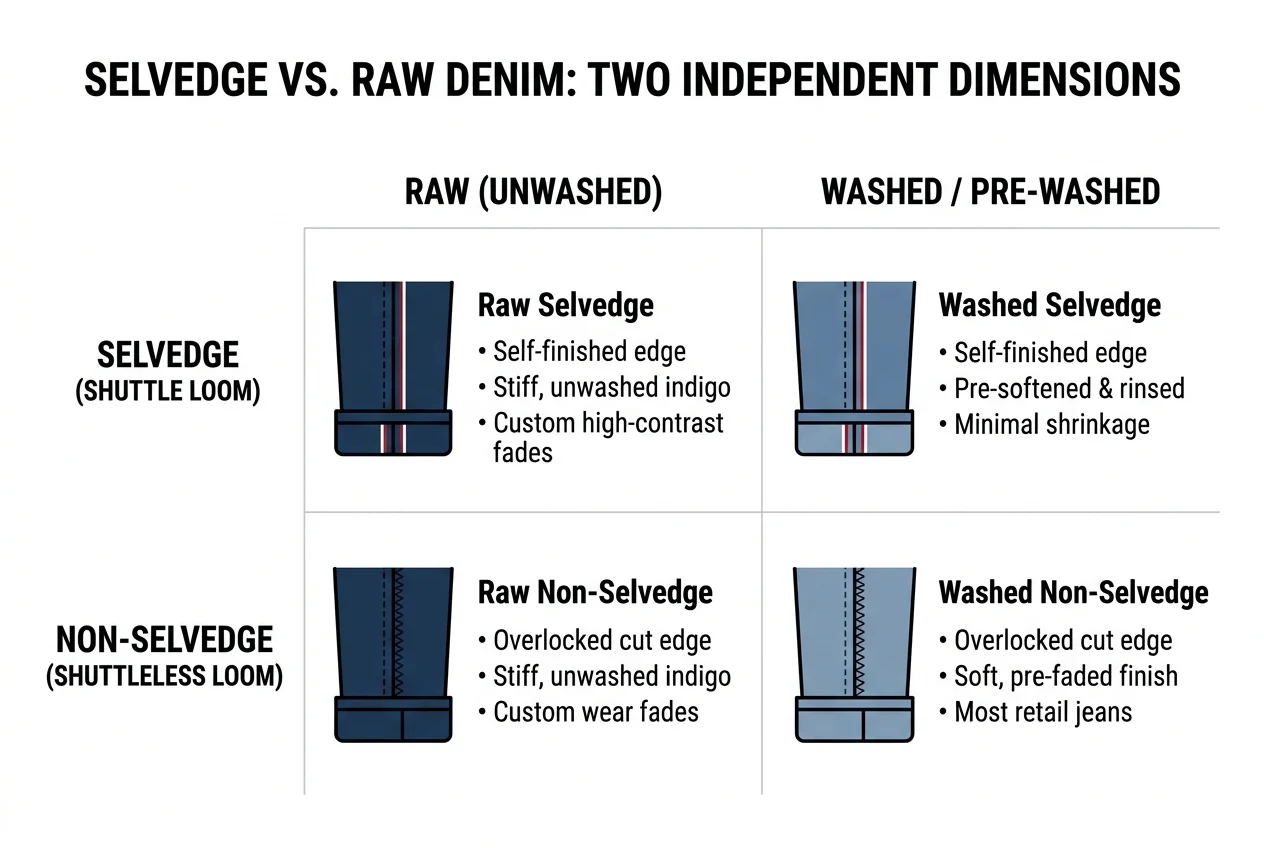
Use the four-quadrant matrix below to identify which combination sits in front of you before checking fit or weight:
| Denim combination | Loom & outseam edge | Post-weave wash state | Initial hand-feel & fading behavior |
|---|---|---|---|
| Raw selvedge | Shuttle loom; clean self-finished busted outseam | Unwashed, unsanded, untreated after sewing | Stiff deep indigo; fades strictly from wearer creases and friction |
| Washed or rinsed selvedge | Shuttle loom; clean self-finished busted outseam | Factory rinsed, softened, or garment-washed | Softer out of the box; shrinkage reduced before purchase |
| Raw non-selvedge | Shuttleless loom; cut edge finished with overlock stitching | Unwashed, unsanded, untreated after sewing | Stiff deep indigo; still develops personal whiskers and honeycombs |
| Pre-washed non-selvedge | Shuttleless loom; cut edge finished with overlock stitching | Factory washed, stone-washed, or enzyme-treated | Soft and broken-in immediately; accounts for most everyday retail jeans |
Separating those two columns prevents two classic buying mistakes: assuming every cuffed red-line selvedge jean will shrink heavily or stain light upholstery, or assuming a dark non-selvedge pair with overlocked seams has already been washed and color-locked.
What is selvedge denim, and how does loom choice change the fabric?
Selvedge denim—spelled selvedge in British English and selvage in U.S. English—is warp-faced twill denim woven on a shuttle loom whose continuous weft yarn turns back at both sides to form a tightly bound “self-edge.” Used since the 16th century, a self-finished edge resists unraveling and fraying without requiring a separate hem or bias tape.
Every piece of traditional denim starts with a sturdy cotton warp-faced 3/1 twill weave, in which each horizontal weft thread passes under two or more vertical warp threads. That twill stepping creates diagonal ribbing that separates denim from flat plain-weave fabrics such as cotton duck canvas. Because indigo denim dyes the warp threads blue while leaving the weft threads white, the warp-faced twill places blue yarns on the exterior face and leaves the inside of jeans predominantly white.
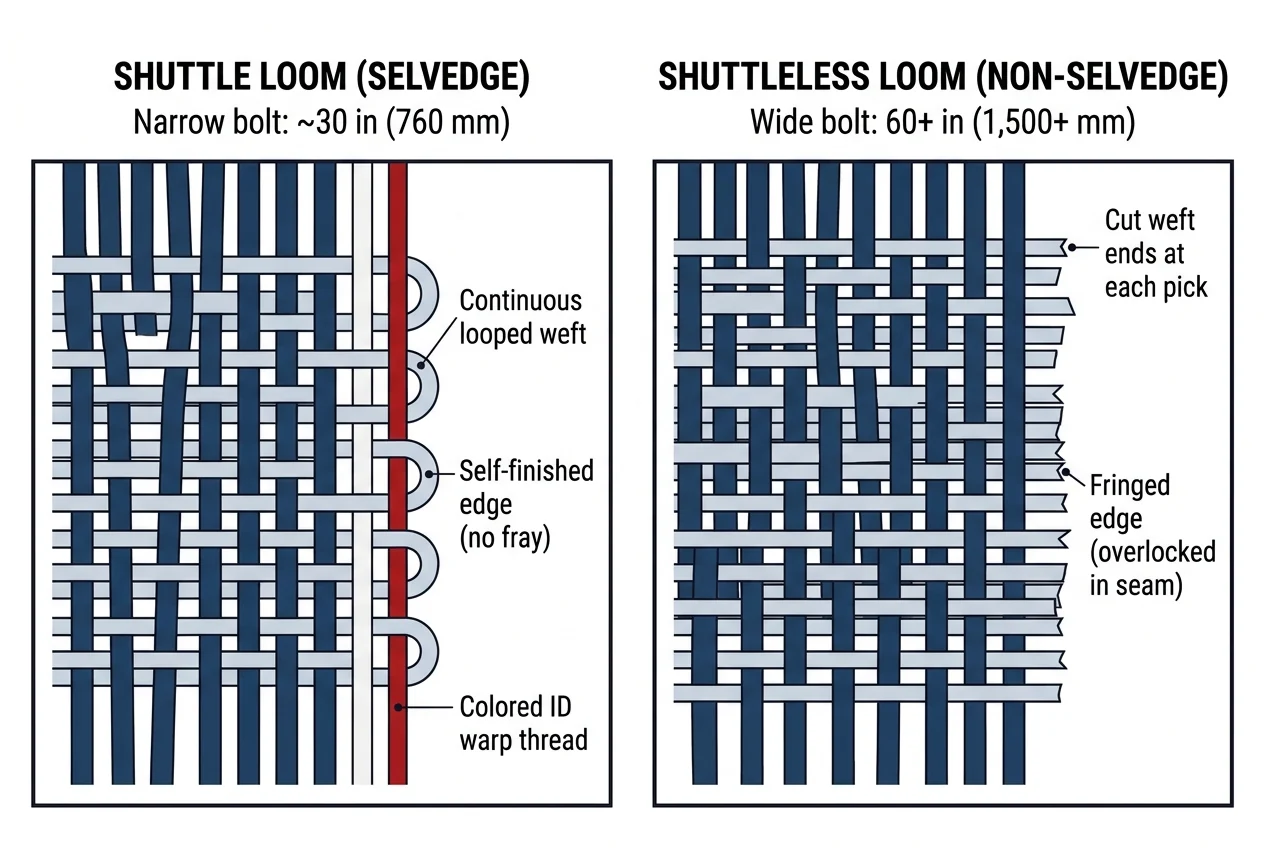
The loom determines what happens at the left and right borders of that woven bolt:
| Construction attribute | Shuttle loom (selvedge denim) | Shuttleless loom (non-selvedge denim) |
|---|---|---|
| Typical bolt width | Narrow roll, typically 30 inches (760 mm) wide | Wide roll, 60 inches (1,500 mm) or wider |
| Weft path at edge | Continuous weft yarn reverses direction on each pass | Projectile, air-jet, or water-jet loom cuts each weft pick |
| Resulting edge structure | Clean, tight self-finished edge (most narrow, some up to 0.75 inches / 19 mm) | Fringed edge, leno-locked weave, or mechanically tucked edge |
| Visual identifier | Contrasting colored warp thread along the flat-pressed busted outseam | Overlocked (serged) interior seam covering trimmed cut edges |
| Fabric consumption & pace | Slower weaving speed; requires more linear fabric length per pair | Faster output and higher pattern yield from wider rolls |
Why selvedge jeans take more cloth and mill time
Because traditional shuttle looms weave narrow 30-inch (760 mm) bolts at a slower pace than modern 60-inch (1,500 mm) shuttleless machines, cutting the same number of garments requires more meters of fabric and more mill production time. Placing the finished selvedge cleanly along a busted outseam originally solved a practical manufacturing goal: jeans makers could cut leg panels right up to the roll border and maximize usable fabric without overlocking the outer edge.
Showcasing that selvedge straight down the outer leg still demands greater care during cutting and assemblage, which is why shuttle-loom denim became closely linked to heritage and specialty garments. When pairing cuffed selvedge jeans with boots or chunky trainers, check how cuff turn-ups alter visual break and leg balance in our men’s streetwear layering and proportions guide.
How does raw denim differ from pre-washed regular jeans?
Raw denim—also called dry denim or unwashed denim—is denim that has never been washed, sanded, or garment-treated after leaving the sewing floor, whereas pre-washed regular jeans undergo industrial washing to soften the fabric and minimize shrinkage before retail sale. Until the 1960s, all jeans were sold raw and stiff so the wearer broke them in through use.
Commercial pre-washing reshaped everyday denim over two decades. In 1965, New York East Village boutique Limbo was reported as the first retailer to wash new jeans for a worn-in look, and in the early 1980s the broader denim industry adopted stone washing. Today, garment finishing can range from a single factory rinse to heavy distressing that pairs physical abrasion with cellulase enzymes or chemical treatments so newly sewn jeans mimic dry denim faded over years of wear.
How rope-dyed indigo creates personal fade patterns
Raw denim fades differently from most colored cotton trousers because of how indigo bonds to cotton yarn. Most modern denim uses synthetic indigo—roughly 20 thousand tons are produced annually worldwide for denim, though only a few grams dye each pair—applied to the warp yarns through repeated dipping and air oxidation cycles.
Two industrial warp-dyeing methods dominate denim production:
- Rope dyeing (developed in 1915): Continuous yarns are gathered into long ropes, dipped into indigo vats and oxidized in sequence—often up to thirty times—and then re-beamed for weaving. Re-beaming distributes minor bath variations evenly across the warp, preventing side-to-side shade bands.
- Slasher or sheet dyeing (developed in the 1970s): Parallel warp yarns travel through dye vats laid out in sheet order, making bath circulation critical to avoiding edge-to-edge shade shifts.
Unlike vat dyeing, which fully saturates yarn right to the center, repeated short indigo dips leave a ring-dyed structure: a deep blue shell coating a white cotton core. As raw jeans bend and rub against your body, friction strips surface indigo first at high-stress zones—knees, seams, upper thighs, pockets, and ankles—gradually revealing the white interior core. Over extended wear, dry denim forms four signature patterns:
- Whiskers: Faded streaks radiating outward from the crotch and lap creases.
- Honeycombs: Meshes of crisp faded line segments behind the knees.
- Stacks: Irregular horizontal fade bands above the ankle where excess hem fabric accordions over footwear.
- Train tracks: Parallel abrasion fades running vertically along the pressed outseam edges.
Lifespan, wash water, and care-label checks
Skipping factory abrasion changes both durability and resource footprint. Although stone washing with pumice increases flexibility and softness right away, tumbling cotton twill with abrasive stones shortens the lifespan of the jeans; mills have increasingly shifted toward cellulase enzymes and alternative abrading equipment to reduce pumice usage and chemically tainted residue.
Factory washing also adds directly to denim’s water footprint. A typical pair of blue jeans consumes 3,479 litres (919 US gal) of water across its full life cycle—spanning cotton irrigation, manufacturing, and consumer laundry—and factory garment washing alone reaches 90 litres per pair in traditional Pullman machines compared with about 27 litres in modern frontloaders.
When caring for unwashed or dark-rinsed denim at home, inspect the sewn care label closely. Under 16 CFR Part 423 (specifically Section 423.6 for textile wearing apparel), federal care labeling rules specify that omitting a water temperature means regular hot water up to 145 degrees F (63 degrees C) will not harm the garment, and require non-colorfast garments to carry explicit warnings such as “Wash with like colors” or “Wash separately.” That warning is especially important on raw indigo denim whose surface-bound dye transfers onto pale fabrics during early washes.
What does sanforized mean when buying raw or selvedge jeans?
Sanforization is a mechanical pre-shrinking process patented by Sanford Lockwood Cluett in 1930 that stretches, shrinks, and fixes woven cloth in length and width before cutting and sewing. Because sanforization happens at the textile mill rather than as a post-sewing garment wash, sanforized raw denim stays unwashed and stiff while shrinking far less in laundry.
Inside a sanforizing machine, the woven denim is moistened with water or steam and fed between a rotating rubber sleeve and a heated rotating cylinder. As pressure compresses and laterally expands the rubber sleeve before it relaxes back to normal thickness, the cloth is forced to contract mechanically; greater rubber-sleeve pressure leaves less residual shrinkage during garment use. Pre-shrunk sanforized cloth and finished garments may be labeled to a specific shrink-proof benchmark such as under 1%.
Pre-shrinking transformed denim sizing decades ago: Levi Strauss introduced pre-shrunk 505 regular-fit jeans in 1962 (following Lee and Wrangler, which were already pre-shrunk), allowing buyers to pick their true waist and inseam without guessing post-wash shrinkage. Today, shoppers buying raw denim—whether selvedge or non-selvedge—still encounter two distinct mill-finishing states:
- Sanforized raw denim: Mechanically pre-shrunk before cutting; stays rigid and unwashed with minimal further shrinkage after cold or cool washes.
- Unsanforized (loomstate) raw denim: Skips mechanical pre-shrinking at the mill; requires shrinkage allowance before hemming or tailoring.
Fabric skew and preventing denim leg twist
Shrinkage is not the only dimensional shift in woven twill denim. Under ASTM D3882-08(2020), textile laboratories measure bow and skew of filling yarns across woven fabrics—and the standard specifically notes that a controlled amount of skew is sometimes intentionally engineered into twill fabrics to prevent twisting of pant legs.
When a twill denim is left completely loomstate without skew stabilization, washing can pull the vertical outseam forward around the shin or calf. If you plan to shorten or tailor raw jeans—especially unsanforized pairs—let any initial shrinkage settle first before bringing exact hem notes to an alterations shop, using our clothing repairs and alterations consultation checklist.
Is selvedge denim automatically higher quality, and how do you read a denim weight chart?
No: quality denim can be produced on either shuttle or shuttleless looms, and a selvedge edge does not automatically guarantee heavier, tougher, or better-fitting jeans. Denim manufacture spans five main stages—raw cotton, spinning, dyeing, weaving, and finishing—and selvedge directly describes only the fourth stage, weaving.
Two pairs of jeans can both display a red-line selvedge cuff yet behave completely differently in everyday wear depending on cotton staple quality, yarn slub, dye depth, finishing, elastane content, and fabric mass. Across the market, denim weight spans 9 to 32 oz per yard (260 to 910 g per yard), with 11 to 14 oz (310 to 400 g per yard) being typical. Commercial raw and selvedge denim catalogs commonly organize weights into lightweight (11 oz), midweight (13.5 to 14.5 oz), and heavyweight (18 to 21 oz) tiers.
To compare U.S. ounce-per-square-yard specs against metric GSM tags cleanly, multiply by the exact NIST Special Publication 811 factor: each ounce (avoirdupois) per square yard equals 3.390575E-02 kg/m² (33.90575 g/m²).
| Denim weight tier | Imperial weight (oz/yd²) | Metric mass (g/m², via NIST SP 811) | Practical wear & break-in profile |
|---|---|---|---|
| Ultra-light baseline | 9 oz/yd² | 305 g/m² | Lower end of denim weight range; breathable for warm-weather shirts and light trousers |
| Lightweight | 11 oz/yd² | 373 g/m² | Easy drape; frequent tier for lightweight raw and stretch selvedge jeans |
| Typical everyday range | 11 to 14 oz/yd² | 373 to 475 g/m² | Standard all-season denim benchmark balancing structure and break-in comfort |
| Midweight raw/selvedge | 13.5 to 14.5 oz/yd² | 458 to 492 g/m² | Classic raw indigo weight; crisp initial creases without extreme stiffness |
| Heavyweight raw/selvedge | 18 to 21 oz/yd² | 610 to 712 g/m² | Thick, rigid cloth demanding a longer break-in; pronounced high-contrast wear lines |
| Extreme heavyweight ceiling | 32 oz/yd² | 1,085 g/m² | Upper end of specialty denim production; stiff collector cloth rather than daily wear |
Fiber blend matters just as much as weight. While traditional denim is 100% cotton, stretch denim substitutes an elastane component such as Spandex or Lycra for up to 3% of the cotton, delivering elasticity of up to 15%—and stretch yarns are woven on both shuttle looms (as lightweight 11 oz stretch selvedge) and wide shuttleless looms. Before adding a new weight tier to your rotation, map which tops and footwear it actually pairs with using our men’s street-casual capsule wardrobe checklist.
Textile standards mills use to measure denim specs
When comparing published fabric specs across brands, four ASTM textile standards clarify what laboratory numbers actually measure—and where their limits lie:
- Fabric weight (ASTM D3776/D3776M-20): Establishes four approved options for mass per unit area—Option A (full piece, roll, bolt, or cut), Option B (full-width sample, which includes selvages unless specified), Option C (small lab swatch, which excludes selvages unless an allowance is specified), and Option D (narrow fabrics).
- Weave density (ASTM D3775-17(2023)): Measures end (warp) count and pick (filling) count across woven fabrics, quantifying how tightly yarns pack per centimeter or inch.
- Abrasion resistance (ASTM D4966-22): Tests textile abrasion using the Martindale abrasion tester while explicitly cautioning that laboratory abrasion cycles represent only one of several factors contributing to actual wear performance and durability.
- Roll-level cotton denim specification (ASTM D6554/D6554M-14, withdrawn 2023): Historically covered roll-ready performance requirements for 100% cotton woven denim fabrics prior to making jeans, casual apparel, work clothing, and outerwear, before being withdrawn without replacement in 2023.
Understanding both axes—shuttle-loom edge versus wash state, alongside weight and sanforization—lets you read any denim product tag without guesswork. For more textile breakdowns and everyday wardrobe guides, browse the full editorial archive.