Duck canvas—also called cotton duck or duck cloth—is a heavy, tightly woven plain-weave cotton fabric woven with two yarns together in the warp and a single yarn in the weft. Named after the Dutch word doek (“cloth”) rather than waterfowl, its dense, flat structure resists snagging and tearing and softens with repeated wear and washing.
- Fibre and name: Heavy cotton fabric (with linen duck used less often) and unrelated to birds or down.
- Weave geometry: A tight plain weave with identical face and back, giving a smooth surface without diagonal twill ribs.
- Weight scale: U.S. numbered duck grades run inversely, so a lower number marks a heavier cloth.
What is duck canvas and why is it called “duck”?
Cotton duck takes its name from the Dutch word doek, meaning cloth, and has nothing to do with waterfowl or feathers. In textile construction, duck canvas is a heavy plain-woven cotton cloth built by weaving two parallel yarns together in the warp against a single yarn in the weft.
Linen duck also exists, though modern garments and workwear rely predominantly on cotton. Because two warp yarns pack tightly around each weft thread in a flat plain weave, the resulting cloth feels noticeably denser and smoother than looser plain-woven cottons.
That same tight cotton construction shaped several everyday goods well beyond chore jackets. Cotton duck strips formed the backing of early duck tape—recorded in the Oxford English Dictionary as in use since 1899—and Levi Strauss and Jacob Davis even constructed their earliest pairs of riveted jeans from duck canvas before switching over to denim a few years later.
Is there a difference between regular cotton canvas and duck canvas?
Yes: canvas comes in two basic varieties, plain and duck, and the threads in duck canvas are woven more tightly than in plain canvas. Both share a plain weave rather than a twill weave, yet duck canvas’s tighter thread packing gives it a smoother surface that resists snagging and tearing.
The word “canvas” itself traces back to 13th-century Anglo-French canevaz and Old French canevas, derived from Vulgar Latin cannapaceus (“made of hemp”) and Greek kannabis. While historical canvases were made from hemp or linen, modern apparel and utility canvas relies primarily on cotton.
When comparing unlabeled “canvas” garments against cotton duck, check both tightness of weave and stated fabric mass. In general canvas classification (such as stretched artist canvas), light-weight cloth sits around 4 to 5 oz/yd² (140 to 170 g/m²), medium-weight around 7 to 8 oz/yd² (240 to 270 g/m²), and heavy-weight around 10 to 12 oz/yd² (340 to 410 g/m²). Numbered cotton duck picks up right at that heavy range and climbs far higher for workwear and gear.
What do duck canvas numbers and weights mean?
In the United States, numbered cotton duck uses an inverse grading system established in the 1920s by the Cotton Duck Association and the U.S. Department of Commerce: Grade 1 is the heaviest cloth and Grade 12 is the lightest. A lower grade number therefore always indicates heavier, thicker fabric.
The grade comes from a specific historical benchmark based on a 36-by-22-inch (91 cm by 56 cm) piece of cloth: the duck number equals 19 minus the weight of that piece in ounces. Cloth weighing under 19 ounces for that reference piece is called numbered duck, whereas heavier grades above 19 ounces are called naught duck. For example, a 36-by-22-inch piece of No. 8 numbered duck weighs 11 ounces (310 g), because 19 minus 8 equals 11. Although the scale nominally runs from 1 to 12, grades 7, 9, and 11 are no longer used.
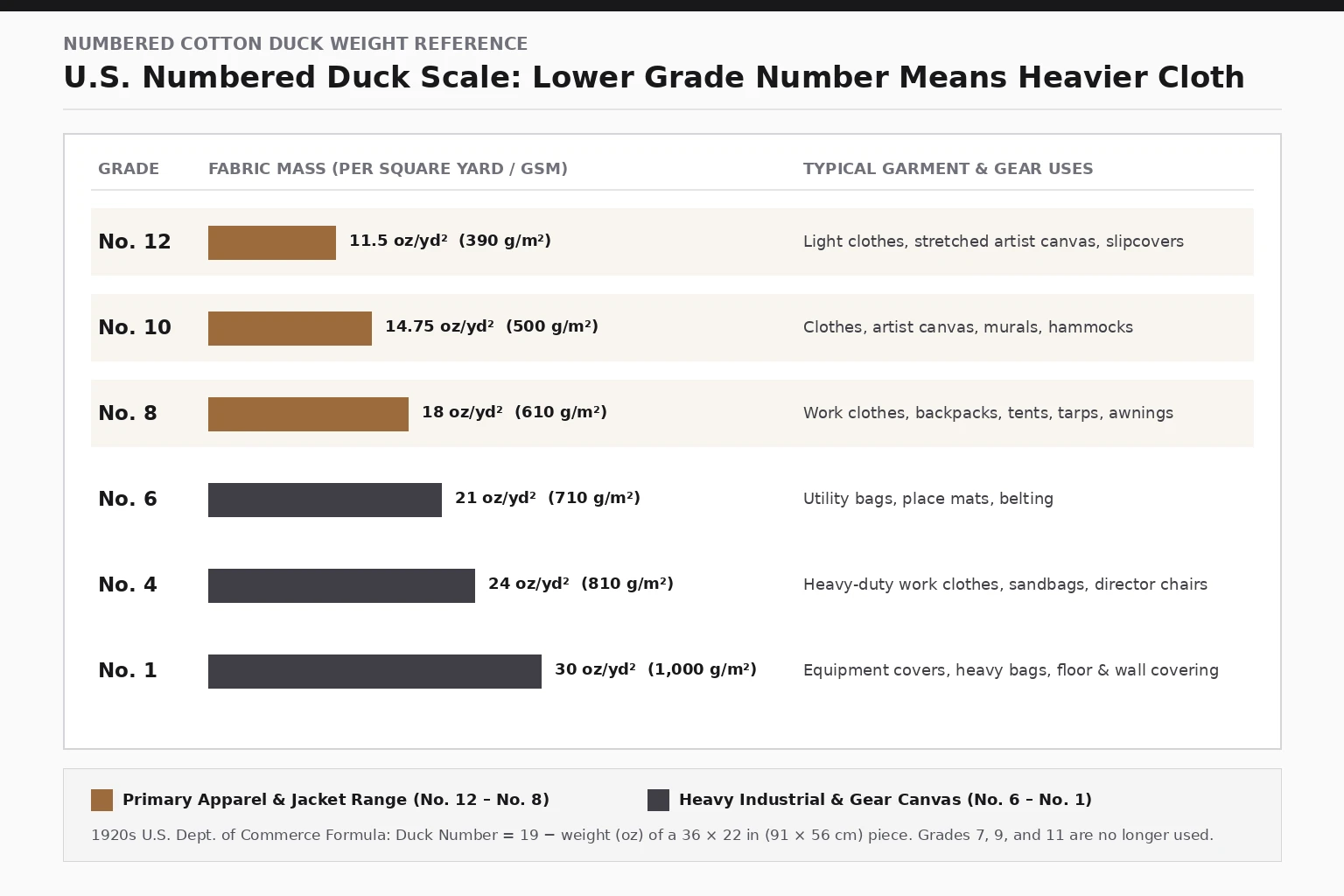
Because linear-yard 22-inch weights are easily confused with full square-yard specs, compare garments using per-square-yard ounces (oz/yd²) or grams per square meter (g/m²):
| Numbered duck grade | Weight per square yard (oz/yd²) | Metric mass (g/m²) | Typical listed applications |
|---|---|---|---|
| No. 12 | 11.5 oz/yd² | 390 g/m² | Light clothes, stretched artist canvas, furniture slipcovers |
| No. 10 | 14.75 oz/yd² | 500 g/m² | Clothes, artist canvas, murals, shower curtains, hammocks |
| No. 8 | 18 oz/yd² | 610 g/m² | Work clothes, backpacks, tents, tarps, awnings, clothes bags |
| No. 6 | 21 oz/yd² | 710 g/m² | Utility bags, place mats, belting |
| No. 4 | 24 oz/yd² | 810 g/m² | Heavy-duty work clothes, hammocks, sandbags, director chairs, belting |
| No. 1 | 30 oz/yd² | 1,000 g/m² | Floor and wall covering, equipment covers, heavy bags, storage bins |
How fabric weight, yarn count, and durability are tested
When textile mills and garment brands publish fabric mass in oz/yd² or g/m², ASTM D3776/D3776M-20 defines the standard test methods for mass per unit area (traditionally called fabric weight). The standard specifies four approved specimen options: Option A for a full piece, roll, bolt, or cut; Option B for a full-width sample; Option C for a small swatch; and Option D for narrow fabrics.
To measure weave tightness directly, ASTM D3775 covers the measurement of end (warp) and pick (filling) count across woven fabrics. For mechanical durability, ASTM D2261 measures fabric tearing strength by the tongue (single rip) procedure on a constant-rate-of-extension (CRE) tensile testing machine, while ASTM D4966 determines textile abrasion resistance using the Martindale abrasion tester.
If you also compare cotton outerwear against synthetic shells, pair fabric mass with yarn and construction details—our ripstop nylon fabric weight and weave guide explains why GSM and yarn denier must be read side by side.
How does duck canvas compare to denim, cotton twill, and chino cloth?
Duck canvas uses a flat plain weave with matching warp and weft colors, whereas denim and chino cloth are warp-faced twills featuring parallel diagonal ribs called wales. Because twills have fewer yarn interlacings than plain weave, denim and chino drape more softly from day one while duck canvas holds a crisper, flatter silhouette.
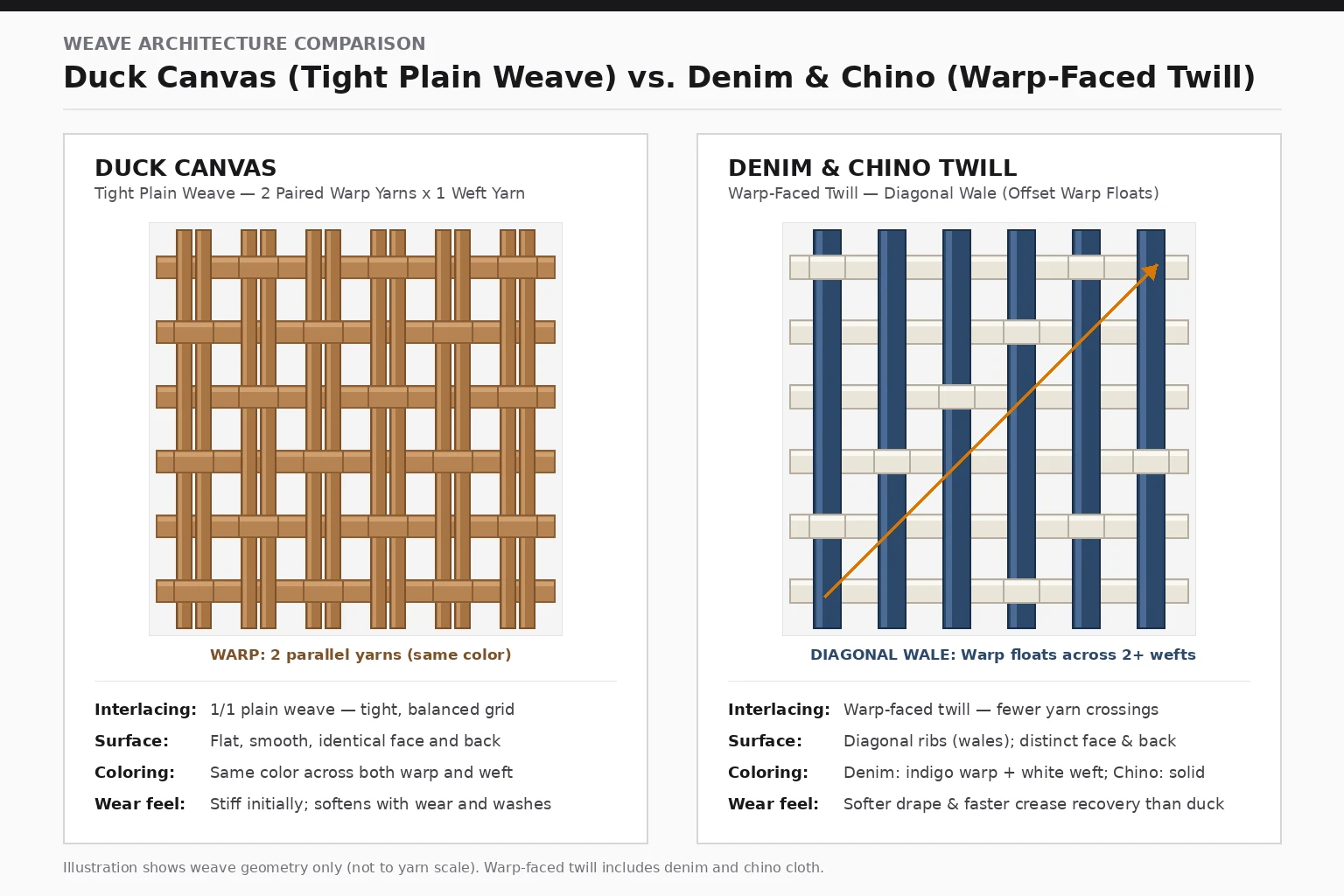
Use this side-by-side matrix to distinguish the four woven cotton workwear and casualwear fabrics at a glance:
| Fabric | Weave structure | Surface and face vs. back | Typical yarn coloring | Reference weight context | Wear and drape traits |
|---|---|---|---|---|---|
| Duck canvas | Tight plain weave (two warp yarns x one weft) | Flat, smooth, identical face and back | Normally single solid color (often brown-orange, black, navy, indigo, khaki) | No. 12 at 11.5 oz/yd² (390 g/m²) to No. 1 at 30 oz/yd² (1,000 g/m²) | Stiff at first; softens with wear and washes; resists snagging |
| Plain canvas | Standard plain weave | Plain woven, looser thread density than duck | Natural unbleached or piece-dyed solid | Light 4–5 oz/yd² (140–170 g/m²) to heavy 10–12 oz/yd² (340–410 g/m²) | Sturdy flat cloth; more open grain than cotton duck |
| Denim | Warp-faced twill (weft passes under two or more warps) | Pronounced diagonal ribbing; distinct face and back | Dyed indigo warp with undyed white weft | 9 to 32 oz (260 to 910 g) per yard; 11 to 14 oz (310 to 400 g) typical | Ring-dyed indigo fades at knees, seams, and pockets; pliable twill drape |
| Chino cloth (cotton twill) | Warp-faced twill | Fine diagonal ribs (wales); distinct technical face and back | Solid earth tones, traditionally khaki (light brown) | Pure cotton or cotton-synthetic blend trouser twill | Softer, more pliable drape and stronger crease recovery than plain weave |
Duck canvas vs. denim
Denim is a sturdy, cotton, warp-faced twill in which each weft thread passes under two or more warp threads, producing diagonal ribbing that immediately separates it visually from flat cotton duck. Typical denim weighs 11 to 14 oz (310 to 400 g) per yard within a broader 9 to 32 oz (260 to 910 g) range.
Dyeing creates the second major contrast. Most indigo denim dyes only the warp yarns while leaving the weft yarns white, so the outside of a pair of jeans reads blue and the inside appears predominantly white. Because indigo adheres primarily to the outer surface of the yarn in a ring-dyed structure, abrasion gradually reveals lighter cotton cores along knees, seams, and pockets. By contrast, duck canvas normally uses one color across both warp and weft—commonly brown-orange, black, navy, indigo, or khaki—so wear softens the cloth and tones down color more uniformly rather than exposing a bright white weft underside.
Historically, both cloths built American workwear side by side: Jacob W. Davis and Levi Strauss popularized rivet-reinforced denim pants in 1873 after first using duck canvas for their earliest riveted jeans.
Chino vs. twill and how both differ from duck canvas
When comparing trousers, chino vs. twill is not an either-or contrast: twill is a fundamental weave category, and chino cloth is one specific fabric woven in a twill pattern. Alongside plain weave and satin, twill is one of the three fundamental textile weaves, identified by parallel diagonal ribs (wales) created when yarns pass two up and one down in an offset step rather than alternating one up and one down as in plain weave. Warp-faced twills include chino, denim, drill, gabardine, and cavalry twill.
Chino cloth began in the mid-19th century as a durable, comfortable pure-cotton twill dyed in Indian khaki for military uniforms, becoming standard issue for both the British Army and the United States Army in the latter half of the 19th century (modern chinos also appear in cotton-synthetic blends). Unlike plain-weave duck canvas—whose two sides are identical—twill fabrics have a technical face and technical back. Because twills contain fewer yarn interlacings than plain weaves, the yarns shift more freely: chino and cotton twill feel softer, drape more fluidly, recover from creasing better, and disguise surface soiling on their uneven ribbed face better than smooth plain-weave cotton duck.
What is duck canvas used for in clothing and how does it break in?
Cotton duck is used across chore jackets, work pants, overalls, sneakers, backpacks, tents, sandbags, and traditional boat sails because its thick, tightly woven cotton construction resists tearing, snagging, and rough wear. In apparel, duck canvas feels stiff out of the box and breaks in progressively through repeated wear and washing.
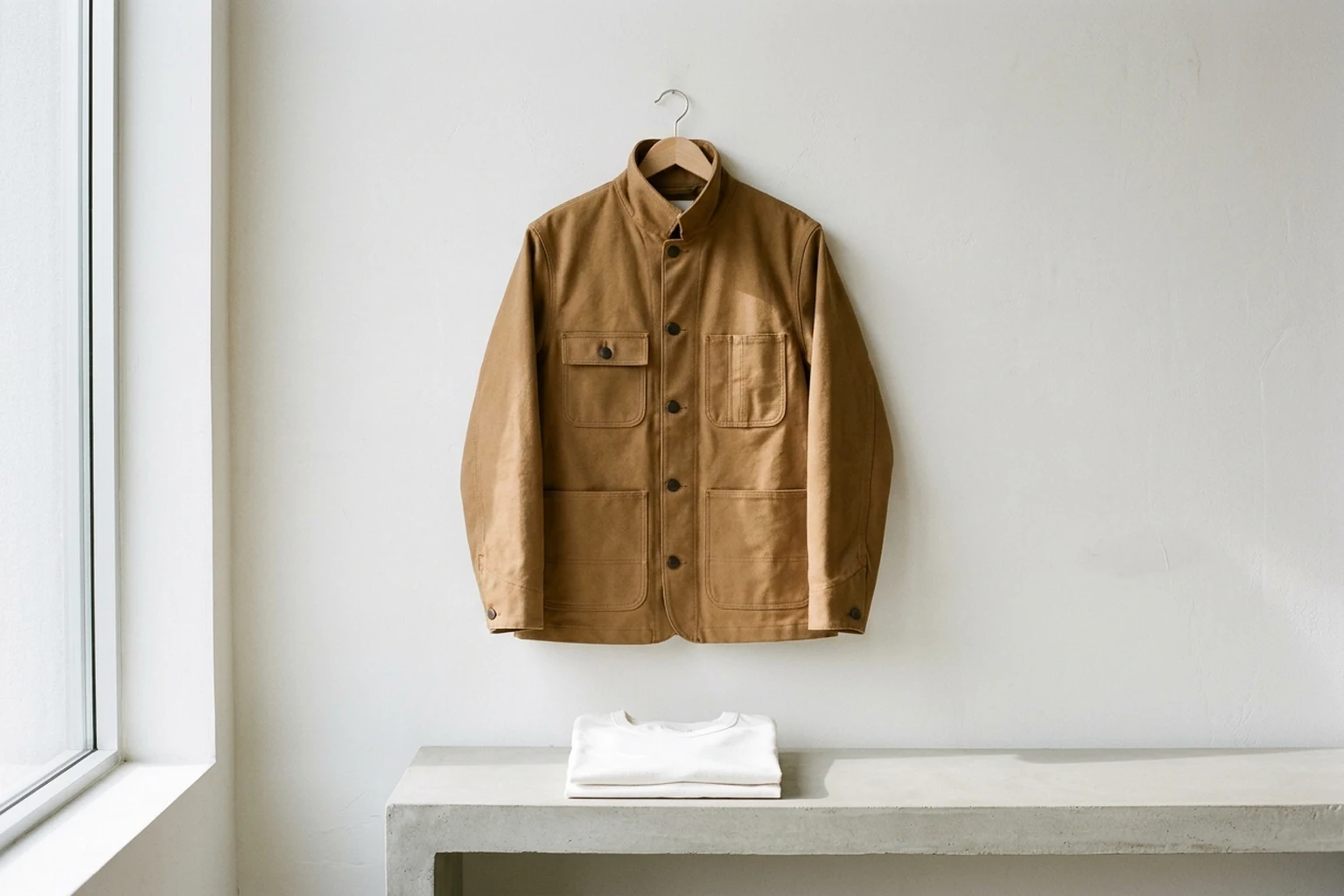
Historically, white untwilled cotton or linen duck uniforms clothed British and French soldiers in tropical postings. In modern workwear and street style, heritage makers such as Carhartt and Pointer Brand anchor the category with duck chore coats, work trousers, and overalls. Because the tight weave blocks wind strongly among workwear fabrics, an unlined duck chore jacket layers cleanly over a tee or heavyweight hoodie when temperatures dip.
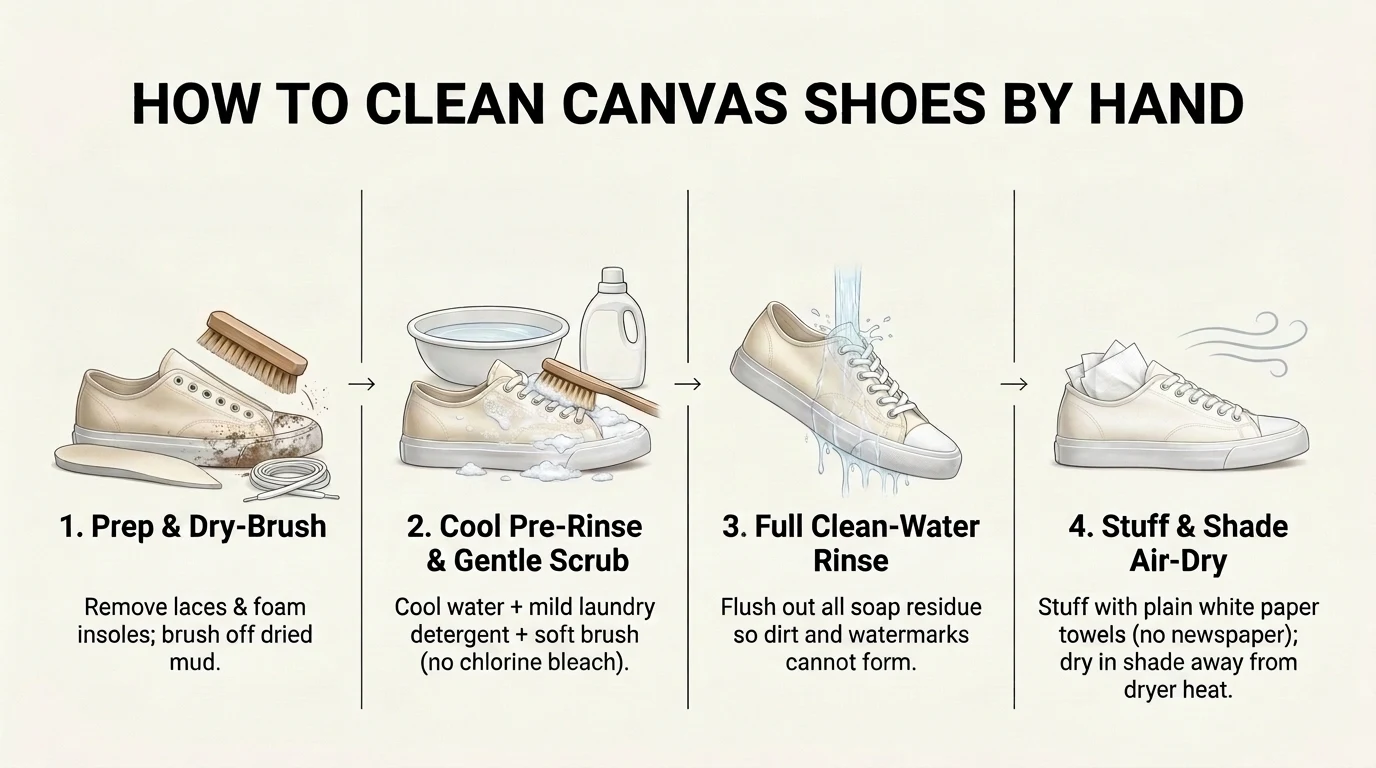
Two practical properties distinguish cotton duck from synthetic streetwear shells. First, its crisp plain weave holds boxy shoulder and sleeve lines rather than collapsing closely against the body—check cuff clearance and hem drops over your usual base layers using our streetwear layering and proportions guide. Second, while cotton duck is certainly flammable, a few stray campfire sparks or shop ashes are less likely to melt pinholes into cotton duck than into nylon or similar synthetics. For synthetic abrasion and outdoor shell comparisons, read our ripstop nylon vs. CORDURA and polyester outerwear breakdown, and if you wear duck or plain canvas sneakers, follow our hand-wash guide for cleaning canvas shoes.
Is duck canvas naturally waterproof or only water-resistant?
Untreated cotton duck is tightly woven enough to block wind and provide light weather resistance, but raw cotton fibers are not naturally waterproof. Treating duck canvas with wax makes the fabric waterproof, yet wax impregnation trades away breathability and introduces regular maintenance.
Waxed cotton—cotton impregnated with paraffin or natural beeswax-based wax—developed in England and Scotland’s sailing industry and was widely used for waterproofing from the 1920s to the mid-1950s. While waxed duck remains prized for rugged jackets and bags, it carries two clear drawbacks compared with modern synthetic waterproof shells: waxed cloth is not very breathable, and it tends to feel heavier and bulkier.
Expect visible character and upkeep if you choose waxed duck canvas:
- Patina and chalk marks: As the wax layer experiences friction and folding, it develops a patina along with light-colored crease lines called chalk marks.
- Drying and storage: Waxed cotton products should not be stored damp; allow wet garments to dry slowly before hanging them away.
- Re-waxing cycle: Waxed cotton typically requires annual re-waxing to maintain its barrier.
If your daily commute demands lightweight rain protection rather than heavy waxed workwear, compare coated synthetic shells in our guide to ripstop nylon waterproofing and hydrostatic head ratings, or browse all fabric and styling explainers in the editorial archive.