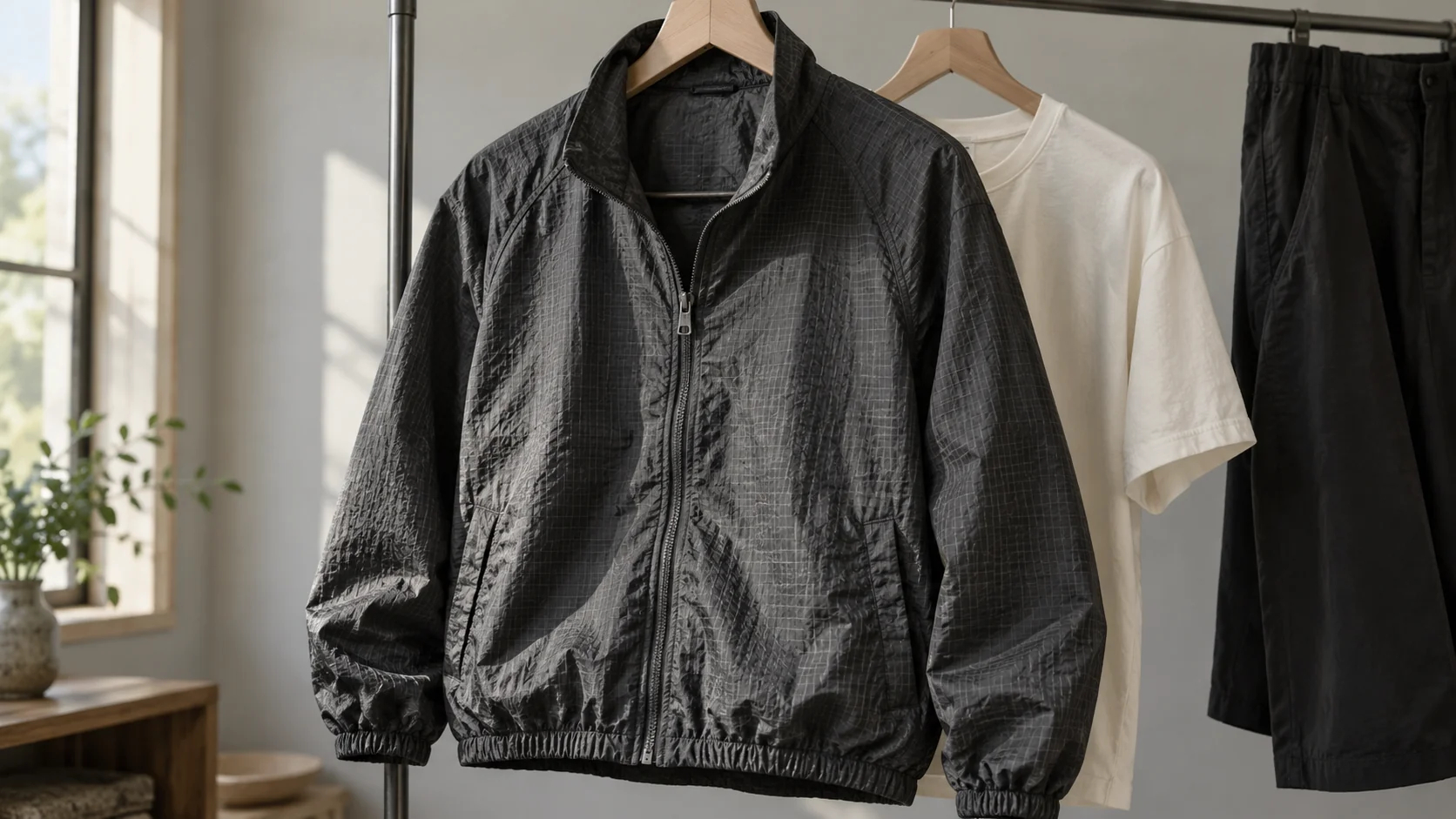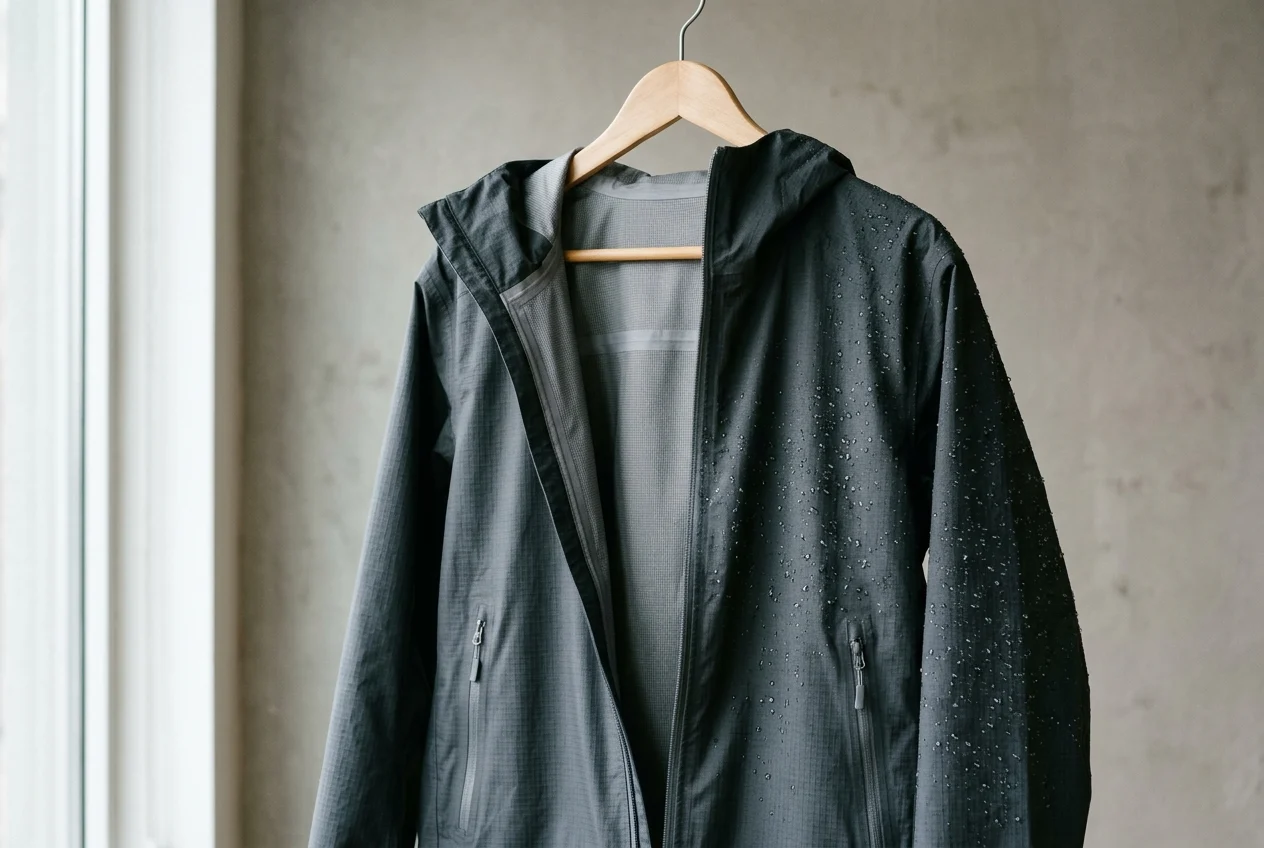
Ripstop nylon is a reinforced woven nylon construction, not a waterproofing treatment on its own. Whether a ripstop nylon jacket, windbreaker, poncho, or pack keeps rain out depends on three separate build details: the backing barrier and its hydrostatic head resistance, heat-sealed seam tape over stitched needle holes, and an intact exterior durable water-repellent (DWR) finish. For yarn denier, fabric GSM weight, and reinforcement grid spacing basics, start with our guide to ripstop nylon fabric weight and weave.
- Backing barrier and water column. Check whether the cloth uses only a surface water-repellent finish, a solid polyurethane (PU) coating, or a laminated membrane evaluated by hydrostatic pressure.
- Seam sealing. Inspect the inside of the garment to see whether stitched needle holes are covered with heat-sealed seam tape.
- Surface DWR care. Match wash temperature, liquid cleaner type, and heat or air-dry re-proofing steps to the garment’s care label and membrane construction.
What is ripstop nylon used for across construction tiers?
Suppliers produce ripstop nylon across distinct moisture-protection tiers, pairing specific yarn deniers and finishes with different apparel and equipment end uses.
Uncoated and DWR-only ripstop nylon
Flagship item 7020-T1 is a 30D * 30D High Tenacity 100% Nylon6.6 fabric weighing 36 g/m2 (1.12 oz/yd2) with a 0.4*0.4CM / Square grid, Water Repellent and Anti-Fusible finish, and PIA-C-7020 Type I Parachute end usage. Flagship item 7020-T1 lists an Air Permeability of 90-110 C.F.M - 125PA. Under test method ASTM D0737, Flagship 7020-T1 has an Air Permeability value of 90-110 C.F.M.
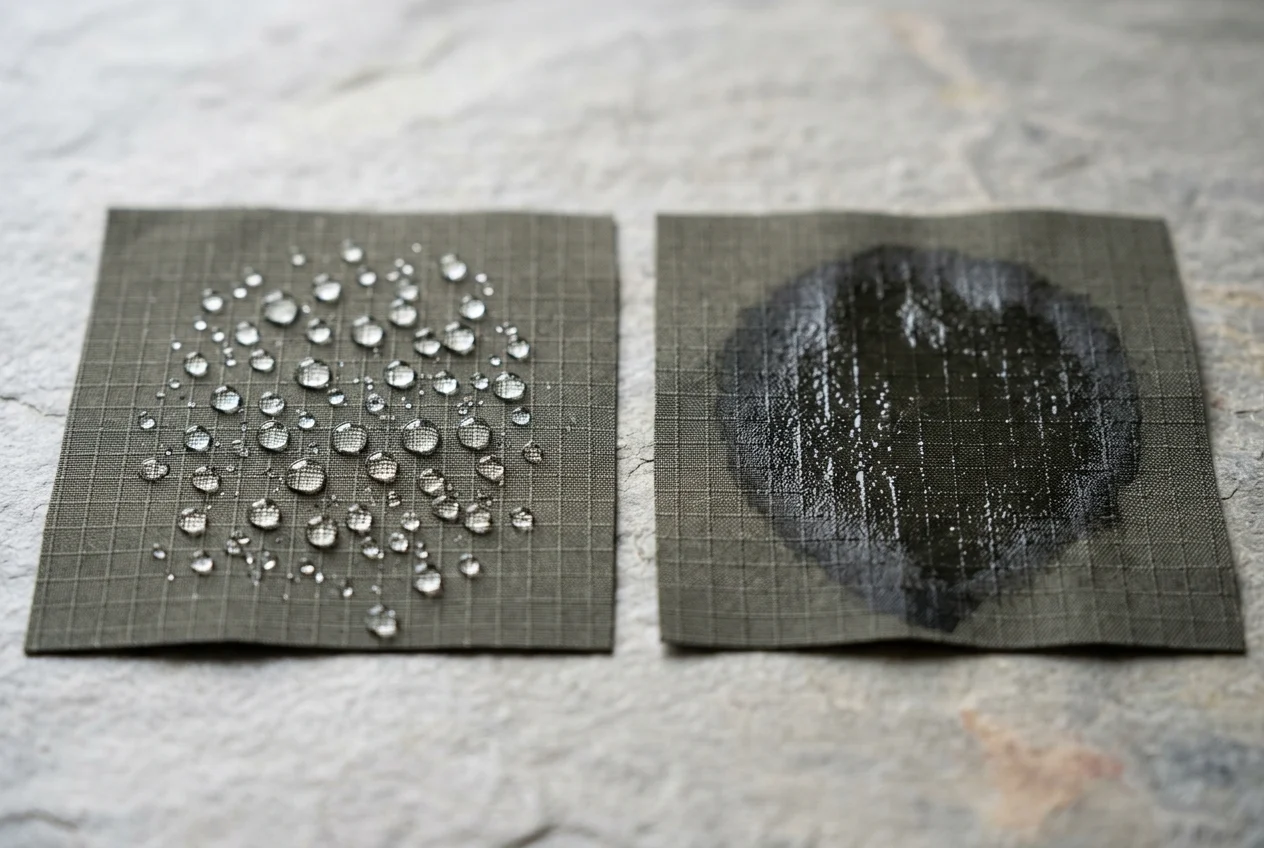
Ottertex Nylon Ripstop (DWR Coating) is sourced from 70 denier thick, 100% nylon fibers with a square-like pattern that repeats every 1/8 inches vertically and horizontally, treated with a durable water-repellent (DWR) coating that repels liquids from the surface. Ottertex Nylon Ripstop (DWR Coating) measures 58/60 inches wide, is 0.12 millimeters thick, has a 70 GSM weight, is sold in 100-yard roll increments, and can be used to sew apparel such as jackets, windbreakers, and tracksuits as well as BBQ covers, tents, bags, and flags. Under its WATER-RESISTANT feature description for DWR-coated ripstop, Ottertex states that most liquids will be rejected by the fabric up to a certain amount of pressure, and after that, some water may penetrate.
Polyurethane (PU) coated ripstop nylon
Ottertex Nylon Ripstop (PU Coating) is sourced from 70 denier thick, 100% nylon fibers with 1/8 inch squares and is treated with a polyurethane (PU) coating that makes the fabric waterproof. Ottertex Nylon Ripstop (PU Coating) measures 62/63 inches wide, is 0.13 millimeters thick, has a 70 GSM weight, resists abrasions, and is used to sew outerwear like jackets, tracksuits, bathing suits, and uniforms as well as backpacks, flags, tents, and covers.
Across technical datasheets, PU-coated ripstop nylon spans multiple hydrostatic head levels even within the same yarn denier:
- Light PU rainwear and tarp cloth. Flagship item NR70P is a 70D * 70D, 100% Nylon fabric weighing 73 g/m2 (2.21oz/yd2) with a 3MM Ripstop grid, Durable Water Repellent water repellency, PU Coated finish, and Poncho / Tent / Tarp / Rain Coat end usage. Flagship NR70P lists a Hydrostatic Head of 800 MM (tested as ISO 811:2018 800 MM) and an Air Permeability of 0 C.F.M under ASTM D0737.
- FR-treated PU ripstop cloth. Paskal 70D Nylon Ripstop PU Coated FR Treated has a 100% Nylon base fabric, an 80 gsm weight, a 150cm roll width, and a 100 metres roll length. Paskal 70D Nylon Ripstop PU Coated FR Treated achieves a Hydrostatic Head result of 1000mm under test method AS 2001.2.17. Paskal 70D Nylon Ripstop PU Coated FR Treated lists a Spray Rating under test method ISO 4920 100. Paskal 70D Nylon Ripstop PU Coated FR Treated has a Breaking Force of Warp 569 N and Weft 402 N under AS 2001.2.3.1, and a Tearing Force of Warp 21 N and Weft 18 N under AS 2001.2.10.
- Mid-grade PU rainwear and tent cloth. Flagship item NR705P is a 70D * 70D, 100% Nylon fabric weighing 78 g/m2 (2.3oz/yd2) with a 5MM Ripstop grid, Durable Water Repellent water repellency, PU Coated finish, and Poncho / Tent / Tarp / Rain Coat end usage. Flagship NR705P has a Hydrostatic Head of 3000 MM tested under ISO 811:2018 and an Air Permeability of 0 C.F.M under ASTM D0737.
- Heavy-duty colored PU ripstop cloth. Flagship item NR210CP is a 210D * 210D, 100% Nylon fabric weighing 185 g/m2 (5.46oz/yd2) with a Ripstop grid, Durable Water Repellent water repellency, Colored PU Coated finish, and Poncho / Tent / Tarp / Rain Coat end usage. Flagship NR210CP has a Hydrostatic Head of 10000 MM tested under ISO 811:2018 and an Air Permeability of 0 C.F.M under ASTM D0737. Flagship remarks that listed values represent average values or estimates and actual weight of fabric has a tolerance of +/-3%.
Laminated waterproof-breathable ripstop nylon
Pertex Shield fabrics are a system comprised of a tightly woven face fabric, a Pertex Shield membrane, and an optional backer in 2 Layer, 2.5 Layer, and 3 Layer constructions. Pertex Shield membrane options include a solid non-porous membrane that provides a barrier against rain and snow while passing water vapour via molecular diffusion, and a hydrophobic microporous membrane with holes far smaller than a water droplet that allow moisture vapour to escape by diffusion.
Using a 40D Pertex Shield 3-Layer construction waterproof technology with fluorocarbon-free DWR (148gsm), a hydrostatic head (HH) of 20,000mm, and breathability (MVTR) of 20,000 g/m2/24hrs, the Rab Men’s Firewall Waterproof Jacket carries product code QWI-08. The 3-layer, 40D Pertex Shield fabric on the Rab Firewall Jacket is built to survive scuffs with rock and pack abrasion while remaining hardwearing and comfortable next to skin. In Rab’s Material Facts table for the Men’s Firewall Waterproof Jacket, No PFAS indicates that all intentionally added fluorocarbons (PFAS) have been phased out from the face, membrane, and backer. When packing an outer shell into a city travel wardrobe, see our carry-on capsule wardrobe packing guide.
Supplier and garment specification comparison
| Material or garment specification | Denier and weight | Grid and finish or construction | Hydrostatic head and method | Air permeability or breathability | Listed end usage |
|---|---|---|---|---|---|
| Flagship item 7020-T1 (100% Nylon6.6) | 30D * 30D; 36 g/m2 (1.12 oz/yd2) | 0.4*0.4CM / Square grid; Water Repellent and Anti-Fusible finish | Not listed on data sheet | Air Permeability 90-110 C.F.M (ASTM D0737) | PIA-C-7020 Type I Parachute |
| Ottertex Nylon Ripstop (DWR Coating) (100% nylon) | 70 denier; 70 GSM; 0.12 millimeters thick | 1/8 inches square-like pattern; durable water-repellent (DWR) coating | Rejects most liquids up to a certain amount of pressure | Not listed on product page | Jackets, windbreakers, tracksuits, BBQ covers, tents, bags, flags |
| Ottertex Nylon Ripstop (PU Coating) (100% nylon) | 70 denier; 70 GSM; 0.13 millimeters thick | 1/8 inch squares; polyurethane (PU) coating makes fabric waterproof | Waterproof via PU coating | Not listed on product page | Jackets, tracksuits, bathing suits, uniforms, backpacks, flags, tents, covers |
| Flagship item NR70P (100% Nylon) | 70D * 70D; 73 g/m2 (2.21oz/yd2) | 3MM Ripstop; Durable Water Repellent; PU Coated | 800 MM (ISO 811:2018 800 MM) | Air Permeability 0 C.F.M (ASTM D0737) | Poncho / Tent / Tarp / Rain Coat |
| Paskal 70D Nylon Ripstop PU Coated FR Treated (100% Nylon) | 70D; 80 gsm; 150cm width; 100 metres roll length | PU Coated FR Treated; Spray Rating ISO 4920 100 | 1000mm (AS 2001.2.17) | Not listed on specification sheet | End usage not listed on specification sheet |
| Flagship item NR705P (100% Nylon) | 70D * 70D; 78 g/m2 (2.3oz/yd2) | 5MM Ripstop; Durable Water Repellent; PU Coated | 3000 MM (ISO 811:2018) | Air Permeability 0 C.F.M (ASTM D0737) | Poncho / Tent / Tarp / Rain Coat |
| Flagship item NR210CP (100% Nylon) | 210D * 210D; 185 g/m2 (5.46oz/yd2) | Ripstop grid; Durable Water Repellent; Colored PU Coated | 10000 MM (ISO 811:2018) | Air Permeability 0 C.F.M (ASTM D0737) | Poncho / Tent / Tarp / Rain Coat |
| Rab Men’s Firewall Waterproof Jacket (QWI-08) | 40D; 148gsm | Pertex Shield 3-Layer construction with fluorocarbon-free DWR | 20,000mm | Breathability (MVTR) 20,000 g/m2/24hrs | Waterproof shell jacket (mountain hikes/scrambles) |
How hydrostatic head testing and rainwear classes work
A fabric’s resistance to water penetration is measured in a laboratory by applying a rising column of water pressure against a clamped specimen.
Hydrostatic pressure test method
ISO 811:2018 specifies a hydrostatic pressure method for determining the resistance of fabrics to penetration by water, applicable to all types of fabrics intended to be water resistant whether or not they have been given a water-resistant or water-repellent finish. In the hydrostatic pressure test principle, the hydrostatic head supported by a fabric measures opposition to water passage as a specimen is subjected to steadily increasing water pressure on one side until penetration occurs in three places, and the pressure at the third place is noted. The hydrostatic pressure test result is immediately relevant to the behaviour of fabric articles subjected to water pressure for short or moderate periods of time.
Key parameters of the laboratory procedure include:
- Clamped specimen area. The fabric clamp subjects an area of the fabric of 10 000 mm2 (100 cm2) to steadily increasing water pressure from below or from above the fabric.
- Water temperature. In the hydrostatic test, water contacts the test specimen at either 20 °C ± 2 °C or 27 °C ± 2 °C, and using water at the higher temperature yields lower values of hydrostatic head.
- Rate of pressure increase. The rate of increase of water pressure shall be 10 cm H2O/min ± 0,5 cm H2O/min or 60 cm H2O/min ± 3 cm H2O/min (9,8 mbar H2O/min ± 0,5 mbar H2O/min or 58,8 mbar H2O/min ± 2,9 mbar H2O/min), and results obtained by different rates may not be the same.
- Specimen sampling and creases. At least five test specimens are taken from different places in the fabric, and areas with deep creases or fold marks shall not be tested.
- Recorded units. Test pressure is recorded as centimetres or millibars of water (cm H2O or mbar H2O) at which water first appears at the third place in the specimen, while the SI unit Pa (Pascal) is unusual for this test.
Rainwear waterproof and breathability classes
EN 343 specifies requirements and test methods for the material and seams of clothing designed to protect against precipitation (rain, snow), mist and ground moisture, while a separate test, EN 14360, assesses the rainproofing of complete garments. Since the 2019 revision, both the X value (waterproofing) and the Y value (water vapour resistance, the garment’s breathability) are rated on four classes, where Class 4 is the highest performance and Class 1 the lowest.
- Waterproofing classes. Under EN 343 waterproofing classes (tested to ISO 811), the four classes are X1 (≥ 8,000 Pa), X2 (≥ 13,000 Pa), X3 (≥ 20,000 Pa), and X4 (≥ 30,000 Pa, incl. seams), with the seam included for the Class 4 test.
- Breathability classes. Under EN 343 breathability classes (tested to ISO 15496), the four classes are Y1 (RET > 40 m²Pa/W), Y2 (RET 20–40 m²Pa/W), Y3 (RET 10–20 m²Pa/W), and Y4 (RET ≤ 10 m²Pa/W), where a lower RET means the fabric breathes better.
Why stitched seams leak without heat-sealed seam tape
Even a high-hydrostatic-head ripstop nylon shell will leak through stitched seams if sewing needle perforations are left unsealed. Bemis states that even the most waterproof fabrics and materials will leak through stitched seams if not sealed properly, and seam tape is applied to cover up needle holes and keep a sewn product watertight.
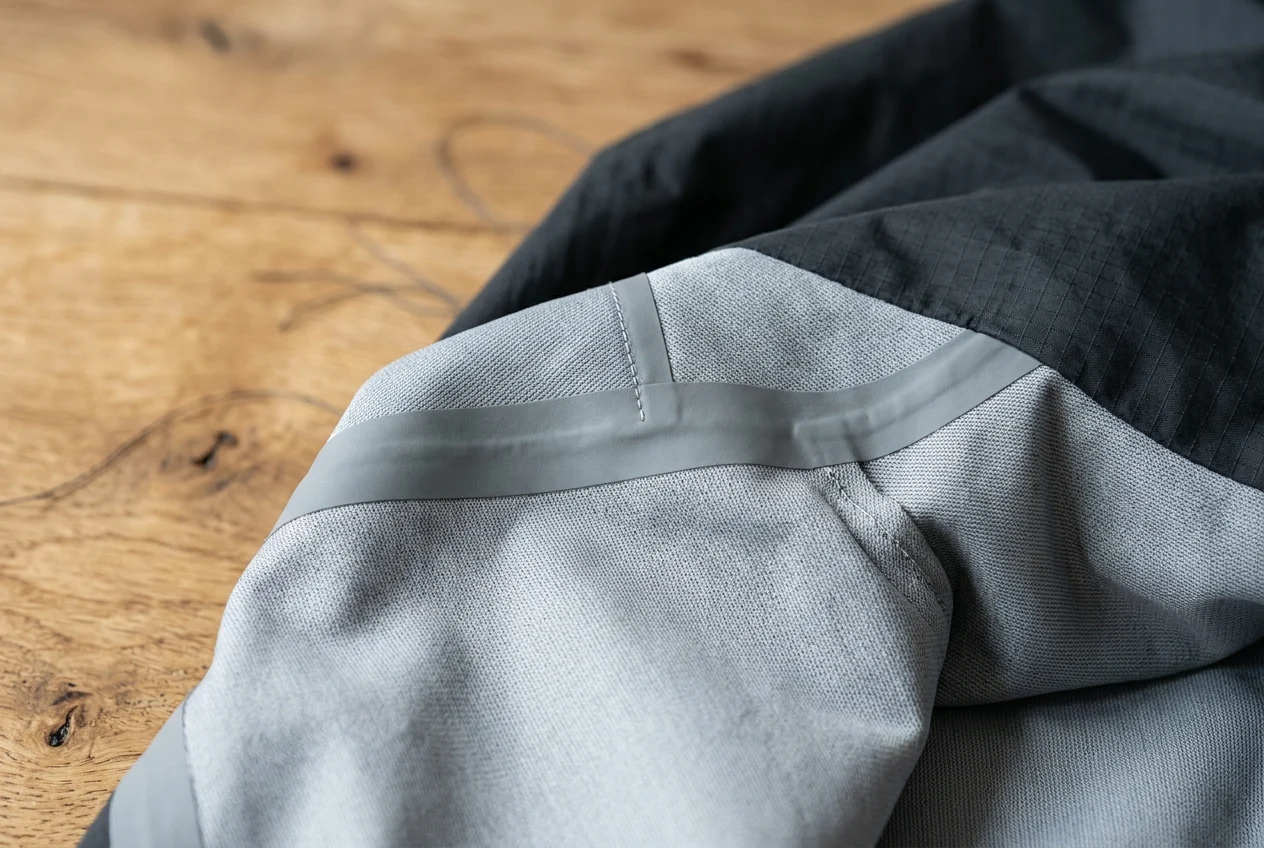
In laminated shell construction, the seam tape backing matches the interior fabric backer:
- Tape composition and width. Bemis 3-layer seam tapes ST306 and ST325 have a Polyurethane / Nylon Tricot composition for 3L fabrics with a tricot fabric backer, whereas ST356 and ST360 have a Polyurethane / Polyester Jersey composition for 3L fabrics with a jersey fabric backer; all four have a 20mm standard width.
- Wash temperature limit. Bemis seam tapes have a wash durability of up to 40ºC.
If an older shell has torn seam allowances or lifting interior tape that needs physical inspection before repair, review our Melbourne clothing repairs consultation checklist.
How to waterproof ripstop nylon at home: DWR reactivation vs re-proofing
Home washing and re-proofing treatments maintain and restore the surface DWR finish so water beads on the outer nylon fibers; they do not add a polyurethane coating or replace peeled interior seam tape.
Why surface wetting out feels like a leak
GORE-TEX states that DWR is an ultra-thin coating that causes water to bead up and roll off the outer layer of a garment instead of being absorbed, while regular wear and tear, dirt, sunscreen lotion, bug repellents, detergents, campfire smoke, and cooking odors diminish water repellency.
Nikwax states that dirt attracts water and conventional household laundry detergents leave behind water-attracting (hydrophilic) residues that mask Durable Water Repellency (DWR), causing fabrics to absorb water and wet out in damp or wet conditions. Nikwax states that if the outer fabric of a breathable waterproof garment absorbs water and ‘wets out’, the garment can lose up to 70% of its breathability, preventing sweat from evaporating and causing the wearer to overheat and feel clammy and wet from condensation.
Washing and heat reactivation for membrane outerwear
- Preparation and machine wash. To wash GORE-TEX outerwear, zip the front, pockets, and pit zips completely, fasten loose flaps and straps, machine wash at 105°F/40°C with a small amount of liquid detergent, rinse twice, minimize spinning, and do not use powder detergents, fabric softeners, stain removers, or bleach. GORE-TEX states that reducing washing machine spin to 400 rpm or lower minimizes creasing, and recommends using one ounce/30ml of liquid detergent per load depending on local water quality and load fill.
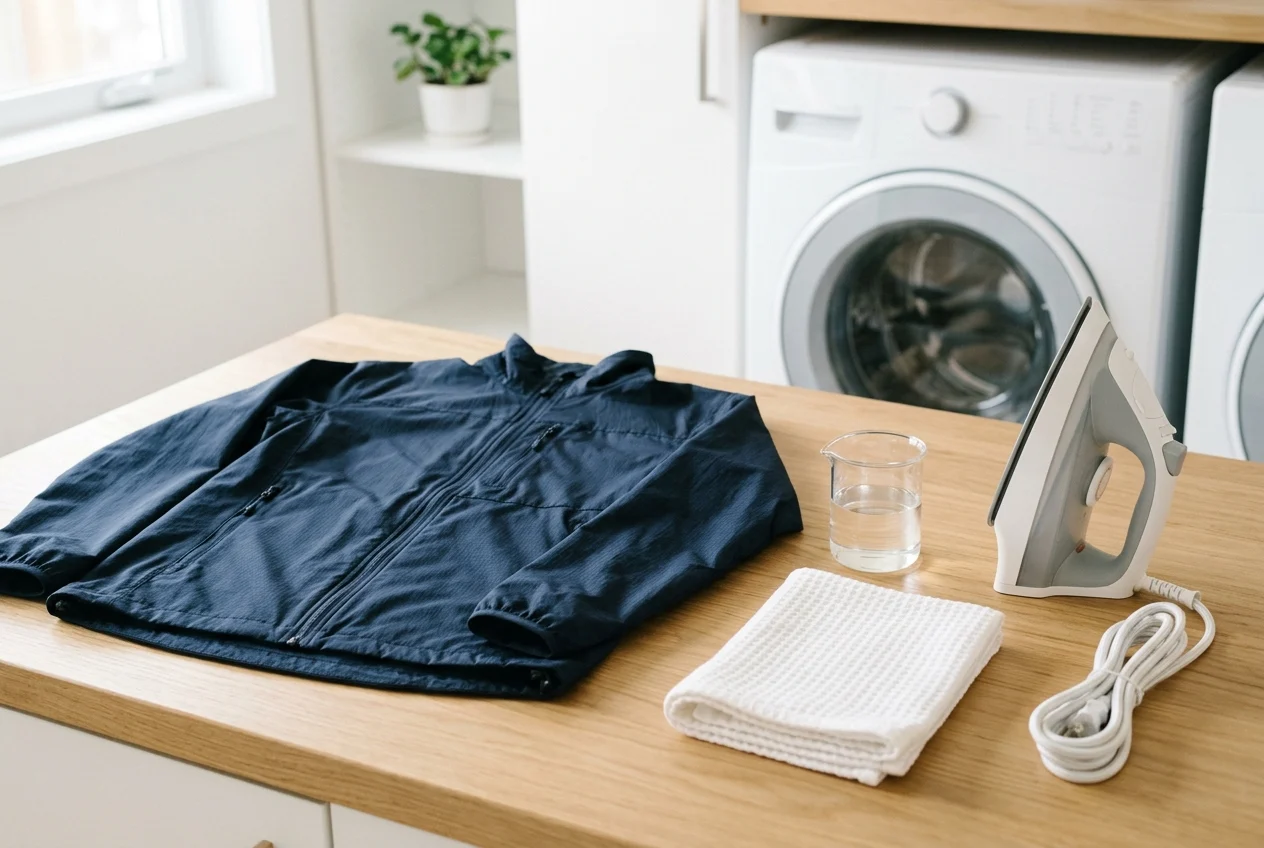
- Tumble-dry or iron reactivation. To dry GORE-TEX outerwear and reactivate DWR, tumble dry on a warm gentle cycle or line dry, then once dry, tumble dry for a further 20 minutes to reactivate the durable water repellent (DWR) treatment; if a dryer is unavailable, iron on a gentle setting with a towel or cloth and no steam. For ironing a GORE-TEX garment after checking the manufacturer’s care instructions, GORE-TEX recommends low temperatures (ironing symbol with 2 dots), no steam, and placing a cloth over the garment so the iron does not touch the garment directly.
- Reapplying DWR when beading does not return. If water does not bead and run off GORE-TEX outerwear after washing, reapply a pump-spray or wash-in DWR product and tumble dry for 20 minutes (or iron warm, gentle, no steam with a towel or cloth between the garment and the iron) to activate the DWR treatment.
- Exclusion for persistent beading membranes. GORE-TEX garments with persistent beading surfaces (such as GORE-TEX SHAKEDRY garments) have no textile outer layer and have no need for DWR: machine wash on delicate cycle at 105°F/40°C, do not dry clean, do not tumble dry, do not iron, do not bleach, and do not apply DWR treatment.
Technical cleaner and air-dry wash-in re-proofing
Nikwax states that with regular cleaning you should be able to clean waterproof gear 5-6 times with Nikwax Tech Wash before it requires re-waterproofing, and re-waterproofing is needed when Tech Wash alone no longer causes water to bead on the fabric surface.
- Machine cleaning with Nikwax Tech Wash. To use Nikwax Tech Wash in a washing machine, remove all detergent build-up from the dispenser, place a maximum of 2 garments in the machine, use 150ml in medium/hard water areas and 100ml in soft water areas, run a 30°C synthetic cycle on a slow spin, and air dry or tumble dry on a low setting if the care label allows.
- Hand cleaning with Nikwax Tech Wash. To apply Nikwax Tech Wash by hand, immerse 1-2 items in 7.5L of warm water, add 150ml in medium/hard water areas or 100ml in soft water areas, agitate to mix, and rinse 3 times in clean water.
- Re-waterproofing with Nikwax TX.Direct Wash-In. Nikwax TX.Direct Wash-In is a non-flammable, PFAS-free wash-in waterproofer for breathable waterproof clothing that adds water repellency, revives breathability, and reduces water absorbency without tumble drying. Nikwax states that TX.Direct Wash-In develops its Durable Water Repellency (DWR) on air drying, removing the need for tumble drying and leaving a flexible water-repellent treatment on individual fibers that allows moisture vapor to pass through.
- Machine application of TX.Direct Wash-In. To apply Nikwax TX.Direct Wash-In in a washing machine, clean first with Nikwax Tech Wash in a separate cycle without drying before waterproofing, remove detergent build-up from the dispenser, place a maximum of 2 clean garments in the machine, add 100ml of TX.Direct per garment, run a 30°C synthetic cycle on a slow spin, and air dry or tumble dry on a low setting if the care label allows.
- Hand application of TX.Direct Wash-In. To apply Nikwax TX.Direct Wash-In by hand, immerse 1 clean garment in 7.5L of hand-hot water in a bowl or sink, add 100ml of TX.Direct, agitate to mix, leave to soak for 5 minutes, agitate thoroughly, and rinse with cold water until the water runs clear.
Before you buy or wash: garment details to record
Keep this short inspection note whenever you compare a new ripstop nylon shell or prepare an existing jacket for laundry care:
- Hydrostatic head and backing tier. Record the stated water-column value and test method on the hangtag, along with whether the ripstop nylon is DWR-only, polyurethane-coated, or a laminated membrane shell.
- Interior seam construction. Turn the garment inside out at the shoulders, hood, and zip placket to verify whether stitched needle holes are covered by continuous heat-sealed seam tape.
- Care-label wash and heat symbols. Check the wash temperature, spin setting, and whether the care label calls for gentle tumble-dry heat reactivation, low-temperature ironing through a barrier cloth, or air-dry curing without heat.
Explore more urban fabric, layering, and wardrobe guides in the blog.
Sources
- ISO — ISO 811:2018 Textiles — Determination of resistance to water penetration — Hydrostatic pressure test
- XM Textiles — EN 343 Protective Clothing Against Rain
- Flagship — 30D Ripstop Nylon 6.6 Fabric (7020-T1) Data Sheet
- Ottertex — Ripstop (DWR Coating & PU Coating) Product Specifications
- Flagship — 70D Ripstop Nylon Fabric (NR70P) Data Sheet
- Paskal — 70D Ripstop Nylon PU Coated FR Treated Specification Sheet
- Flagship — 70D Ripstop Nylon Fabric (NR705P) Data Sheet
- Flagship — 210D Ripstop Nylon Fabric (NR210CP) Data Sheet
- Pertex — Pertex Shield Waterproof Breathable Fabric Technology
- Rab — Men’s Firewall Waterproof Jacket (Pertex Shield Ripstop Nylon Specification)
- Bemis — Three-Layer Seam Tape Selector Guide
- GORE-TEX — Outerwear Care Instructions (Wash, Dry & DWR Reactivation)
- Nikwax — Tech Wash Technical Cleaner for Waterproof Clothing
- Nikwax — TX.Direct Wash-In Waterproofing for Breathable Rainwear