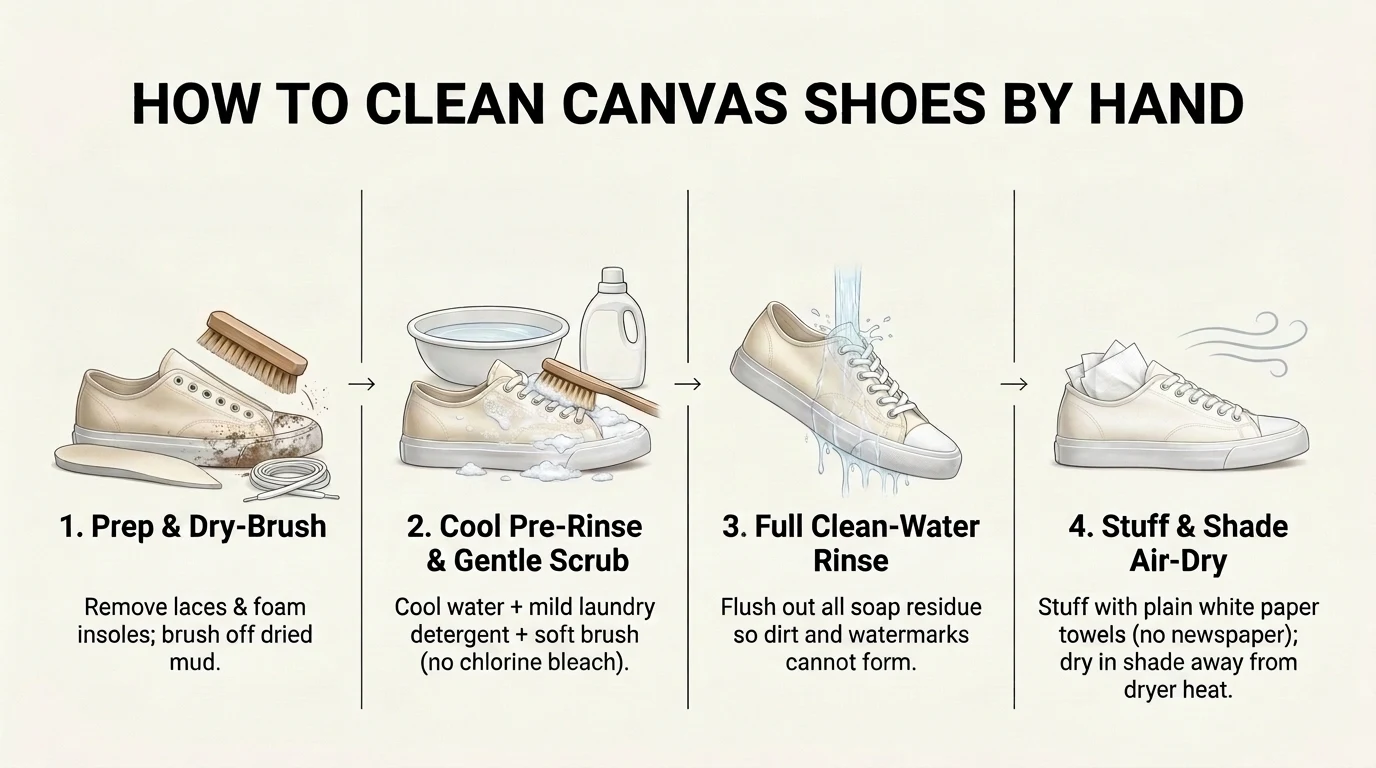
To clean canvas shoes safely, remove the laces and insoles, brush off dried mud, pre-rinse in cool clean water, scrub gently with mild laundry detergent and a soft brush, rinse thoroughly until no soap residue remains, and air-dry stuffed with plain white paper towels in the shade away from bleach and dryers.
Short answer: hand washing in cool water protects both the plain-woven cotton upper and the bonded rubber sole. Skipping machine drum agitation, heated tumble dryers, and household 3–6% sodium hypochlorite (NaOCl) chlorine bleach prevents sole adhesive separation, fiber weakening, dye bleeding, and drying watermarks—provided the rubber sole is still firmly attached before you wet the shoe.
Readers checking our street style archive or browsing all wardrobe and care guides can match their pair’s condition against the quick triage rules below before starting a wash.
| Visible Shoe Condition | Recommended Action | Primary Failure Prevented |
|---|---|---|
| Intact white woven canvas with mud or scuffs | Dry-brush mud, pre-rinse in cool water, scrub with gentle laundry detergent and a soft brush, rinse thoroughly, stuff with white paper towels, and shade-dry | Chlorine bleach fiber damage, soap-residue dirt attraction, migrating-finish watermarks, and newsprint ink transfer |
| Intact colored canvas with street dust or stains | Sort separately from whites, wash by hand in cool water with mild bleach-free detergent, rinse promptly, and air-dry out of direct sunlight | Dye bleeding onto lighter trim, permanent finish watermarks, and ultraviolet chromophore fading |
| Dry canvas interior with trapped odor | Sprinkle dry sodium bicarbonate (bicarbonate of soda) inside dry shoes and leave for at least 24 hours before shaking out | Unnecessary wet saturation cycles and lingering bacterial odor between washes |
| Smooth leather sneaker upper | Wipe gently and treat with dedicated leather cleaners and conditioners instead of water-and-detergent scrubbing | Leather stiffening, surface stripping, and moisture damage from general laundry wash baths |
| Rubber sole or foxing lifted away from canvas upper | Stop wet immersion and route the pair to sneaker regluing or cobbler repair | Water trapped inside separated sole joins and worsening adhesive detachment |
Can You Put Canvas Shoes in the Washing Machine?
Most shoe manufacturers discourage putting canvas shoes in a washing machine because drum agitation and harsh detergents can damage shoe adhesives, while heavy moisture drops woven canvas elastic modulus from 180 MPa at 30% relative humidity to 13 MPa at 90% relative humidity, leaving wet uppers prone to deformation.
According to the American Cleaning Institute, reading and following the care instructions printed inside the sneaker gives the most accurate rule for a specific model, and when no label permits machine washing, hand washing is the safer default for canvas and nylon uppers. Wikipedia’s overview of canvas notes that modern canvas is a durable plain-woven fabric—distinct from twill cottons such as denim—usually woven from cotton, linen, or sometimes polyvinyl chloride (PVC), and widely used in casual shoes from brands such as Converse, Vans, and Keds. Classic canvas tennis shoes pair that woven upper with a vulcanised natural rubber sole, as seen since the 1936 Spring Court design featuring eight ventilation channels on Wikipedia’s history of sneakers.
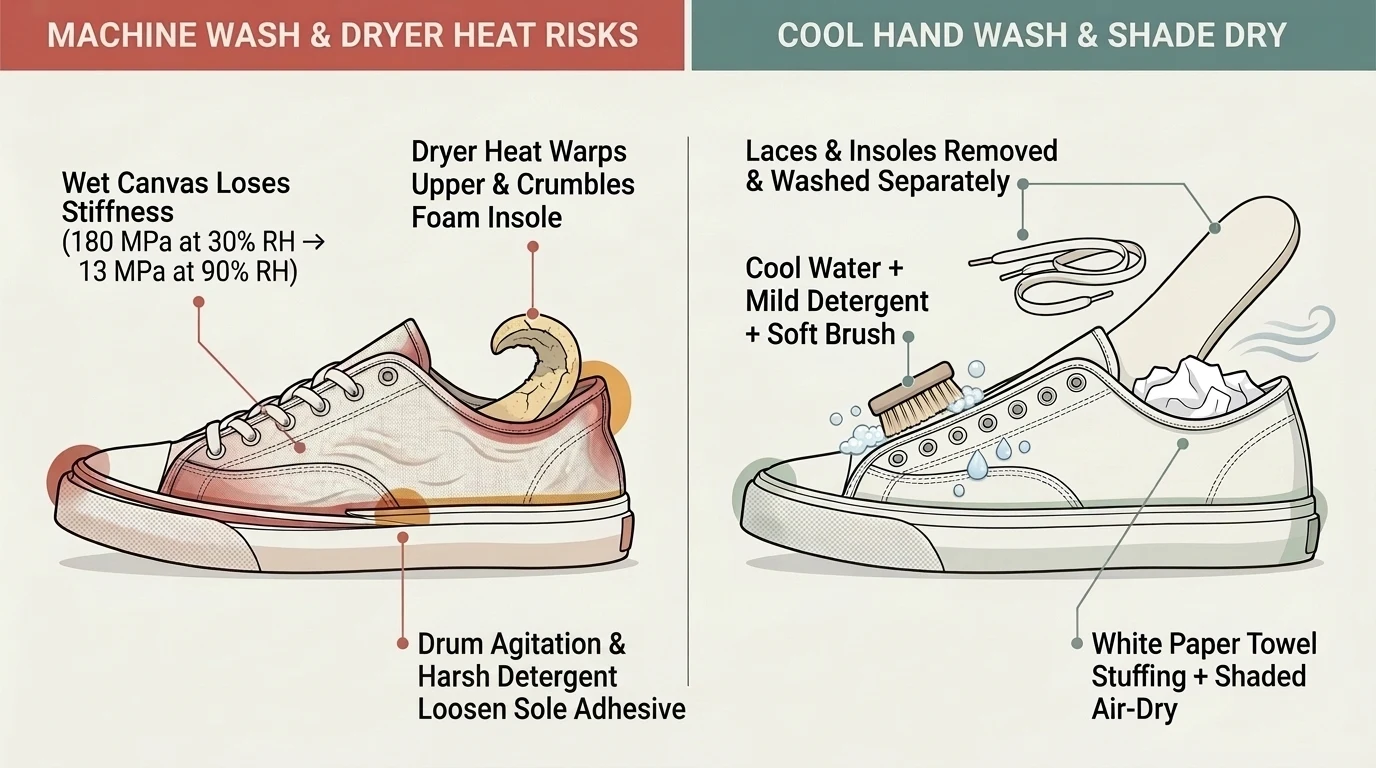
Two structural mechanics explain why full-drum machine cycles shorten the life of canvas sneakers:
- Wet-fabric flexibility under drum impact: Tensile testing summarized on Wikipedia’s canvas reference shows that layered woven canvas responds to rising humidity with localized stresses and a steep drop in combined warp-and-weft stiffness—from an effective elastic modulus of 180 MPa at 30% relative humidity down to 13 MPa at 90% relative humidity—making soaked uppers far more flexible and susceptible to deformation under repeated drum tumbling.
- Adhesive and trim stress: As the American Cleaning Institute explains, harsh detergents and mechanical washing-machine agitation can damage shoe adhesives and leather trim. Only removed fabric laces and machine-safe removable inserts belong inside a mesh laundry bag with regular laundry; if the rubber sole has already lifted away from the canvas upper, cleaning cannot substitute for repair and the pair belongs in our Melbourne sneaker cleaning vs regluing guide.
How Do You Clean Canvas Shoes by Hand Step by Step?
Clean canvas shoes by hand by checking the inner care label, removing laces and insoles, brushing off dried mud, pre-rinsing in cool water, scrubbing gently with mild laundry detergent and a soft brush, rinsing out all detergent residue, stuffing with white paper towels, and re-lacing only once completely dry.
Combining the American Cleaning Institute’s hand-wash sneaker method with washable-textile recovery procedures from North Dakota State University Extension and NC State Extension keeps dirt from setting into plain-woven cotton threads while protecting sole joins. Keeping everyday canvas pairs clean also makes neutral footwear easy to rotate across our streetwear outfit ideas without premature upper wear.
Preparation, Cool Pre-Rinsing, and Gentle Scrubbing
Work through the wet-cleaning phase in order so surface grit is never ground deeper into wet cotton yarns:
- Inspect the inner care label first: Check the care instructions inside the sneaker before wetting it, as recommended by the American Cleaning Institute.
- Separate laces and removable inserts: Pull out the shoelaces and any removable insoles so every hidden tongue crease and eyelet row cleans evenly; wash laces and inserts separately by hand with gentle detergent, or place washable laces in a mesh laundry bag.
- Dry-brush caked mud promptly: Both NDSU Extension and NC State Extension advise shaking out, brushing off, or scraping away dried mud and surface dirt before wetting fabric, then rinsing or washing promptly to help prevent mildew growth.
- Pre-rinse in cool flowing water while supporting the shoe: Rinse the sneaker under cool, clean water to flush loose debris and prepare the canvas for scrubbing; NDSU Extension notes that cool water during pre-washing avoids setting stains into washable fibers and advises supporting hand-washed textiles while wet.
- Scrub gently with mild laundry detergent and a soft brush: Mix a gentle laundry detergent with cool water—avoiding bleach, solvents, harsh chemicals, and abrasives—and work a soft brush patiently across canvas panels and rubber scuff marks without fraying the plain weave.
Thorough Rinsing, Paper-Towel Shaping, and Reassembly
Finish the wash by clearing every trace of surfactant before shaping the damp upper:
| Hand-Wash Stage | Materials & Water Condition | Exact Action | Why the Step Matters |
|---|---|---|---|
| Dry Soil Removal | Dry soft bristle brush or scraper; no water | Shake out loose grit and brush away dried mud before wetting | Prevents grinding mud into wet yarn and curbs mildew growth |
| Initial Pre-Rinse | Flowing cool clean tap water | Rinse outer canvas and sole while supporting the wet shoe | Clears loose debris and avoids setting stains with warm water |
| Detergent Scrub | Gentle laundry detergent in cool water + soft brush | Scrub canvas panels, tongue edges, and sole scuffs without bleach or solvents | Lifts oils and scuffs without weakening cotton fibers or adhesives |
| Residue Flush | Flowing cool clean tap water | Rinse the entire sneaker thoroughly until no detergent remains | Leftover detergent residue attracts fresh dirt and leaves marks |
| Shape & Shade Dry | Plain white paper towels + shaded airflow | Stuff toe box with white paper towels and dry naturally away from sun or dryers | Retains upper shape without newsprint ink transfer or heat warping |
| Final Reassembly | Completely dry shoe, liners, and clean laces | Reinsert insoles and re-lace only after interior padding is completely dry | Preserves fit, comfort, and prevents interior mold regrowth |
How Do You Clean White Canvas Shoes Without Turning Them Yellow?
Keep white canvas shoes from turning yellow by skipping household 3–6% sodium hypochlorite (NaOCl) chlorine bleach, flushing out every trace of dirt-attracting soap and migrating fabric finishes with clean cool water, stuffing wet uppers with plain white paper towels rather than newspaper, and air-drying in the shade.
Yellowing and blotchy tide lines on white canvas sneakers typically trace back to chemical oxidation or incomplete rinsing rather than stubborn street dust. On Wikipedia’s bleach chemistry reference, common household liquid bleach is a dilute 3–6% aqueous solution of sodium hypochlorite (NaOCl), and chemical bleaches react with many organic substances beyond stain pigments—weakening or damaging natural materials such as cotton fibers, cloth, and leather. The American Cleaning Institute likewise warns against using bleach, solvents, harsh chemicals, or abrasives on canvas sneakers.
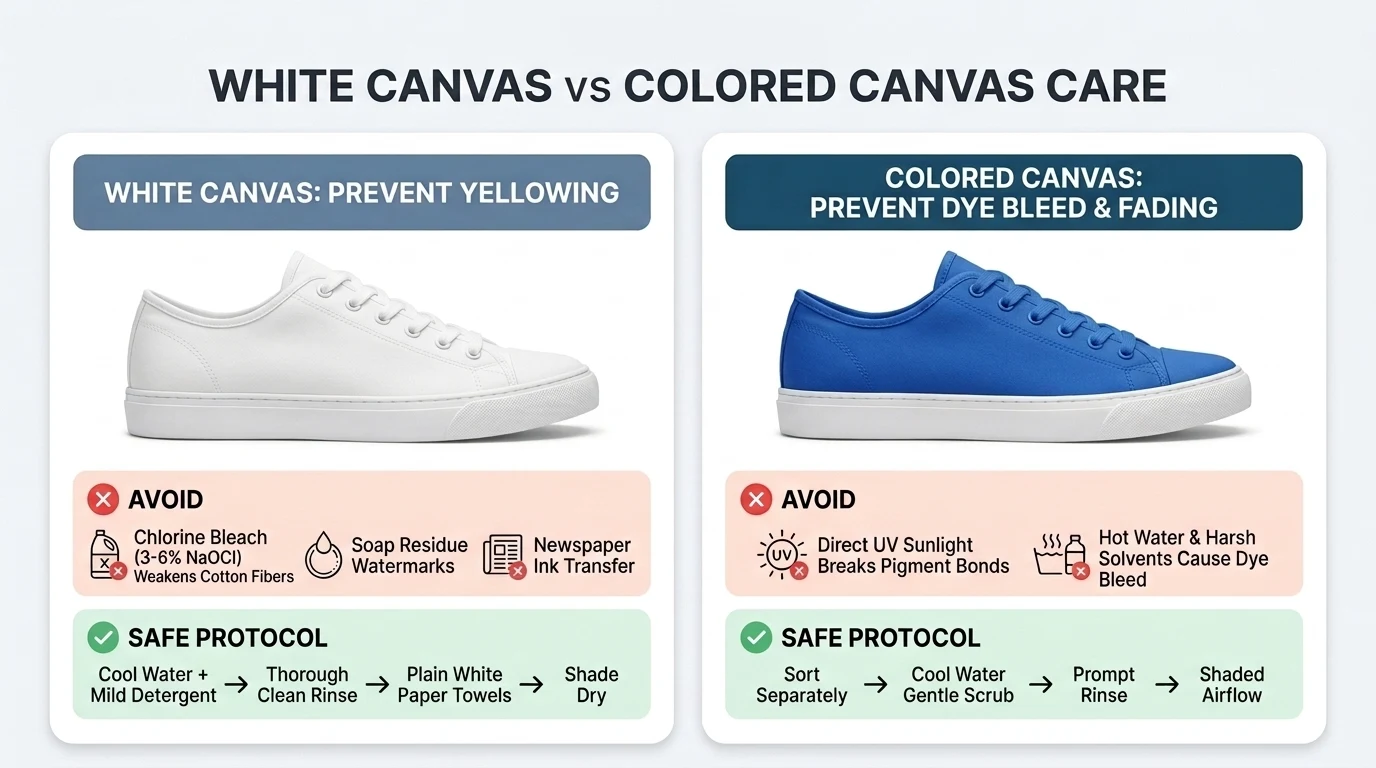
Protect white cotton uppers and household safety with four strict controls:
- Never mix household bleach with acids, ammonia, or peroxide: Wikipedia’s bleach safety profile emphasizes that chlorine bleach must never be mixed with vinegar or other acids—which generates highly toxic chlorine gas capable of severe internal and external burns—nor mixed with ammonia or hydrogen peroxide. Where a care label explicitly permits non-chlorine whitening on white textiles, non-chlorine, oxygen, or color-safe bleaches rely instead on peroxide oxidizing agents such as hydrogen peroxide, sodium percarbonate, or sodium perborate.
- Flush out soap and migrating finishes completely: The American Cleaning Institute stresses rinsing the entire shoe well with clean water because leftover detergent attracts fresh dirt, while NC State Extension notes that wet finished fabrics can develop permanent watermarks from migrating finishes as moisture evaporates unevenly.
- Stuff exclusively with plain white paper towels: As the American Cleaning Institute specifies, stuffing wet sneakers with white paper towels holds the toe box shape as moisture wicks out, whereas newspaper must never be used because newsprint ink transfers onto damp canvas.
How Do You Clean Colored Canvas Shoes Without Fading or Dye Bleed?
Clean colored canvas shoes without fading or dye bleed by sorting colored pairs away from whites, pre-rinsing and scrubbing in cool water with gentle bleach-free laundry detergent, rinsing promptly before wet finishes leave watermarks, and drying in shaded airflow out of chromophore-breaking ultraviolet sunlight.
Dyed cotton uppers face two color-loss mechanisms during washing and drying. First, NDSU Extension advises separating hand-washable items by color and recommended washing temperature before cleaning, and NC State Extension warns that wet dyed or finished textiles commonly suffer color change, dye bleeding, shrinkage, and permanent watermarks if left sitting wet. Washing one colored pair at a time in cool water with mild laundry detergent—free of chlorine bleach, harsh chemicals, and solvents—keeps saturated indigo, red, or black canvas from bleeding into white contrast stitching or rubber foxing.
Second, direct outdoor sun fades wet dyed canvas even when no chemical bleach touches the cloth. As documented on Wikipedia’s photochemical bleaching section, high-energy violet and ultraviolet photons in direct sunlight disrupt chemical bonds inside dye chromophores, causing discoloration and fading over extended exposure. Keeping dyed canvas crisp through shaded air-drying is especially useful when one versatile pair anchors a carry-on travel capsule wardrobe.
Can You Put Wet Canvas Shoes in the Dryer or Direct Sun?
Never put wet canvas shoes in a heated clothes dryer or leave them in direct sunlight, because excessive heat warps or shrinks upper fabrics and degrades or crumbles aged foam rubber and urethane insoles, while ultraviolet light fades dyes; air-dry naturally in the shade until interior padding is completely dry.
Both footwear and textile-conservation guidance align against rushing the drying stage with heat:
- Upper shrinkage and sole warping: The American Cleaning Institute instructs sneaker owners to let washed shoes dry naturally out of direct sunlight and away from a clothes dryer because excessive heat causes shoe materials to warp or shrink.
- Foam insole and cushioning breakdown: NC State Extension advises drying foam rubber and urethane cushioning away from heat and sunlight and never tumble-drying them with heat, noting that foam dries slowly in air and aged foam can crumble under heat stress.
- Preventing interior mold regrowth: NC State Extension also warns that even after surface cleaning, mold will grow back inside padded materials unless the interior dries completely. Replace damp white paper towels inside the toe box during shaded air-drying, and follow the American Cleaning Institute rule to wait until both the sneaker shell and removed liners are completely dry before reinserting insoles and re-lacing.
Can You Use Baking Soda on Canvas Shoes vs Leather Sneakers?
Sodium bicarbonate—called bicarbonate of soda in Australia and baking soda in the United States—deodorizes dry canvas shoes when left inside for at least 24 hours and scours soles as a cold-water paste kept off bare aluminium eyelets, whereas leather sneakers require dedicated leather cleaners and conditioners.
Everyday terminology shifts by region: Wikipedia’s sneakers article notes that Australian English commonly calls rubber-soled casual athletic shoes sneakers, runners, running shoes, tennis shoes, or kicks (while British English calls low-cut canvas-topped rubber-soled shoes plimsolls, daps, or flats), and Wikipedia’s sodium bicarbonate entry notes that bicarbonate of soda is the standard name across Australia, the United Kingdom, and New Zealand. Between full washes, the American Cleaning Institute recommends wiping sneakers regularly with a damp cloth to clear surface dust before build-up forms.
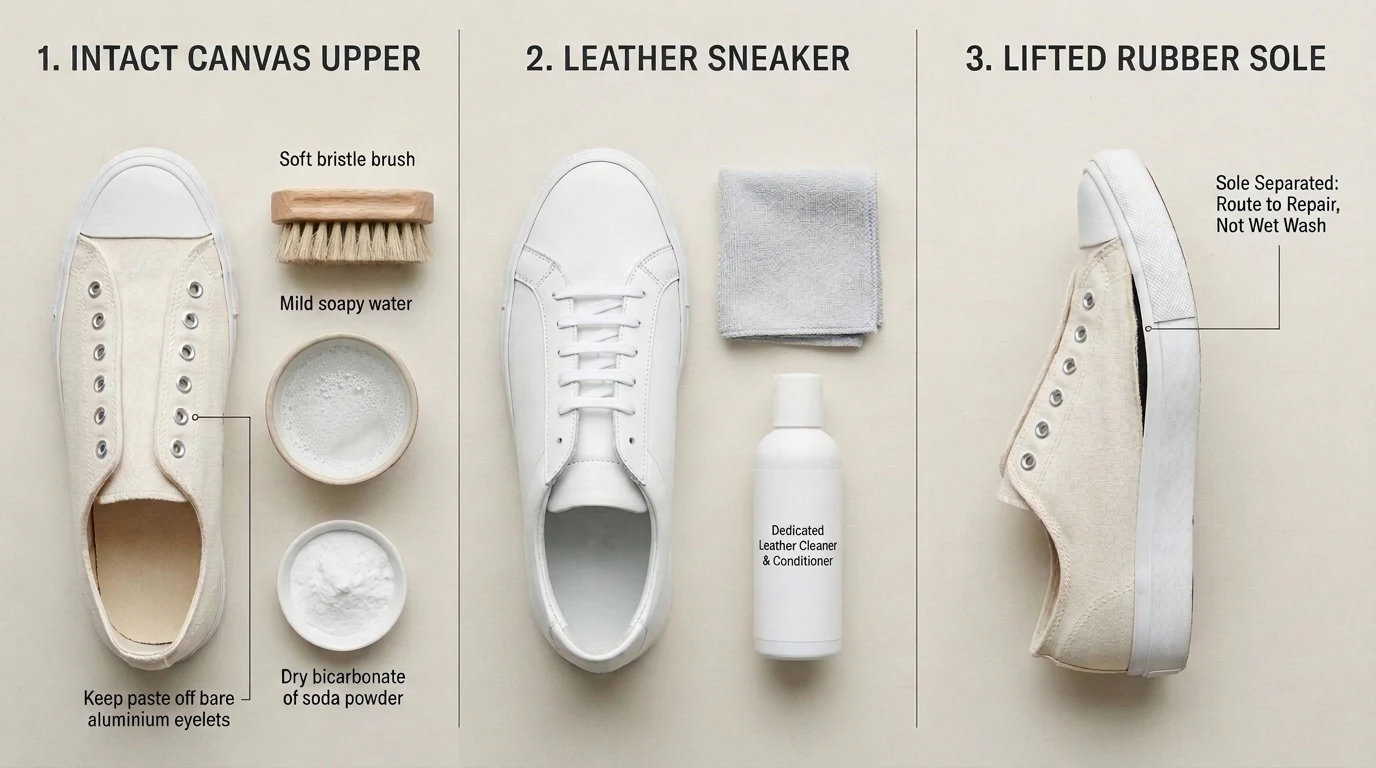
Safe Bicarbonate of Soda Uses and Metal Eyelet Caution
When using sodium bicarbonate on canvas runners, separate dry odor control from wet paste scouring:
- Dry overnight deodorizing (at least 24 hours): For odor control between washes, the American Cleaning Institute advises sprinkling baking soda directly inside dry shoes and leaving it for at least 24 hours to absorb smells and bacteria before shaking out the powder.
- Cold-water paste scouring and aluminium caution: Wikipedia’s cleaning overview for sodium bicarbonate notes that a paste of sodium bicarbonate mixed with minimal cold water works as a gentle alkaline scouring cleaner, whereas sodium bicarbonate attacks the thin protective oxide layer on aluminium—making it unsuitable for bare aluminium eyelets or hardware.
Canvas vs Leather Sneakers Care Comparison
When comparing canvas vs leather sneakers in a mixed rotation, adjust water exposure and chemistry to the upper material and sole bond:
| Sneaker Upper or Structural State | Safe Cleaning Chemistry & Tools | Drying & Conditioning Rule | Key Exclusion |
|---|---|---|---|
| Plain-Woven Cotton or Linen Canvas | Cool clean water, gentle laundry detergent, soft brush; dry bicarbonate of soda for at least 24 hours when dry | Stuff with plain white paper towels and air-dry naturally in shaded airflow until completely dry | Avoid machine drum agitation, 3–6% NaOCl chlorine bleach, newspaper stuffing, bare-aluminium paste contact, and dryer heat |
| Nylon & Washable Synthetic Mesh | Cool clean water, gentle laundry detergent, and soft brush following inner care label | Air-dry naturally out of direct sunlight and away from heated dryers | Avoid high heat, harsh chemicals, solvents, and abrasive scrubbers |
| Smooth Leather Sneakers | Gentle surface wipe plus dedicated leather cleaners and leather conditioners | Air-dry away from heat and condition leather to keep uppers supple | Avoid soaking in general laundry detergent baths, bleach, or washing machines |
| Canvas Upper With Separated Rubber Sole | Dry surface inspection only before workshop intake | Keep dry and route to Melbourne sneaker regluing or repair | Wet upper cleaning cannot substitute for regluing a sole that has come unstuck |